
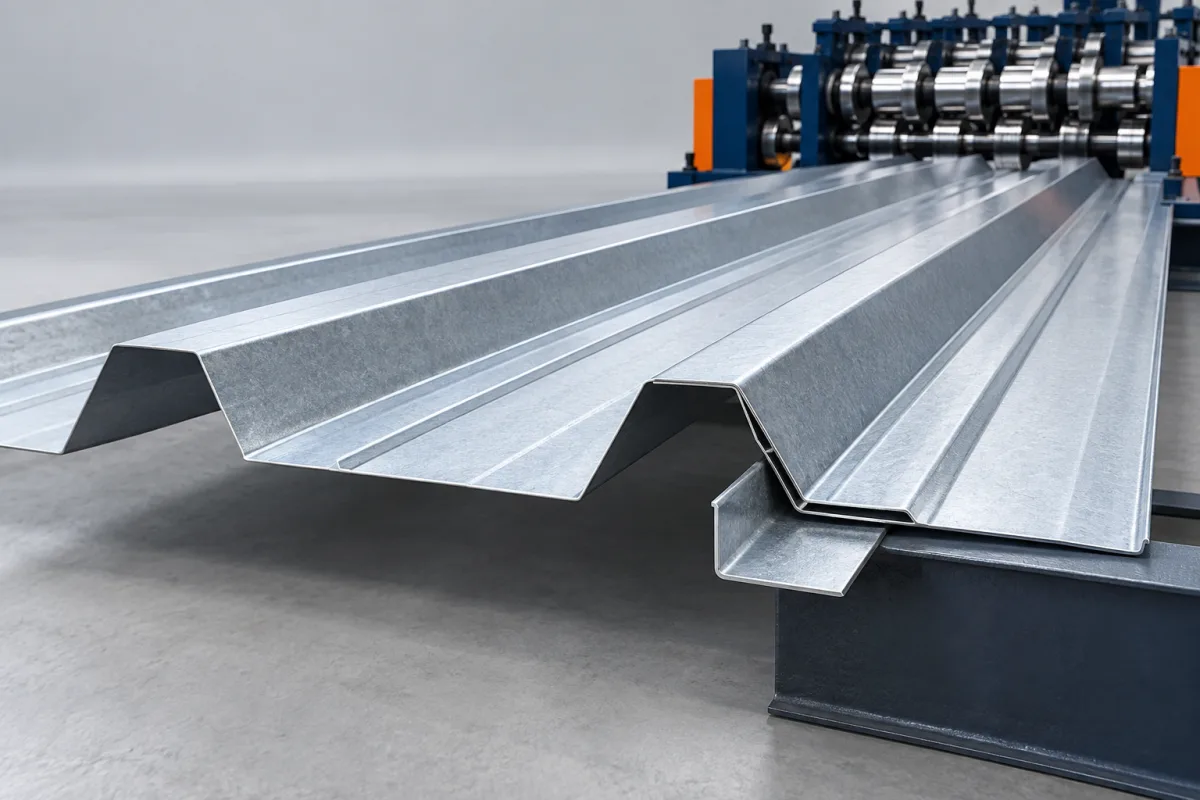
A PBR panel roll forming machine makes a ribbed sheet with a purlin-bearing extension at the under-lap edge. That small-looking feature is central to the product: it supports the overlapping edge in the intended assembly and distinguishes PBR from a similar panel without the extension. The machine specification therefore needs more detail than a photograph of the exposed face.
Specify the PBR section as a complete roof or wall product. Ribs, bearing extension, cover width, material and matched accessories should be considered together. The manufacturing route must preserve that relationship through forming, cutting and stacking, not merely reproduce the central rib pattern.
What does the bearing extension change?
The extension changes the shape beneath the side lap. Its length, angle and relationship to the adjacent rib affect how the next panel sits. A panel can have acceptable central ribs but still leave an unsatisfactory lap if this return is distorted or formed to the wrong drawing.
Show the assembled pair in the profile package. Identify the bearing surface, supporting member and intended fastener location from the system detail. That information gives the tooling designer a functional reference instead of an isolated edge dimension.
Why is PBR not simply an ordinary R panel?
Much of the sheet may be visually similar, but the terminal-edge route can differ. The extended edge needs its own forming space and suitable cutoff support. If a supplier proposes shared tooling, ask which stages and parts are common and which are exchanged.
A dual-product business also needs distinct identification and inspection. Mixing a standard edge into a PBR order may not be obvious from a stack viewed from above. Include a clear sample reference and order label for each approved variant.
Which dimensions control the assembled lap?
Record the major-rib geometry, the two mating edge shapes, the bearing-extension position and effective cover. Dimensions should use an agreed reference rather than a mixture of outside, inside and projected measurements. Show how coating and sheet thickness are treated where they affect a close fit.
- Define the over-lap and under-lap independently.
- Identify the bearing edge's free-end position.
- Show the intended contact and clearance areas.
- Specify the panel's relaxed measurement condition.
- Retain a multi-panel assembly as a fit reference.
Do not force trial panels together to obtain the nominal cover. Unexpected assembly resistance deserves investigation because field installers should not need to correct an inconsistent formed section.
How is the PBR section manufactured?
Coil payoff and entry guidance establish a consistent strip path. Progressive forming develops the ribs and terminal features in a planned sequence. The bearing extension must emerge in its approved relationship to the under-lap rather than as a separate feature judged without the rest of the section.
After length control, the cutoff separates the panel and the takeoff supports it. Review the extension at the first and last part of each sheet. End distortion can cause a troublesome lap even when a measurement taken halfway along the panel looks correct.
What should be included in material trials?
Use the actual grade, thickness and coating combinations intended for sale. If the business will run several material suppliers, establish incoming-material requirements rather than expecting the line to compensate for undefined variation. Keep coil identification with the trial record.
The bearing return and rib bends deserve close inspection for finish damage. Examine the exposed face under agreed lighting, then inspect the hidden contact surfaces separately. Their acceptance concerns differ: one is architectural appearance, the other is geometry and condition at the lap.
How should cutoff and discharge be evaluated?
A profile-supported cutoff should leave usable ribs and an undamaged extension. Check cut squareness, burr condition and distortion at both edges. Compare pieces before and after stacking so a takeoff problem is not incorrectly assigned to the forming tools.
Long panels need a supported discharge path, while short orders need controlled transfer away from the cut area. The proposed handling arrangement should demonstrate both. Packaging should protect the bearing extensions from nesting or strap damage that changes the lap before installation.
What determines useful production output?
Use accepted PBR sheets, or their agreed coverage, as the production measure. State the profile, material, lengths and included operations. A line running long identical sheets has a different cycle from a mixed order with repeated short pieces and frequent stack changes.
Where PBR and non-bearing R panels share equipment, include a complete variant changeover. Measure from the last accepted old product to the first accepted new product, including inspection and any cutoff changes. This reflects the scheduling consequence of sharing the mill.
How can the purchase scope avoid omissions?
List coil handling, entry equipment, roll tooling, cutting, discharge and controls. Then identify inspection fixtures, change parts and accessory-production equipment separately. Confirm whether a proposed package includes marking or protective-film equipment if those operations are required by the order specification.
Keep building-system performance assessment distinct from machine acceptance. A manufacturing trial establishes whether the equipment produces the agreed section. The roof assembly still has its specified supports, fasteners, detailing and project requirements.
Frequently asked questions
Where should the bearing leg be measured?
Use the datums shown on the approved section and inspect its relationship to the adjoining rib. Also assemble panels, because a correct isolated dimension does not necessarily establish correct lap engagement.
Can PBR tooling also make a non-bearing panel?
Possibly, with an agreed change arrangement. Request the exact list of roll, guide and cutoff changes rather than assuming the extension can simply be omitted during normal operation.
Does PBR require different sheet handling?
The handling system must protect its particular edge shape. Review nesting, stack supports and package restraints with actual panels, especially where the bearing extension is exposed to local pressure.
Can a trial use uncoated steel instead?
It may help an early dimensional review, but final acceptance should represent the saleable material. Coating condition and the actual material's forming behavior remain part of the production requirement.
What is the best evidence of a successful trial?
Keep dimensional results, photographs of agreed inspection views, a joined-panel sample and a record of accepted production. Note any deviations openly so the approval refers to a reproducible product.
Make the hidden edge part of the specification
The PBR decision is largely about a feature that becomes less visible after assembly. Treat the bearing extension, mating lap and handling condition as major acceptance items. That approach connects the equipment purchase to the product customers actually install.

Continue your research
- Roofing Sheet Roll Forming Machines
- Corrugated Roof Sheet Roll Forming Machine
- Trapezoidal Roof Sheet Roll Forming Machine
- R Panel Roll Forming Machine
- IBR 686 Roofing Sheet Machine
- IBR 762 Roofing Sheet Machine
- How Roofing sheet roll forming machine Works
- How To Choose a Roofing sheet roll forming machine
- Roofing sheet roll forming machine Price: What Affects the Cost?
Configuration & specification inputs
Match the configuration to your section drawing, material and production requirements.
| Parameter | Requirement / confirmation needed |
|---|---|
| Profile geometry | PBR rib pattern with defined bearing extension, over-lap and assembled cover. |
| Material | Production-intent coated steel with traceable grade and exposed-face identification. |
| Thickness & grade | Defined material and base-metal thickness combinations assessed at the bearing return. |
| Process route | Guided entry, rib and bearing-edge development, length cutting and protected discharge. |
| Cutting | Profile-supported ends that preserve the bearing extension and neighboring lap. |
| Output | Accepted PBR orders including stated variant changes, inspection and stack handling. |
| Electrical supply | Site supply and utility requirements for the complete PBR equipment arrangement. |
| Acceptance | Bearing surface geometry, joined-panel fit, cutoff condition and undamaged edges after packaging. |