
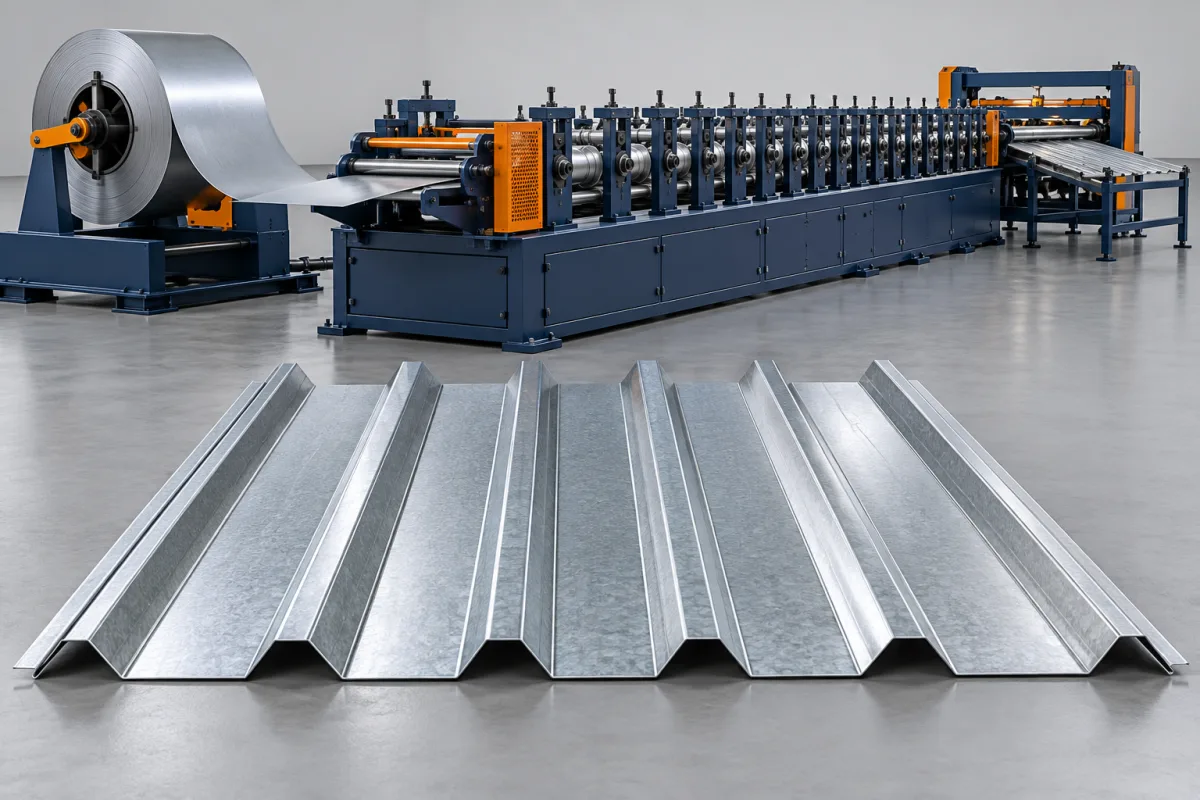
An IBR roof sheet roll forming machine produces the particular ribbed sheet defined by the buyer's IBR drawing. The name is widely used for a recognizable roofing family, but the equipment still needs an exact section, material and edge-lap specification. Treating the name or a nominal cover designation as the complete drawing can lead to tools that produce a similar-looking but incompatible sheet.
The buying process is strongest when it connects the commercial product sold in the target market with measurable geometry: rib pitch and depth, pans, terminal edges, effective cover and incoming strip requirements. From there, the line can be configured for the actual materials, lengths, order pattern and handling route.
What does the IBR designation tell the equipment supplier?
It provides a starting point for identifying the product family, not every detail required for tooling. A regional profile drawing or a supplier's named product may define a particular geometry, but another similarly labeled product should not be assumed identical. Ask which controlled drawing the quotation follows.
For replacement or compatible supply, provide measured reference sheets and the intended mating relationship. An external photograph rarely shows enough of the underlap or terminal return to establish that a newly formed panel will fit an existing roof.
Which differences need to be resolved before tools are ordered?
Nominal width versus effective cover
Determine exactly what a number in the product designation represents. Effective cover is measured after the intended overlap; overall sheet width and flat strip width are different quantities. Keep them separately labeled throughout the enquiry.
Rib and pan geometry
Confirm pitch, depth, top widths, pan details and the number of repeating features. Do not enlarge or shrink another profile drawing merely to reach a requested width. The target product must be defined in its own right.
Terminal edges and lap support
Show the actual overlap and underlap, including any supporting return. Those features can determine compatibility even when the central rib pattern is familiar. Use an assembled sample pair as part of tooling approval.
What should the IBR drawing and material brief contain?
- Complete cross-section with both terminal edges.
- Overall width, effective cover and the assembly method used to establish cover.
- Main rib and pan dimensions, including any smaller specified features.
- Grade or alloy, base-metal thickness and coating.
- Visible-face orientation and appearance requirements.
- Required lengths and cut-end acceptance.
- Reference samples where existing-system compatibility is required.
Use one agreed revision when ordering tools, programming production and inspecting trial sheets. A nominal IBR label on an order should lead back to that revision rather than allowing each party to fill in missing dimensions from its own assumptions.
How does the production route work?
- Present the coil: establish the specified material and safe loading arrangement.
- Guide the strip: maintain the intended entry and visible-face orientation.
- Develop ribs and pans: form the section progressively through the roll tooling.
- Complete the laps: reproduce the terminal geometry required by the approved IBR product.
- Control and cut length: create finished sheets with suitable support and end quality.
- Discharge and inspect: assess sheets after normal takeoff, then stack or pack them for the order.
The supplier should identify the actual operation sequence and equipment included. Optional surface layers, curving or other secondary operations need separate review rather than being inferred from the roofing-machine description.
How should coil development and coverage be checked?
The strip requirement follows the approved profile and its development through forming. It is not simply the useful roof cover plus a standard margin. Obtain the confirmed input width and material requirements associated with the proposed tools.
During a trial, measure the finished sheet and assemble neighboring panels. Confirm effective cover using the intended lap rather than selecting the overlap that happens to produce a preferred number. Retain the assembly reference with the tooling record.
For production reporting, calculate nominal panel area from accepted length and effective cover. Keep this separate from a building takeoff, which has its own details, cutting needs and installation allowances. Rejected or damaged sheets should not count toward accepted coverage.
What changes when another IBR variant is needed?
Identify whether the change affects cut length, material, width within a reviewed family or the actual section geometry. A different rib pattern or edge arrangement can require another roll set, cutting components or forming path. A new commercial designation should trigger a drawing comparison, not an assumption of simple adjustment.
Request a variant matrix with the tools and setup actions required for each transition. Include the first-off dimensional and lap checks. A line described as multi-profile should have an explicit list of the profiles it is supplied to make.
If the business repeatedly returns to established variants, demonstrate that recovery. Setup records and approved reference sheets make it easier to verify the product rather than relying only on remembered machine positions.
How should coated materials be included in the review?
Specify the actual substrate, coating and thickness convention. Forming behavior and surface acceptance should be demonstrated with representative production material. A sample in a different finish does not establish acceptable marking on the intended painted sheet.
Inspect ribs, pans, terminal bends and cut ends. Trace contact through guides, tooling, supports and stacking. Some damage can appear after the roll-forming stage, so the equipment review should include the complete handling path.
Where more than one material combination is required, list the combinations explicitly and identify the important trial cases. Separate maximum width and thickness values are not a substitute for a reviewed production envelope.
Which cutting and stacking details affect delivery?
Provide the shortest, longest and most frequent order lengths. The cutoff and discharge arrangement must support the profile across that range. Check for local deformation at cut ends and compare sheets at the machine exit with sheets in the stack.
Specify how finished orders will be grouped, protected and identified. Color changes, small batches and long sheets create different handling needs. A line can run steadily while the downstream operation becomes the practical limit on acceptable output.
Include enough layout information to assess coil loading and finished-order removal. The former's footprint alone does not describe the space and equipment needed for a working IBR production route.
How can quotations be compared on the same basis?
Issue the same profile revision, material matrix, length schedule and acceptance plan to each supplier. Ask for explicit inclusion of coil handling, required roll sets, cutting, takeoff and any auxiliary operations. Identify what must be supplied or completed elsewhere.
For output, use the agreed order mix and count accepted sheets over a stated time boundary. Record setup material, rejects, coil changes and stack handling as required by the trial. Comparing an uninterrupted run with a mixed production shift does not establish a fair performance difference.
Keep potential future variants in a separate scope section. This makes the cost of another IBR drawing or a different roofing family visible instead of hiding it behind an unspecified promise of flexibility.
What should the IBR acceptance trial demonstrate?
- Match the trial to the exact IBR drawing and material specification.
- Measure the central pattern and both terminal edges after cutoff.
- Assemble sheets and confirm the intended lap and effective cover.
- Inspect finish, cut ends and the agreed straightness condition.
- Run representative lengths through the normal discharge and packing route.
- Demonstrate required variant or material changes.
- Record accepted output and any unresolved compatibility issue.
Keep the approved sample identified with its drawing and material. It becomes a useful reference for later tooling work and for resolving claims that two similarly named products are the same.
Frequently asked questions
Does IBR always mean one universal profile?
The term alone is not a sufficient tooling specification. Use the particular product drawing and identify its dimensions and laps. A familiar market designation does not remove the need to confirm the actual manufacturing target.
Can a wider IBR panel be made by scaling another drawing?
Not without a specific engineering review. Rib count, pitch and edge details may differ rather than scale proportionally. Obtain the intended product drawing instead of deriving it from another commercial width label.
Can new sheets be matched from a sample alone?
A representative sample is valuable but should be supported by measured drawings and defined acceptance. It may be worn, distorted or incomplete at an edge. Record the intended mating arrangement and resolve uncertainties before tools are approved.
Does a roofing profile's capacity come from the machine?
The machine produces the specified geometry and material configuration. Building application and performance depend on the defined panel system and design. Do not treat a forming capability as a structural or weather-performance rating.
Are corrugated and IBR tools interchangeable?
The section geometries differ. A line needs the specified tool sets or paths for both products. Confirm the equipment and changeover scope rather than assuming the shared roofing application makes them interchangeable.
What should be sent with an enquiry?
Provide the exact IBR drawing, material combinations, length mix, lap references and finish criteria. Include existing samples where matching is required. These inputs establish a practical basis for tools, handling and acceptance.
Make the commercial name point to one controlled product
An effective IBR equipment brief removes ambiguity between the market name and the physical sheet. Agree the drawing, edges, material and installed cover first, then evaluate the complete line against them. This reduces the risk of receiving a familiar-looking profile that does not fit the intended product system.

Continue your research
- Roofing Sheet Roll Forming Machines
- Corrugated Roof Sheet Roll Forming Machine
- Trapezoidal Roof Sheet Roll Forming Machine
- R Panel Roll Forming Machine
- PBR Panel Roll Forming Machine
- IBR 686 Roofing Sheet Machine
- How Roofing sheet roll forming machine Works
- How To Choose a Roofing sheet roll forming machine
- Roofing sheet roll forming machine Price: What Affects the Cost?
Configuration & specification inputs
Match the configuration to your section drawing, material and production requirements.
| Parameter | Requirement / confirmation needed |
|---|---|
| Profile geometry | IBR is a regional profile-family name, not a universal set of tooling dimensions. Supply the intended rib layout and cover width, preferably with a sample from the roof system that new production must match. |
| Material | Galvanized or coated steel; aluminum only after a separate tooling review |
| Thickness & grade | Buyer to specify base-metal thickness and grade; operating range requires supplier verification. |
| Process route | Coil payoff → entry guiding → progressive forming → profile-matched cutoff → supported stacking |
| Cutting | Confirm profile-supported cutoff, cut lengths, end quality and any secondary operations. |
| Output | Define accepted output per shift with the actual profile and material. |
| Electrical supply | Buyer to state voltage / frequency / phase. Installed power requires a confirmed equipment schedule. |
| Acceptance | List decoiling, entry guidance, forming, cutoff and sheet receiving as separate responsibilities. Include the required length range and bundle arrangement. If short flashings or trim parts are also required, identify their manufacturing route instead of assuming the roofing former will produce them. |