
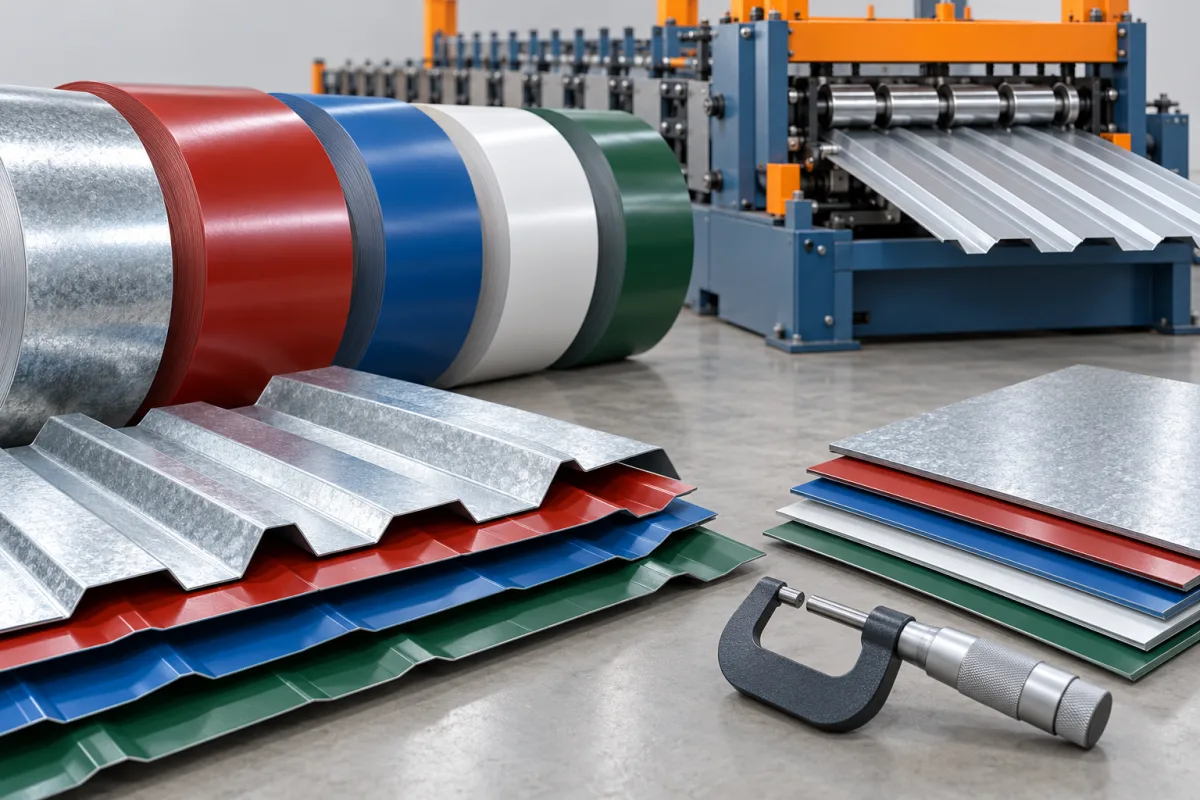
Material selection for roofing-sheet roll forming is a combination of the metal, its mechanical properties, thickness, coating and profile geometry. A thickness value alone does not define whether a coil is suitable for a line or a roof product. The purchasing specification needs to connect incoming coil data with the shape, appearance and installation requirements of the finished sheet.
Define which thickness is being measured
Coated roofing descriptions can refer to different thickness conventions. Record whether the stated value represents the base metal or a total coated measurement and identify the measurement method used in acceptance. Otherwise, two coils described with the same nominal number may not be equivalent inputs.
Keep nominal thickness and permitted variation separate. The line supplier needs to understand the intended material envelope, while incoming inspection needs a usable criterion for accepting deliveries. A purchasing shorthand should not become an unexplained assumption in the tooling agreement.
Pair thickness with grade and profile
The same nominal thickness in different metals or grades can behave differently during bending and after leaving the rolls. Provide the specified grade or alloy and relevant mechanical property information with the thickness. Ask the tooling supplier to review the combinations actually required rather than approving one isolated maximum thickness.
Profile geometry also matters. A relatively open corrugation and a section with tighter return features are different forming tasks. Successful production of one profile does not demonstrate that every other section can use the same coil envelope. Keep material approvals tied to the drawing revision.
Steel and aluminum require distinct production reviews
Do not substitute aluminum for steel merely because its thickness fits a stated range. The forming response, surface requirements and handling can differ. Any shared-tooling proposal should identify the material combinations reviewed and provide representative formed samples, including the functional side laps.
Material choice for the roof itself must also account for the project environment, compatible accessories and applicable design requirements. The roll former's ability to shape a strip is only one part of that decision. Equipment feasibility should not be presented as universal approval of a roofing material for every building.
Coatings affect both product appearance and trial design
For prepainted stock, record the exterior face, coating system and finish criteria supplied for the product. Inspect bends and contact areas after forming, cutting and normal handling. A trial using an unrelated finish may fail to reveal the marking or bend-appearance issues relevant to the order.
If protective film is used, agree whether it remains in place during each operation and how it is assessed during inspection. Film can change what is visible during a quick check. Remove or examine it according to the agreed evaluation method so hidden damage is not discovered only after shipment.
Strip width is developed material, not installed cover
A roofing section consumes material in ribs, slopes and laps. Its flat strip width is therefore a different quantity from effective installed cover. Obtain the required slit width from the approved forming design and retain that value with the profile record. A fixed percentage allowance is not a reliable substitute for section development.
For an illustrative distinction, a sheet might have a specified effective cover of 0.9 metre while using a wider flat strip. The exact input width must come from that profile's geometry; it cannot be inferred from the cover value alone. Buying coil by the wrong width can prevent the terminal edges from forming correctly.
Incoming coil condition deserves its own checks
Identify the coil and inspect the characteristics included in the purchasing specification before attributing every profile deviation to the mill. Width variation, surface damage or strip shape can complicate diagnosis. Retain supplier identification and the relevant incoming records with trial results.
- Coil identity, grade or alloy and supporting material documentation.
- Thickness convention and agreed sampling method.
- Slit width, edge condition and specified strip-shape criteria.
- Coating, exterior-face orientation and protective layers.
- Coil envelope compatible with loading and payoff equipment.
Construct a trial matrix around the difficult combinations
Do not test only the easiest middle condition. Ask the equipment and material specialists which combinations are most informative for the approved range: a critical lap, a tighter feature, a finish-sensitive coil or another boundary product. The matrix should be justified by the actual profile family, not by a habit of trying the minimum and maximum thickness alone.
For each trial, record finished geometry, lap assembly, surface condition and cut-end quality. Use the intended support and viewing conditions. Comparing measurements from a freely supported sheet with those from a clamped sample can create an apparent disagreement unrelated to the material.
Handle substitutions as controlled changes
A substitute coil can be commercially attractive but should not enter production solely because its nominal thickness matches the purchase order. Compare the material identity, mechanical properties, coating, width and approved profile applications. Determine whether additional trials or product-system review are needed.
Keep the decision traceable. If a later order shows a different lap fit or appearance, the team should be able to distinguish a stock change from a tooling change. Avoid undocumented adjustments intended to make an unreviewed substitute resemble the accepted reference.
Connect material efficiency to accepted roofing
Track setup scrap, rejected sheets and damaged packed material separately. A lower coil purchase price does not necessarily lower cost per accepted square metre if it causes more rejected starts or surface losses. Use actual consumption and effective cover to compare the complete result.
For example, if two trial lots deliver the same accepted coverage but one consumes more input mass, investigate the cause rather than declaring the cheaper-per-tonne coil the better choice. The difference might arise from the specified thickness, coil condition, setup, or handling; the production record should help separate them.
Frequently asked material questions
What thickness can a roofing-sheet machine process?
The answer belongs to the specific machine, profile and material combination. Supply grade, width and finish along with thickness and obtain the agreed capability envelope. A universal number would hide these dependencies.
Can thicker metal fix a side-lap problem?
Not reliably. Lap fit depends on the approved geometry, material response and production condition. Changing thickness without review can create a different mismatch rather than correct the original one.
Is every galvanized coil suitable for painted roof panels?
No. Coating and paint-system suitability are material specifications, not conclusions from the word galvanized. Obtain the correct product documentation and validate the intended formed finish.
What sample should be retained after a material trial?
Keep identifiable formed sheets or representative sections showing the central profile and both laps, with measurements and coil records. Include assembly and appearance observations so the reference captures more than a thickness reading.
Continue your research
- Roofing Sheet Roll Forming Machines
- Corrugated Roof Sheet Roll Forming Machine
- Trapezoidal Roof Sheet Roll Forming Machine
- R Panel Roll Forming Machine
- PBR Panel Roll Forming Machine
- IBR 686 Roofing Sheet Machine
- How Roofing sheet roll forming machine Works
- How To Choose a Roofing sheet roll forming machine
- Roofing sheet roll forming machine Price: What Affects the Cost?