
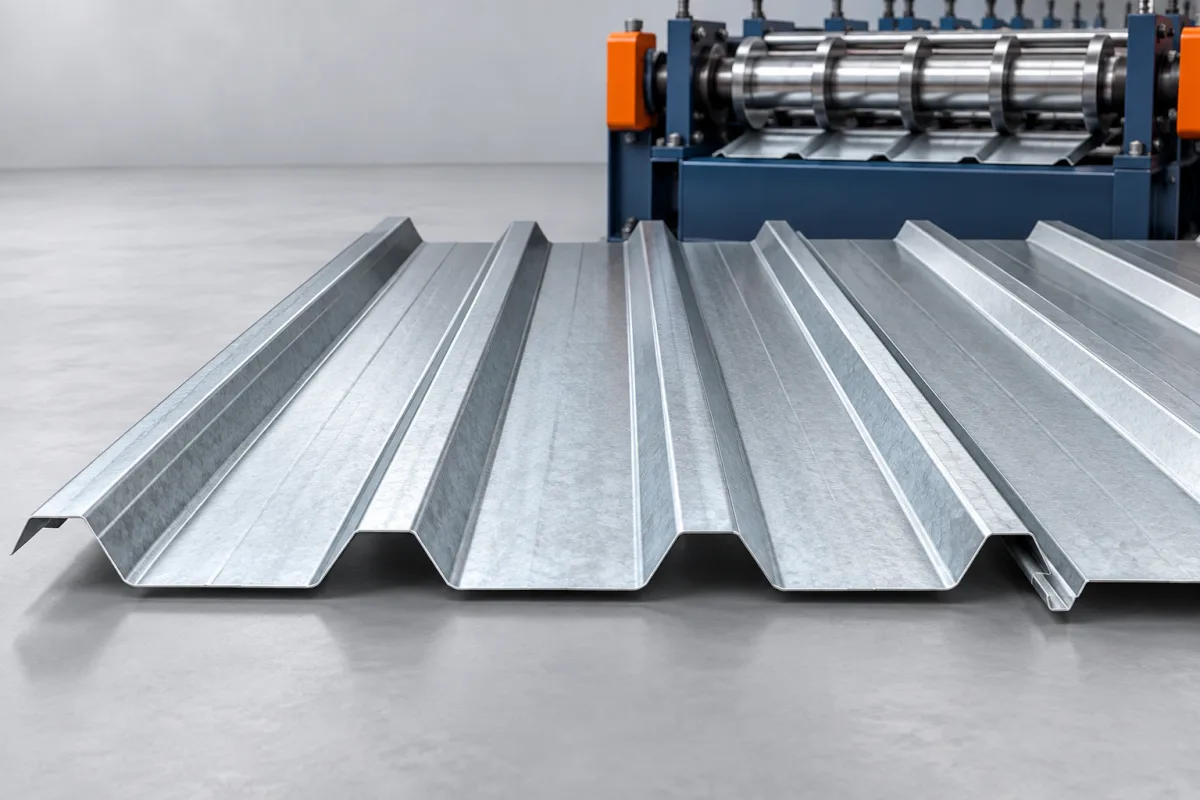
An IBR 762 roofing sheet machine forms a specified IBR roof profile associated with a 762 mm coverage designation. The purchase should begin by confirming exactly what that number means in the target market and drawing. Installed cover, physical sheet width and input-strip width are different measurements and cannot be exchanged in a tooling specification.
This profile-specific route is most useful when a producer has already chosen the roofing section it wants to sell. The next task is to connect that section to the available coil, customer length mix, matching accessories and handling arrangement. Those details turn a product name into a practical production brief.
Why does the larger cover designation need a new review?
Compared with another IBR designation, a 762 profile may change rib count, pitch, lap shape or several dimensions together. It should not be treated as a scaled drawing until the actual sections have been compared. Scaling can alter the interface with closures and adjoining sheets.
If an existing 686 product will remain in the catalogue, record both profiles independently. Decide whether they serve different markets or whether customers expect accessories to remain common. That commercial decision helps define the useful scope of any shared production equipment.
What belongs on the approved section?
Show the full rib pattern and both terminal edges, with a consistent dimensional reference. Include crest widths, valley widths, rib depths, bend radii and the specified overlap. An assembled view should explain the effective cover and identify the exposed face.
Keep the drawing revision with approved samples and inspection records. A supplier should not have to choose between contradictory photographs, an informal sketch and a nominal width in an email. Resolve those differences before committing to roll tools and cutoff components.
How should coil purchasing be linked to the profile?
The input strip must supply the developed rib walls and laps, so the required flat width comes from the full section rather than the coverage label. Coil width, material grade and base-metal thickness should be confirmed as a combination. Coating and surface-protection requirements should be recorded separately.
For business planning, ask how incoming width variation is handled and what specification the coil supplier must meet. Do not assume that a machine described as adjustable can correct any strip width while preserving the same finished section and edge shape.
What does a complete manufacturing route contain?
Coil handling presents the material to the entry equipment. Guided strip then travels through the progressive forming stages, where the rib pattern and lap edges are developed. The length-control and cutting arrangement separates individual sheets, followed by supported discharge and stacking.
Identify optional operations explicitly. Protective-film application, order marking and powered stacking may be useful, but they should not be inferred from a generic description of a complete line. The equipment schedule should show what performs each required step.
How can the line accommodate different roofing lengths?
Define minimum and maximum required lengths together with the normal order distribution. A route optimized around long repeated sheets may behave differently on frequent short pieces. The length-control proposal should be reviewed alongside cutoff cycling and transfer to the stack.
The longest order must fit the discharge path without inappropriate overhang or dragging. At the short end, pieces need a stable transfer method and clear order identification. Ask for both conditions in a trial rather than approving the line from one convenient demonstration length.
Is shared tooling with another IBR profile worthwhile?
Compare the annual order mix and the complete changeover burden. A shared machine can reduce duplicated equipment, but every profile transition may involve guides, roll sets, cutoff parts and renewed inspection. The practical benefit depends on how frequently those transitions occur.
Request a variant schedule stating which dimensions are adjusted and which require replacement components. Time the change to the first accepted 762 sheet. A quick movement of the main tooling does not represent the full change if the lap or cutoff still needs correction afterward.
How should the 762 panel be inspected?
Measure a relaxed panel on defined supports, then assemble several panels to verify cover and side-lap behavior. Inspect the terminal ribs along the length and at cut ends. The edge can be acceptable in the middle yet become distorted near the cutoff.
- Check rib spacing against the approved datum.
- Compare both sheet edges with the intended overlap.
- Confirm effective cover without forcing the assembly.
- Inspect coating at bends and contact points.
- Fit the specified closures and trim references.
- Repeat finish checks after normal stacking.
Keep dimensional results separate from appearance observations. That makes it possible to distinguish an incorrect section from a handling mark or a lighting-dependent surface impression.
What should output and cost comparisons include?
Use accepted sheets or agreed coverage from a representative order, with material, lengths and included delays stated. Count setup waste and rejected ends. Nominal strip speed alone cannot show whether the route delivers the required mix of roofing orders.
Compare quotations with the same coil handling, tooling, cutoff, discharge and change-parts scope. Include inspection fixtures and commissioning responsibilities. Accessories such as flashings or ridge pieces may need other equipment and should have a separate manufacturing plan.
Frequently asked questions
Does 762 mm define the full machine?
No. It identifies only one aspect of the intended product designation. The complete rib and lap drawing, material envelope and finished-length requirements determine the equipment proposal.
Can an IBR 686 line simply be widened?
That depends on the two actual cross-sections and the machine design. Compare rib count, pitch and edge geometry before considering adjustment, tool replacement or a separate forming path.
Should the sample be measured while panels overlap?
Use both individual-section measurements and assembled-cover measurements. They answer different questions. The approved method should explain the support condition and how the lap is engaged.
Are long sheets automatically more productive?
They reduce cutoff events per metre but can increase handling demands. Evaluate the complete route, including stack removal and package preparation, before drawing an output conclusion.
What if customers use different coatings?
List each coating and material combination in the trial plan. Confirm exposed-face orientation and appearance requirements, and retain identification so later production can be compared with the approved material.
Connect coverage to the finished order
The best IBR 762 configuration is the one that reproduces the approved section and handles the orders the business will actually sell. Start with the complete profile, then compare forming, changeover and discharge as one production route.

Continue your research
- Roofing Sheet Roll Forming Machines
- Corrugated Roof Sheet Roll Forming Machine
- Trapezoidal Roof Sheet Roll Forming Machine
- R Panel Roll Forming Machine
- PBR Panel Roll Forming Machine
- IBR 686 Roofing Sheet Machine
- How Roofing sheet roll forming machine Works
- How To Choose a Roofing sheet roll forming machine
- Roofing sheet roll forming machine Price: What Affects the Cost?
Configuration & specification inputs
Match the configuration to your section drawing, material and production requirements.
| Parameter | Requirement / confirmation needed |
|---|---|
| Profile geometry | Specified IBR 762 rib pattern, terminal details and separately identified effective and overall widths. |
| Material | Traceable grade and coating combinations with defined exposed-face requirements. |
| Thickness & grade | Base-metal thickness paired with grade and developed strip width for each approved product. |
| Process route | Controlled payoff, entry guidance, progressive IBR forming, cutting and order handling. |
| Cutting | Length schedule demonstrated at both short and long ends of the intended product range. |
| Output | Accepted 762-profile orders with startup scrap, cutoff and stacking conditions recorded. |
| Electrical supply | Confirmed site electrical supply and utilities for forming and auxiliary equipment. |
| Acceptance | Relaxed-section measurements, multi-sheet cover, lap fit, matched closures and coating condition. |