
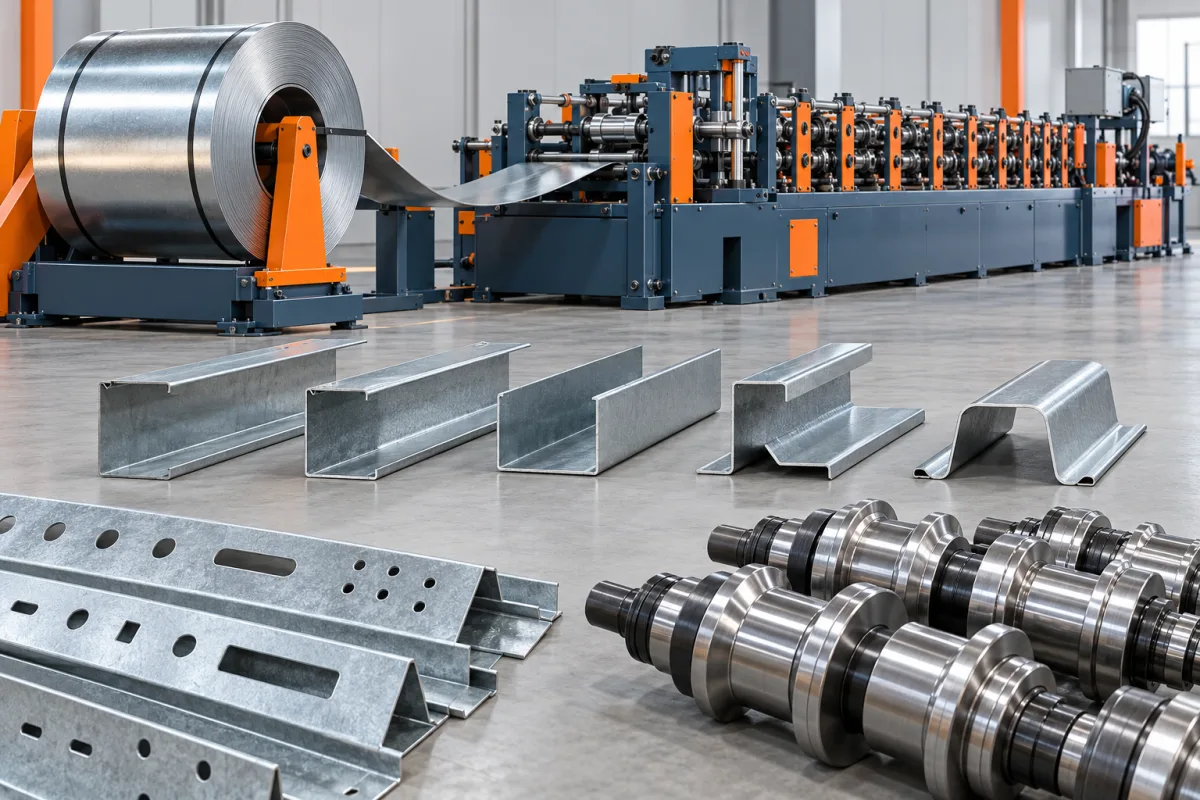
Choosing a purlin roll forming machine requires a clear view of the building components it must produce. Section sizes are only the beginning. Material strength, flange and lip combinations, connection holes, order sequencing and bundle handling determine whether a proposed line fits the business.
Create a member catalog from real drawings
List the C, Z and any additional sections required, with web, flange, lip and bend geometry. Include length and feature drawings. Avoid presenting one minimum and maximum dimension as though every possible combination between them is needed or supported.
Group members by actual demand. A stable catalog with long runs can justify a different arrangement from frequent small building packages. Identify the highest-volume work and the difficult boundary parts so proposals address both production economics and essential capability.
Pair every section with its material
Specify grade, thickness convention, width and coating for the required combinations. The strongest material at the greatest thickness may create a different task from a thinner low-strength member. A thickness-only enquiry leaves an important gap.
Include incoming coil and loading requirements. The line needs to handle the actual coil envelope and present material to the intended preparation and forming route. Confirm these details with the supplier rather than inferring them from a nominal coil-weight description.
Map the connection-feature envelope
Collect representative hole, slot and notch patterns. Identify their locations on the web or flanges, their datums and the required finished condition. Ask which features the proposed punch arrangement can make and which need additional equipment or offline work.
Use difficult feature combinations in the review. A plain C channel demonstration may say little about a purlin package with dense punching or features near critical ends. Feature capability and its effect on output belong in the selection, not in a later commissioning discussion.
Compare changeover methods against your order mix
Manual, assisted and automated arrangements can all serve different businesses. The relevant measure is the complete time and work required to recover an accepted member after a needed transition. Identify which actions are automated and which remain manual.
Include C-to-Z conversion, size changes, material changes, punch positioning and cutoff components where relevant. A claim about one movement should not be interpreted as the duration of the complete production change.
Review cutting and end condition with actual lengths
Ask suppliers to explain their precut or postcut route and how it meets the required end condition. Compare complete members, including end flare and local distortion, rather than choosing a route from its label alone.
Use representative short and long parts in acceptance. Their handling and cutting behavior can differ. Confirm the measurement references and support condition in advance so competing demonstrations produce comparable evidence.
Plan identification and order-data handling
A building package may contain visually similar members with different holes and lengths. Determine how approved order data reaches the line and how the finished piece is identified. Check units, orientation and revision handling where data transfer is involved.
Do not assume that an automated interface eliminates validation. A test order should include intentionally varied part marks and feature patterns so the team can verify that the right physical member receives the right identity. Data correctness is part of usable output.
Draw the complete material and bundle route
Include coil receiving, loading, preparation, punching, forming, cutting, inspection and stacking. Check access and the longest member's supported movement. A compact mill can still require substantial working space around loading and finished bundles.
Compare manual and automated handling using the expected lengths and quantities. The correct choice depends on the production route and safe operating requirements, not just the number of forming stands. Bundle removal should not repeatedly interrupt a line whose other stages have excess capacity.
Use a building-package trial rather than a showpiece
Select a basket containing representative sections, lengths and hole patterns. Include an important size change and recovery of a previous setup. Count accepted complete members and record the time boundary, scrap and stops.
- One common high-volume section.
- A required boundary material or geometry combination.
- A feature-dense member that tests punching.
- Short and long parts that challenge handling.
- A C/Z or size transition important to the order book.
- Verified part identification and bundle assignment.
Compare lifecycle scope, not just the purchase figure
Consider a buyer whose common work is one C section but whose contracts occasionally require Z members with a different hole arrangement. The first question is whether the occasional product is essential to winning the whole package. If it is, demonstrate that transition and feature pattern. If it is not, compare the economics of a separate supply route. This avoids purchasing a broad theoretical range while leaving the one commercially essential connection detail unresolved. The decision should be made from the actual package requirements and margins, not from the number of profiles listed in a brochure.
Require a common inclusion schedule for tools, punches, cutoff components, handling, controls, training and commissioning. Identify buyer-supplied utilities and site work. Mark unresolved items clearly before ranking total prices.
Ask how the team obtains the correct replacement punch or cutting component and recovers an approved setup. Documentation and training should correspond to the actual member catalog. Future section additions need a written boundary between supported adjustments and new engineering work.
Frequently asked purlin selection questions
Is automatic changeover always the best investment?
Its value depends on transition frequency, recovery time and the order mix. Measure complete changes and compare the additional investment with realistic use rather than buying automation by label alone.
Should I specify only the largest web size?
No. Flanges, lips, material combinations and feature locations also matter. Supply the actual section catalog so the capability envelope is unambiguous.
Can a supplier's plain-channel trial prove purlin output?
It demonstrates only part of the route. Include connection features, identification and changes representative of your building packages before using the result for capacity planning.
What makes a proposal ready for purchase?
A defined member and material envelope, clear equipment responsibilities, relevant trial evidence and agreed acceptance methods. Resolve assumptions about punching, changeover and handling before final commitment.
Continue your research
- Purlin Roll Forming Machines
- C Purlin Roll Forming Machine
- Z Purlin Roll Forming Machine
- 80-300mm CZ Purlin Roll Forming Machine
- 100-400mm CZ Purlin Roll Forming Machine
- Automatic Size Change CZ Purlin Machine
- How Purlin roll forming machine Works
- Purlin roll forming machine Price: What Affects the Cost?
- Materials and Thickness for Purlin roll forming machine