
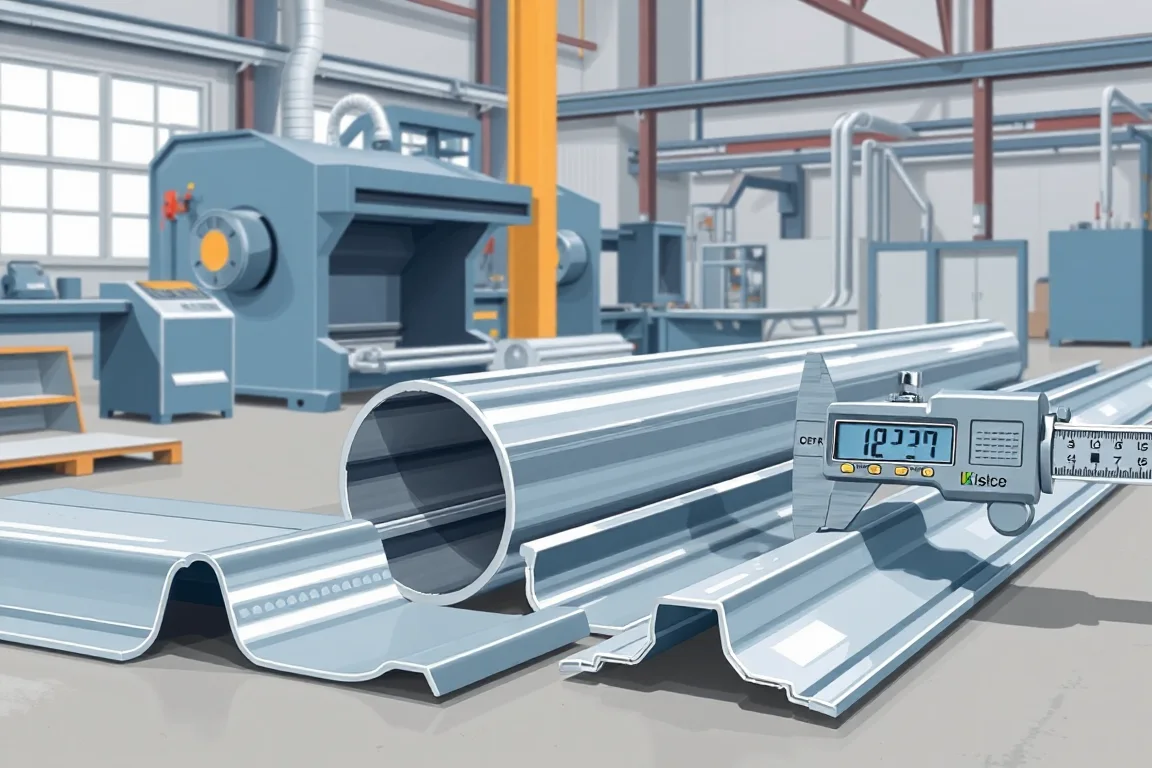
Why material thickness is a forming variable, not just a number
In gutter roll forming, base-metal thickness influences how the strip bends, how much springback you must manage, and whether the edges can be hemmed or seamed without cracking. Thickness also affects the load the roll stands and drive train must carry. A machine set up for one thickness and grade may not produce acceptable parts when thickness or strength changes, because the bend radius, roll gap, and forming sequence are tuned to a specific combination. Coating thickness adds a separate layer of behavior: a thick paint or laminate can crack at tight bends even when the steel itself forms cleanly. For these reasons, material thickness should be treated as one part of a forming specification that includes grade, strength range, coating, and surface protection.
What “thickness” should mean in a purchase specification
Thickness in a gutter roll forming specification should be stated as base-metal thickness with a standard and a permitted tolerance. Ambiguous gauge numbers are not enough because gauge systems vary and do not define the tolerance band. The buyer should provide the nominal base-metal thickness, the allowed variation, the steel or aluminum grade, and the strength range. If the material is coated, the coating type and thickness should be listed separately from the base metal. The reason is practical: two coils with the same base-metal thickness but different yield strength will behave differently in the rolls. A forming line that runs one grade at a given thickness has not demonstrated the same capability for a harder or softer material. Written confirmation should identify supported combinations, not a list of unrelated maximum values.
How material choice changes the forming sequence
Gutter profiles divide broadly into open sections and closed seams, and the forming sequence follows that division. An open gutter section is usually formed progressively from the center outward, with edge details such as beads or hems added in later stands. A closed downpipe seam requires the strip to be rolled into a tube and the edges brought together and locked, which demands different roll geometry and often a different number of forming stages. The sequence typically runs from coil payoff through section forming, then edge or seam closure, then cutoff. Outlets, elbows, and end caps are separate operations and may use different equipment. The important interface is between the forming section and the cutoff: the cutoff must be supported by the profile so it can sever the part cleanly without crushing or distorting the formed shape. If the profile changes, the cutoff tooling and the support may also need to change.
Coated steel, aluminum, and the question of copper
Coated steel and aluminum are common gutter materials, but they do not form identically. Aluminum tends to be softer and more prone to scratching, so roll surfaces and handling need attention. Coated steel offers higher strength but the coating can crack at tight bends. Copper requires its own process review because it work-hardens and its forming behavior differs from steel and aluminum. A tool set designed for one of these materials should not be assumed to handle the others equally. The practical approach is to begin with the complete roof drainage detail and the selected material, then verify the operating envelope with the machine supplier. Finish durability, bendability, and joint compatibility should be reviewed together, because a material that forms well but cannot be joined reliably will still produce a poor installation.
Relating profile geometry to thickness and grade
Profile names such as K-style or ogee overlap between suppliers, so a sketch and cross-section dimensions are more reliable than a style name alone. Thickness and grade influence the minimum bend radius that can be formed without cracking and the amount of springback the rolls must accommodate. A thicker or stronger material may require larger radii, more forming stages, or different roll materials. When the profile includes a hem or bead, the formability of the edge depends on both the material and the tooling sequence. For downpipes, the seam quality depends on how the edges are prepared and closed, which in turn depends on thickness and coating. Reviewing profile geometry alongside material properties helps avoid a mismatch where the roll tooling is capable of the shape but not the material.
Cutoff, secondary operations and outlet interfaces
Cutoff is often the point where material and profile issues become visible. A cutoff that is not supported by the profile can deform the part, leave a poor end, or produce inconsistent lengths. The buyer should confirm that the cutoff is designed for the specific profile and that cut lengths and end quality are acceptable. Downpipe outlets and elbows are usually produced by separate operations, not by the gutter former. If the project requires elbows, the production plan should define the secondary forming process and how the mating fit with the downpipe will be checked. Drainage design must account for the building and local requirements; a gutter former does not establish drainage capacity. The machine produces the part, but the system performance depends on the complete detail.
What to verify before accepting a machine for your material
Acceptance should be based on the actual profile and material combination. Representative samples from the intended coil supplier are more useful than generic demonstration pieces. During acceptance, inspect the bead or hem, straightness, and joining fit. For downpipes, check the seam and the mating outlets or elbows. If the machine is claimed to run a range of thicknesses or grades, ask for written combinations that have been demonstrated, and confirm how the changeover is managed. The goal is to establish that the machine can produce accepted output with your material, not merely that it can move strip through the rolls.
How to compare machine alternatives without relying on marketing numbers
When comparing gutter roll forming machines, focus on capability statements that can be verified. Does the supplier offer a written operating window for your specific grade and thickness? Can they provide a sample formed from material similar to yours? What is the forming sequence for your profile, and how many stages are used? How is the cutoff supported? What secondary operations are needed for outlets and elbows? The answers will distinguish a machine that is configured for your work from one that is presented as universally capable. Cost comparisons should also be scoped carefully: a quote may cover only the forming machine, while tooling, cutoff, secondary operations, installation, and training may be separate. The accepted-output cost per part is more meaningful than a headline price, because it depends on the true production rate for your profile and material, not a claimed maximum.
FAQ
What thickness range can a gutter roll forming machine handle?
There is no universal thickness range. The supported range depends on the machine design, the profile, the material grade, and the forming sequence. A machine configured for one combination of grade and thickness may not run a different material at the same thickness without changes. The buyer should specify the base-metal thickness and grade, then ask the supplier to confirm the supported operating window in writing for that specific combination.
Can one machine form both steel and aluminum gutters?
It may be possible, but it should not be assumed. Steel and aluminum differ in strength and forming behavior, and the roll tooling may need different settings or designs. Coating and surface finish also affect performance. If both materials are required, the buyer should ask for written confirmation of the supported combinations and representative samples for each material.
How does base-metal thickness affect the cutoff operation?
Thickness affects the force required to cut and the support needed to prevent distortion. A cutoff designed for a thinner material may not perform well on a thicker one, and the profile geometry also matters. The buyer should confirm that the cutoff is matched to the intended profile and thickness range and that end quality and length consistency are acceptable.
Why is gauge not a sufficient thickness specification?
Gauge numbers are ambiguous because different gauge systems exist and do not define a tolerance band. Two suppliers can use the same gauge number to mean different actual thicknesses. Stating base-metal thickness with a standard and permitted variation removes that ambiguity and allows the machine supplier to confirm whether the material is within the supported operating window.
What role does coating play in formability?
Coating can crack or delaminate when the base metal is bent, especially at tight radii or hems. The coating type and thickness affect how much the material can be formed before surface damage occurs. For exposed faces, the appearance of the coating after forming is part of acceptance. The buyer should specify the coating separately from the base metal and verify that the forming sequence produces acceptable surface quality.
How should I evaluate a supplier’s claim of a wide thickness range?
A wide range claim should be supported by written combinations of grade, thickness, and profile that have been demonstrated. Ask for samples formed from material similar to your intended coil and for details of any changeover required between combinations. Unrelated maximum values do not show that the machine will produce acceptable parts across the range.
Practical checklist for material and thickness decisions
- State base-metal thickness with a standard and permitted variation, not a gauge number.
- List the grade, strength range, and coating separately from the base metal.
- Provide representative samples from the intended coil supplier.
- Record surface finish and the exposed face alongside material strength.
- Define the complete roof drainage detail, including outlets and elbows.
- Confirm the forming sequence and cutoff support for your profile.
- Ask for written supported combinations of grade, thickness, and profile.
- Verify acceptance criteria for bead or hem, straightness, seam, and joining fit.
- Clarify the scope of any quote, including tooling, secondary operations, and installation.
- Plan for drainage design and local requirements separately from machine selection.
Continue your research
- Gutter & Downspout Roll Forming Machines
- Gutter Roll Forming Machine
- Downspout Roll Forming Machine
- K Style Gutter Roll Forming Machine
- Half Round Gutter Roll Forming Machine
- Box Gutter Roll Forming Machine
- How Gutter roll forming machine Works
- How To Choose a Gutter roll forming machine
- Gutter roll forming machine Price: What Affects the Cost?