
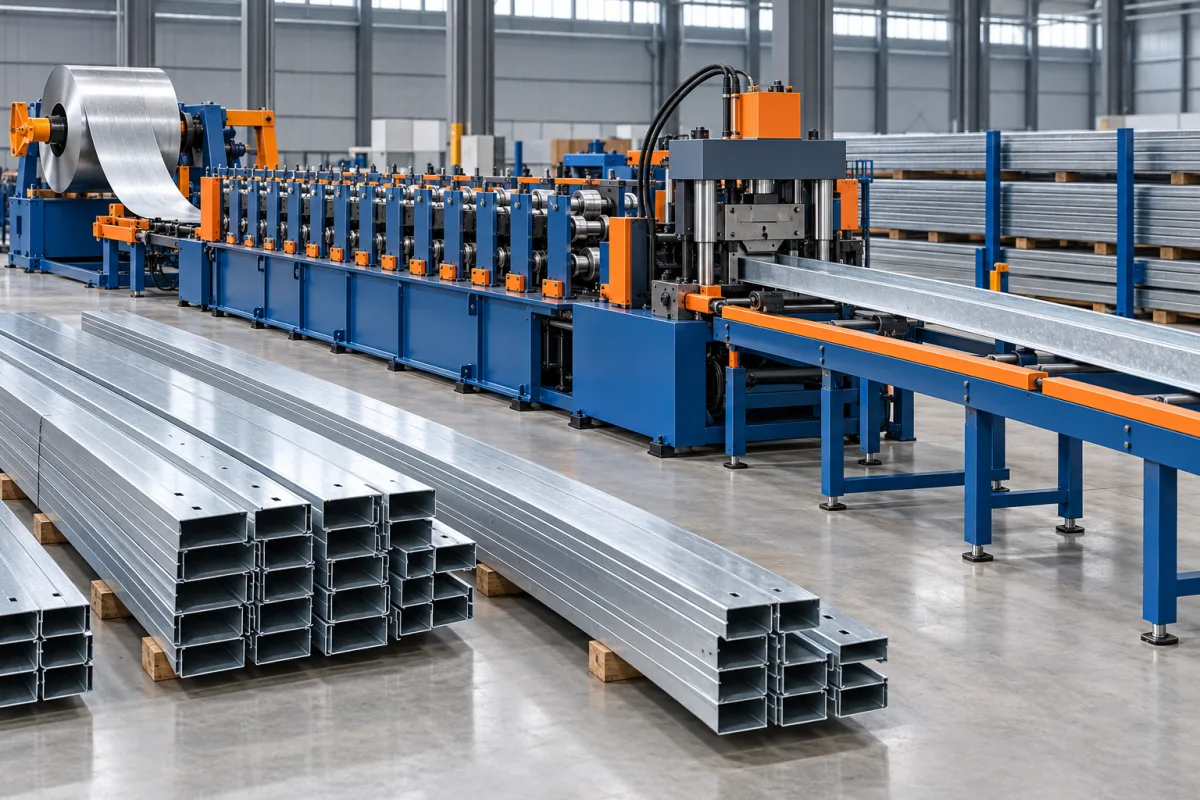
Purlin output depends on how quickly the complete line makes accepted, identified members with their required connection features. Strip speed alone omits punching, cutting, size changes and bundle handling. A useful capacity estimate starts with a representative building-package schedule rather than an unloaded machine demonstration.
Define the finished-member boundary
Decide whether the output count ends after forming, after all holes and notches are complete, or after inspection and bundle release. State that boundary explicitly. A plain channel awaiting fabrication is not equivalent to a finished purlin ready for its building position.
Use accepted members as the main output measure. Keep gross metres and rejects separately. A part with the correct cross-section but an incorrect hole pattern is not saleable output for the intended order.
Build a representative member basket
Include common sections, important boundary combinations, short and long lengths and feature-dense members. Preserve the required order sequence if it reflects how the business actually works. A basket selected only for easy forming can hide the operation that controls production.
Record material and section identity for every group. If the trial later changes to a different grade or simpler hole pattern, the result should not be presented as an improvement on the original basket without explanation.
Punch density changes work per metre
Two members of equal length can require different production time when their feature patterns differ. The effect depends on the proposed punching and feed sequence. Ask for demonstrated output on the actual patterns rather than applying a plain-section speed to all orders.
Include feature quality and location in the count. A high punching rate that produces misplaced or unacceptable holes does not improve completed-member output. Inspection should use the final part's datums, including end references and face orientation.
Short parts increase individual cycles
Short members require more cuts, identifications and handling events for the same linear quantity. An average length can obscure this work. Retain the length distribution and piece count when comparing trials or planning labor.
Long members create a different constraint: supported discharge, inspection and bundle movement. A line may have spare forming capacity but wait for long parts to be removed. The complete route needs to balance both cases.
Calculate accepted linear output transparently
Assume a hypothetical basket of 50 accepted members at 6 metres and 40 at 3 metres. Total accepted length is 50 × 6 + 40 × 3 = 420 metres. If the measured route takes 140 minutes, average output is 3 metres per minute, or 180 metres per hour over that boundary.
These are planning assumptions, not machine ratings. Keep the basket's hole patterns and section changes with the calculation. Without them, another 420-metre order may represent substantially different work.
Measure complete size and orientation changes
Record the interval from the last accepted member of one setup to the first accepted member of the next. Include forming changes, punch positions, cutting components and inspection as required. C-to-Z conversion is one possible transition, not a synonym for all setup work.
For a hypothetical day with six changes at 20 minutes each, 120 minutes are occupied by recovery. Reducing only a small mechanical movement may have limited effect if most time is spent on other tasks. A detailed change log identifies the useful improvement target.
Track identification and data-related losses
Wrong part marks, outdated drawing revisions or incorrect feature data can waste otherwise capable machine time. Record those losses separately from mechanical stops. The remedy may be order validation or information flow rather than faster equipment.
Where production data is transferred electronically, test units, orientation and member identity with a controlled sample order. Automation can reproduce an incorrect instruction efficiently; it does not make the instruction correct.
Separate the major time-loss categories
A useful report distinguishes setup, coil changes, feature cycles, cutting, inspection, handling waits and unplanned stops. Avoid a single downtime total that mixes unrelated causes. Each category suggests a different investigation.
- Frequent first-off rejects: review setup recovery and material changes.
- Waits at punch operations: examine the feature work content.
- Long discharge waits: review supports and bundle removal.
- Identification rework: investigate data and labeling controls.
- Unplanned equipment stops: connect the event to service records.
Plan capacity around the actual constraint
Scheduling can also change the observed result. Grouping compatible sections may reduce transitions, but building packages still need their correct delivery sequence and identification. Measure any scheduling benefit against additional storage, sorting and work in progress. A higher daily metre count is not necessarily better if the factory creates a large inventory of members that cannot yet complete a customer package.
If punching dominates the basket, increasing available roll speed may have little benefit. If the order mix changes constantly, setup recovery may matter more. If bundles block discharge, the constraint lies after forming. Choose improvements from measured losses rather than a generic desire for higher speed.
Repeat the study on comparable work after a change. Keep a less favorable scenario with more small orders or dense feature patterns for delivery planning. A capacity promise based only on the easiest basket is vulnerable when the order book changes.
Frequently asked purlin output questions
Can line speed be converted directly into tonnes per shift?
A theoretical conversion can use section mass and time, but real output also depends on features, changes, stops and yield. Label theory clearly and validate with accepted production.
Why is a perforated member slower than a plain one?
Feature-making adds work whose effect depends on the line sequence. Compare the actual hole patterns and measured cycles rather than assuming every metre has equal production content.
Should size-change time end when the controls finish moving?
No, not for operational planning. End it when the required member is accepted, including feature and end checks. Mechanical movement is only one part of recovery.
What should a supplier's capacity report contain?
The member basket, material, features, accepted quantity, elapsed-time boundary, changes, stops and rejects. These details allow the result to be compared with your real building-package demand.
Continue your research
- Purlin Roll Forming Machines
- C Purlin Roll Forming Machine
- Z Purlin Roll Forming Machine
- 80-300mm CZ Purlin Roll Forming Machine
- 100-400mm CZ Purlin Roll Forming Machine
- Automatic Size Change CZ Purlin Machine
- How Purlin roll forming machine Works
- How To Choose a Purlin roll forming machine
- Purlin roll forming machine Price: What Affects the Cost?