
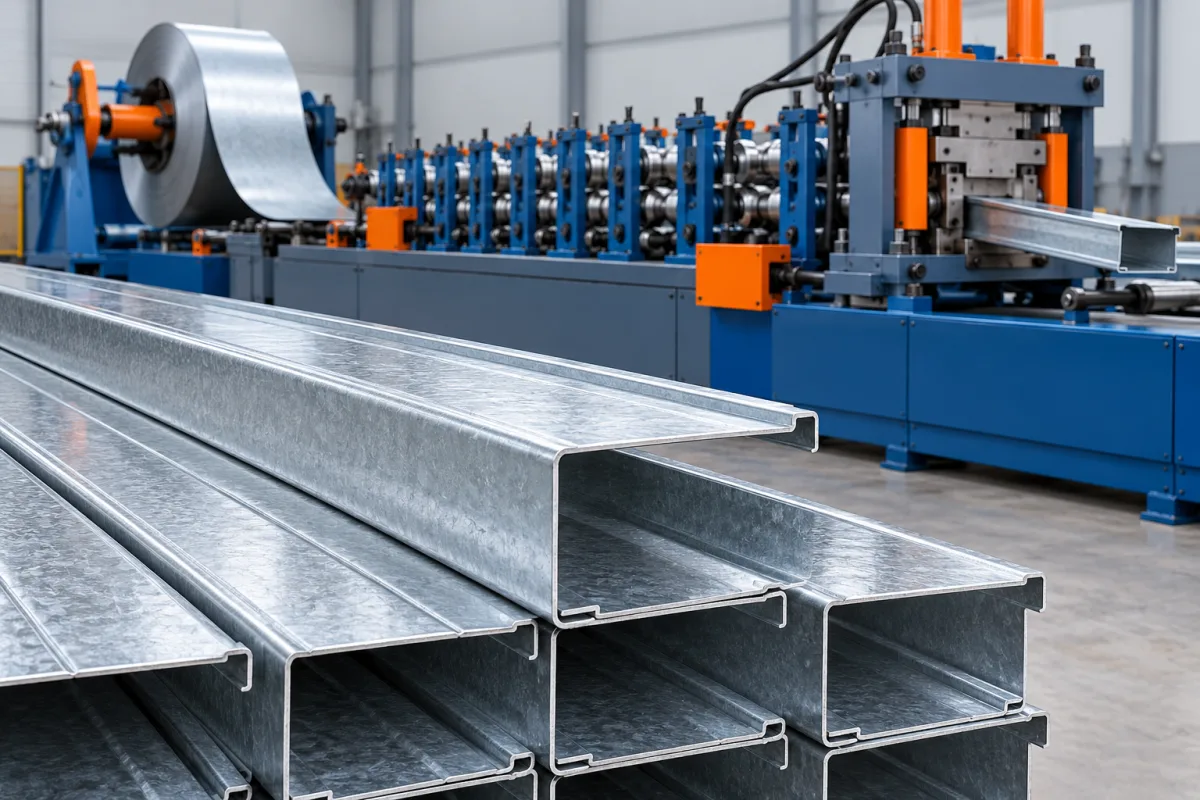
A C purlin roll forming machine produces steel members whose principal flanges extend to the same side of the web, with lips or other features where the selected section requires them. The equipment coordinates forming with the holes, cut lengths and handling needed to supply a defined component. Its configuration should follow the engineered section family, not simply the letter C.
The important buying distinction is between a line dedicated to a stable C-section range and equipment expected to make multiple structural profiles. Web depth, flange width, lip geometry, material and connection holes all influence the production route. Define those combinations before comparing size adjustment, automation or nominal running speed.
What does a C purlin line produce?
The basic output is a cut member with the approved C-shaped cross-section. A project may also require punched connection holes, slots, notches or identification. These features need to appear in the equipment scope because a plain formed channel and a completed connection-ready purlin are different outputs.
C-shaped members can serve different roles in building assemblies, but the line does not establish their structural suitability. The section, material, connections and intended use come from the relevant design. A machine should be evaluated on its ability to reproduce that defined component consistently.
Which C-section family is required?
A recurring section with varying lengths
If one geometry dominates orders, the main production changes may be length, holes or material lots. A dedicated setup can then be reviewed around a relatively stable section. Include the actual feature patterns rather than assuming every order is a plain cut length.
A size family sharing a basic form
Several web depths, flange widths or lip dimensions create a size matrix. Determine which dimensions can change together and which require additional tools or setup work. A nominal web-depth range does not prove every flange and lip combination is covered.
A broader structural-profile catalogue
If the business also needs Z, U, sigma or other sections, list those separately. A machine sold for C purlins is not automatically a universal structural former. Compare the additional tooling or a combined-line proposal against the real order pattern.
Which drawing dimensions matter?
Record web, flanges, lips, bend radii and the reference surfaces used to inspect them. Identify any unequal dimensions instead of assuming a symmetrical section. The relationship between a connection hole and the finished web or flange should be explicit.
- Cross-section: dimensions of every functional leg and return.
- Material: specified grade, strength requirements, thickness convention and coating.
- Connection features: hole shape, size, pitch and datums.
- Length: finished-length schedule and how features relate to cut ends.
- Geometry acceptance: agreed measurement of straightness, twist and local end condition.
- Assembly: representative brackets, sleeves or other mating parts where relevant.
Provide these inputs as linked drawings and schedules. A sketch of the section with a material thickness written beside it leaves major questions about connection-ready output unanswered.
How does the coil become a finished C member?
- Coil preparation: establish the specified material, loading arrangement and strip-entry condition.
- Feature production: create the required holes or notches at the defined stage of the route.
- Progressive forming: develop the web, flanges and lips through the roll tooling.
- Length control and cutting: produce the required cut length with support suited to the section.
- Discharge: support, identify and stack members without compromising their geometry.
- Inspection: check the finished section and features against the controlled references.
The sequence of punching and cutting relative to forming depends on the proposed design. Ask the supplier to show it and explain how hole location and section support are maintained. Do not assume that all purlin lines use the same route.
How should punching and connection details be specified?
List each required feature and its position from agreed datums. Hole diameter alone does not define a punching task: the material, number of features, location on the section and relationship to cut ends also matter. Include special slots or notches as separate requirements.
Determine which dies are shared between sizes and which need changing. A line with automatic size adjustment may still require manual work on punch tools or supports. Those operations should be included in the changeover description and first-off inspection.
For approval, compare a representative finished member with its intended connection components. The exercise can reveal a datum or end-reference misunderstanding that a simple hole-count check would miss.
What does adjustable size actually mean?
Separate web-depth adjustment, flange changes, lip changes and material changes. Request a matrix identifying the required combinations and the means of producing each. Some transitions may use controlled adjustments; others may need replacement parts.
A useful demonstration includes the more demanding combinations in the agreed range and a return to a previously accepted setting. Measure the whole section and the required features after cutoff. Moving the stands successfully is not the same as recovering an acceptable member.
Keep setup references by drawing revision and material. A size designation alone may not identify a section if its lips, radii or connection features have changed.
Dedicated C equipment or a combined C/Z line?
A dedicated C route concentrates on the required C-section catalogue. A combined line can serve more profile families, but the changeover work and shared production capacity need to be assessed. Neither arrangement is universally preferable without the order mix.
Compare a realistic schedule containing lengths, quantities, hole programs and profile changes. If different products must be supplied simultaneously, one combined line still represents one shared resource unless its design explicitly provides otherwise. If orders alternate in small batches, changeover recovery may carry more weight.
Include tooling, floor space, coil handling and discharge in the comparison. A combined-machine label should not hide extra dies or auxiliary work needed for the actual products.
How does the material range affect the configuration?
Pair thickness with grade, strength and width rather than treating it as an independent capacity figure. The required forming and cutting duties depend on that combination and the section being made. Use the agreed production material in trials.
Specify coating and any later processing. Inspect the finished member at the appropriate stage and keep incoming material identity with the trial record. This makes it possible to distinguish changes in stock from changes in setup when investigating later variation.
A material substitution should be reviewed against both manufacturing capability and the component design. Producing a visually similar C section from another grade does not establish that it can replace the intended structural member.
How should output and quotation scope be compared?
Measure accepted members over a representative order. Frequent holes, short lengths, changes in size and unloading can determine delivery more than uninterrupted strip speed. Record setup scrap and rejected components rather than counting every cut length as successful output.
Quote the same section matrix and hole schedule to each proposed supplier. Include coil handling, required dies, cutting components, length control, discharge and identification where needed. List installation, training and inspection responsibilities separately.
Future expansion should be explicit. Ask which additional sizes or profiles require tools, engineering or another route. This gives a useful basis for comparing a lower initial scope with a more flexible package.
What should a C purlin acceptance trial check?
- Verify the drawing, material and complete feature schedule.
- Measure web, flanges, lips and the agreed free-state geometry.
- Check holes and notches from the specified datums and cut ends.
- Inspect both ends for deformation introduced during cutting.
- Trial the intended connection arrangement where applicable.
- Demonstrate a required size change and return to an earlier configuration.
- Review handling, identification and the accepted production count.
Record unresolved deviations before releasing the tooling. Approval should refer to the finished drawing-defined member, not merely a successful run of material through the line.
Frequently asked questions
Can any C purlin machine make Z sections?
No. That capability depends on the proposed tooling and line arrangement. A dedicated C line and a combined C/Z line have different stated scopes. Request a demonstration of the actual additional profile rather than inferring it from the similarity of the letters.
Does a greater web depth mean a stronger purlin?
Structural behavior depends on the complete section, material, connections and design conditions. The former's size setting is not a structural rating. Use the engineered member specification as the manufacturing target.
Are connection holes included automatically?
Not necessarily. Hole patterns, dies and positioning requirements must be included in the scope. A plain-channel former does not by itself establish the ability to produce every finished purlin connection feature.
Does automatic adjustment eliminate manual setup?
Only the identified operations are covered. Punch dies, guides, cutting supports or first-off checks may still require work. Compare the full transition through to an accepted member rather than one automated movement.
Can the required coil width be read from the web depth?
No. Flanges, lips and bend development also consume strip. Obtain the incoming-width requirement for the approved section and process. Avoid a fixed allowance that ignores the actual profile.
What should accompany an enquiry?
Provide the section matrix, material specification, hole drawings, lengths and typical orders. Add inspection references and mating components where useful. These inputs make configuration and accepted-output comparisons meaningful.
Build the specification around a connection-ready C member
Define the complete section and its features before deciding how much adjustment or automation is needed. Connect every requested variant to tooling, setup and inspection. That approach turns a broad C-purlin enquiry into a production requirement that can be demonstrated and compared.

Continue your research
- Purlin Roll Forming Machines
- Z Purlin Roll Forming Machine
- CZ Purlin Roll Forming Machine
- 80-300mm CZ Purlin Roll Forming Machine
- 100-400mm CZ Purlin Roll Forming Machine
- Automatic Size Change CZ Purlin Machine
- How Purlin roll forming machine Works
- How To Choose a Purlin roll forming machine
- Purlin roll forming machine Price: What Affects the Cost?
Configuration & specification inputs
Match the configuration to your section drawing, material and production requirements.
| Parameter | Requirement / confirmation needed |
|---|---|
| Profile geometry | A C purlin has an open side and typically inward lips. Record web, flanges and lips separately, and locate holes from a clear datum. Demonstrate the intended section range rather than one convenient middle size. |
| Material | Specified galvanized or uncoated structural steel grade |
| Thickness & grade | Buyer to specify base-metal thickness and grade; operating range requires supplier verification. |
| Process route | Payoff → leveling → punching/notching → adjustable forming → cutoff → dimensional inspection |
| Cutting | Confirm profile-supported cutoff, cut lengths, end quality and any secondary operations. |
| Output | Define accepted output per shift with the actual profile and material. |
| Electrical supply | Buyer to state voltage / frequency / phase. Installed power requires a confirmed equipment schedule. |
| Acceptance | A dedicated C line and a combined line should be compared using the required order mix. If Z sections are not part of that mix, quantify the value of the additional capability rather than assuming more profile options always improve the business case. |