
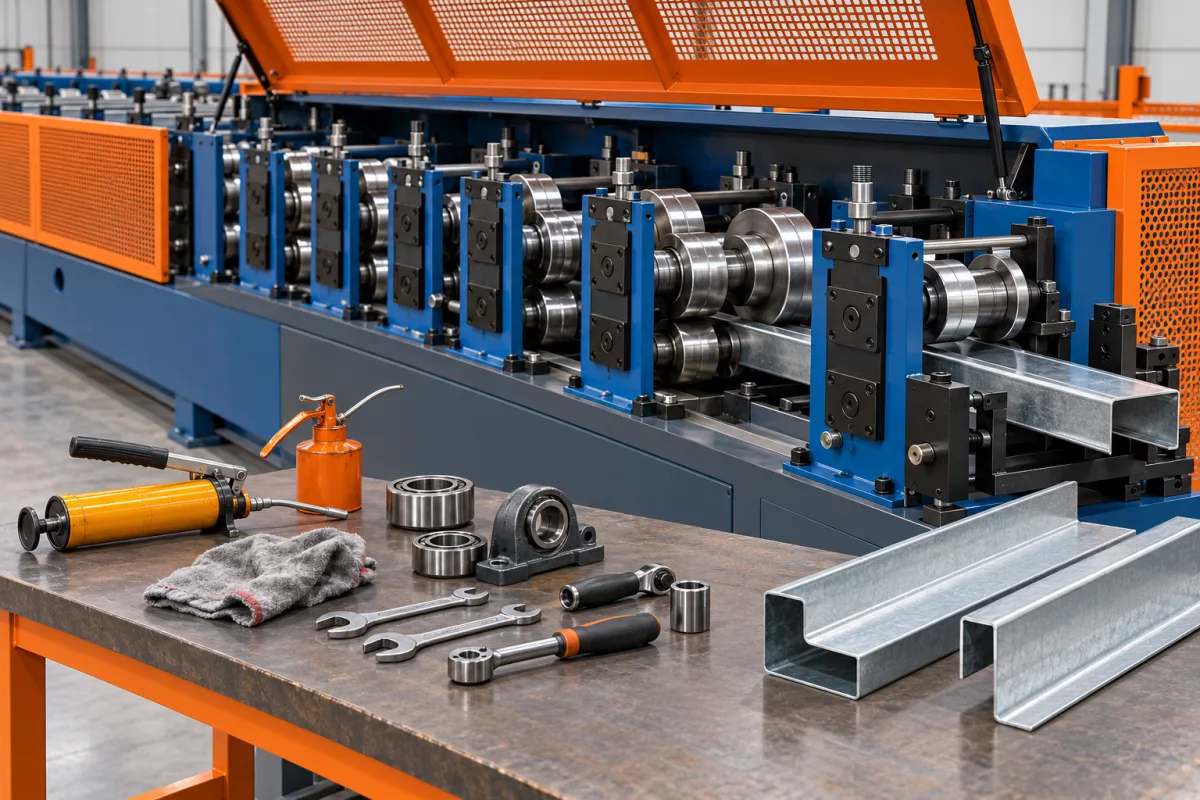
A purlin-line maintenance plan should preserve repeatable section changes, accurate connection features and complete-member quality. The route includes coil preparation, punching, forming, cutting and handling, often with data and marking interfaces. Maintaining only the forming stands leaves several important causes of rejected building components unchecked.
Organize maintenance by the actual equipment route
Identify each asset, its instructions and the person responsible. Use the manufacturer's intervals, isolation procedures and service methods rather than generic settings. Mechanical, electrical, hydraulic and control work should be assigned to appropriately qualified personnel.
Keep records specific to the line and configuration. A site with several punch units or interchangeable components needs to know exactly which one was serviced. The record should link the asset, finding, action and return-to-service decision.
Separate production observations from isolated work
Operators can report unusual sounds, alarms, repeated stops and changes in member quality from permitted positions. Inspection or cleaning within hazardous areas requires the approved shutdown and isolation procedure. Moving strip, punches and stored energy must not be treated casually because the line is running slowly.
Define escalation for defective guarding, leaks or abnormal motion. Production pressure should not lead to bypassing protective devices. The responsible team should control the investigation and equipment release.
Maintain payoff and preparation equipment
Review coil support, loading accessories and the specified preparation route according to their documentation. Record conditions that could affect material presentation. The line's forming result depends on a controlled incoming path as well as correct rolls.
Keep the approved coil envelope and setup references available. Changes in width, weight or loading arrangements may require review. A new product range can create different demands from those present when the maintenance plan was first written.
Inspect punching tools and scrap handling
Feature-making tools need verified identification and condition. Follow the maker's isolated inspection and replacement procedures, including the associated scrap arrangement. Record wear or damage with the affected feature and material combination.
After service, verify both feature condition and position on the final member. A cleanly punched hole does not prove the correct datum relationship. Keep tool references connected to the section and feature program used during release.
Preserve forming and adjustment references
Size-changing mechanisms and profile tools should be maintained under the approved instructions. Record work that could affect alignment or recovered settings. Do not substitute apparently similar spacers or components without the relevant confirmation.
Maintain readable configuration references for web, flange, lip and C/Z orientation. The team should be able to recover an approved setup after service without relying on undocumented operator memory. This is particularly important for infrequently produced sections.
Match cutoff components to the member range
Inspect the cutting station and support components according to the equipment documentation. Identify parts by the relevant section or approved range. A component that belongs to another profile can produce local end damage even when the mill is otherwise correctly set.
Release checks should include length, cut condition and end geometry. Inspect both ends and compare with the center. A successful unloaded cycle is an equipment observation, not proof of an accepted purlin.
Include discharge and bundle equipment
Long members depend on a suitable supported path through inspection and stacking. Maintain rollers, supports and handling equipment within their specified requirements. Investigate deformation first appearing after cutoff separately from forming defects.
Keep marking and bundle-identification equipment operational and controlled. Its service may belong to another team, but a loss of part identity affects release. Coordinate responsibilities so physical and information handling remain connected.
Control backups and approved production data
Follow the supplied process for preserving control configurations and authorized setup information. Record changes and retain the correct revision. A hardware repair should not leave the line using an unverified feature program or section setting.
Where order data is transferred, verify the relevant interface after service affecting it. A controlled test should check units, orientation, feature pattern and part mark. Do not assume a successful connection proves correct production information.
Release maintenance with representative members
Choose post-service checks proportionate to the work and retain normal first-off requirements. If adjustment mechanisms were serviced, demonstrate recovery of relevant sizes. If punch or cutoff work was performed, inspect those features on complete members.
- Confirm section, material and program references.
- Produce identified first-off members.
- Measure web, flanges and lips.
- Check feature positions, length and both ends.
- Inspect straightness and handling condition.
- Verify part marks and record the release decision.
Use recurring losses to refine the plan
Keep setup recovery evidence after major service rather than recording only the first convenient section. A commonly used size may pass while a less frequent boundary configuration remains untested. Select the release basket from the work performed and the approved product range so the next unusual order does not become the first meaningful test.
Link downtime and defect records with maintenance findings. Repeated feature problems, configuration recovery delays or end damage may reveal a task that needs better evidence or a broader engineering review. A correlation should be investigated rather than assumed to prove the cause.
Review critical spares against the current member catalog and service history. Keep verified part references and identify obsolete configurations. A shelf of similar-looking punches or cutoff parts is not a reliable spare system if their applications are unclear.
Frequently asked purlin maintenance questions
Does automatic size adjustment eliminate setup maintenance?
No. The mechanisms, controls and references still require their specified service and verification. Automation changes the work but does not remove the need for condition control.
Why check holes after servicing forming equipment?
The final member connects section geometry with feature datums. Work affecting the product route may change that relationship, so complete-member release is safer than checking one isolated dimension.
Can different punch tools be stored together without labels?
That creates avoidable identification risk. Use verified tool references and preserve their approved applications so replacement does not introduce the wrong feature.
What demonstrates successful return to production?
The required equipment release plus accepted representative members with correct section, features, ends and identity. Completing maintenance tasks alone does not establish the finished product result.
Continue your research
- Purlin Roll Forming Machines
- C Purlin Roll Forming Machine
- Z Purlin Roll Forming Machine
- 80-300mm CZ Purlin Roll Forming Machine
- 100-400mm CZ Purlin Roll Forming Machine
- Automatic Size Change CZ Purlin Machine
- How Purlin roll forming machine Works
- How To Choose a Purlin roll forming machine
- Purlin roll forming machine Price: What Affects the Cost?