
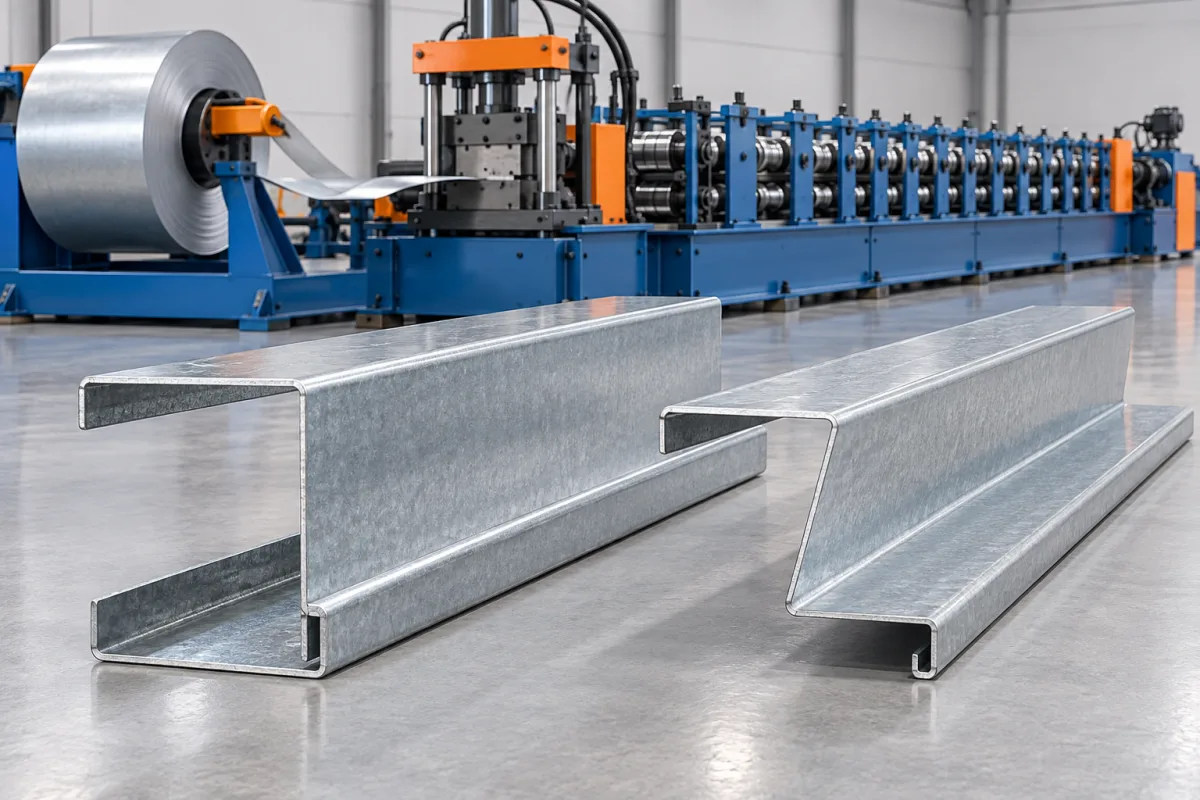
A CZ purlin roll forming machine makes C-shaped and Z-shaped steel members on a configurable production line. The buying decision is not simply whether a machine can produce both letters. It is whether it can make your actual section sizes, steel grades, hole patterns and order mix with an acceptable changeover process.
What does a CZ purlin machine produce?
A C section has its principal flanges on the same side of the web; a Z section has them on opposite sides. Return lips, flange dimensions and hole arrangements further define the finished member. Two sections with the same nominal web depth can therefore require different production settings and connection details.
Start with the approved part drawing and its revision. The machine quotation should identify the C and Z sections it covers, rather than simply saying “C/Z compatible.” Treat U channels, eave members and other additional profiles as separate scope items unless they are explicitly included. A successful forming trial does not establish the permissible span or load capacity of a building member.
Where does this machine fit in a production business?
A combined line is worth evaluating when a workshop needs both section families and expects repeated changes of size or order. Its value depends on the actual work schedule: mixed short orders emphasize changeover and first-piece checking, while long repeat runs place more emphasis on stable production, material handling and finished-member removal.
Compare a combined CZ line with a dedicated C line, a dedicated Z line, or separate lines using the same representative order list. A single line concentrates both product families on one production resource. Separate equipment may permit parallel orders but also requires its own tooling, space, staffing and handling arrangements. There is no universally better layout without those inputs.
How does a CZ purlin line work?
A useful process review follows the material from the incoming coil to an inspected, identified member. The exact order of punching, forming and cutting depends on the proposed line; request its actual layout rather than assuming every supplier uses the same arrangement.
- Coil preparation and entry: establish the incoming coil specification, loading method, strip guidance and any leveling requirement.
- Hole and feature production: locate web or flange features from the part drawing. Confirm which features are made before or after forming.
- Progressive section forming: develop the web, flanges and returns through the roll tooling. Review the proposed adjustments for different dimensions and material.
- Length control and cutoff: define the finished length reference, cutting arrangement and support of the section at the cut.
- Takeoff and inspection: support long members, identify the order and verify the agreed dimensions and hole positions before accepting production.
C-to-Z switching is not the same as changing size
Ask the supplier to separate four operations: changing web depth, changing flange or lip dimensions, changing material thickness, and switching the section from C to Z. A control described as automatic may cover one operation without covering all four. Public equipment descriptions show that purlin-line changeover approaches vary; the label alone is not enough to compare them.
For a useful demonstration, begin with an accepted C member and finish with an accepted Z member. Record manual work on guides, roll tooling, punch tools, cutoff support and the part program. Include first-off inspection and any setup scrap. Then repeat the change in the reverse direction. Timing only the movement of the forming stands leaves out work that the operator still has to perform.
Which dimensions belong in the specification?
Provide a section matrix listing the combinations you actually intend to sell. Include web depth, flange dimensions, lip dimensions, bend radii, base-metal thickness, material grade and hole pattern. Identify unequal flanges or an asymmetric Z section explicitly. State whether the drawing dimensions are internal, external or referenced to a centerline.
Do not combine independent maximum values into an assumed operating point. The largest web dimension, the thickest strip and the strongest proposed steel may not be a supported combination. Ask the supplier to mark each requested combination as included, excluded or subject to a trial, and retain that marked matrix with the quotation.
An illustrative drawing brief—not a machine rating
A hypothetical enquiry could describe a C member with a 200 mm web, 70 mm flanges, 20 mm lips and 2.0 mm base-metal thickness. This is only an example of how to organize drawing inputs, not a recommended structural section or a claim of RollVanta capacity. The enquiry still needs grade, radii, tolerances, holes, connections and measurement datums before feasibility can be evaluated.

How should punching and cutoff be specified?
Send the hole schedule with the section drawing. Distinguish round holes from slots, web features from flange features, and repeated pitch from order-dependent locations. Show the reference to the finished cut end. If the line must produce several lengths with different end-hole positions, include those examples in the acceptance trial.
Inspect holes on the completed member, not only on the flat strip. Check whether tooling changes are required for another hole size or section family, how the program handles the end of a coil, and how unusable remnants are identified. A quotation should make clear which punch tools and cutoff tools are included and which are optional.
How much usable output will the line deliver?
Compare accepted members over a representative working period rather than choosing by an isolated forming-speed figure. Include loading, threading, punching, cutting, size changes, inspection and unloading. Ask whether a speed quoted for unpunched material still applies to the required hole pattern and lengths.
An illustrative calculation makes the distinction clear: 120 accepted members, each 6 m long, represent 720 m of accepted output. If the complete trial occupies two hours, the average is 360 m per hour over that trial. These numbers are arithmetic examples, not an equipment performance claim. Record rejected pieces and setup time separately so different proposals can be compared on the same basis.
What changes the price of a CZ purlin line?
There is no reliable single price without a defined equipment scope. Compare the supported section matrix, changeover method, hole-making capability, coil handling, controls, cutoff arrangement, takeoff equipment, installation responsibilities and acceptance work. Separate production hardware from spare tooling, training and additional profile development.
Ask each supplier to return a clear included/excluded list against the same brief. A lower machine-only quote is not automatically a lower cost for an operational production system. Conversely, paying for automatic features that the order mix rarely uses may not be justified. Keep the commercial comparison tied to the work the business will actually perform.
What should a factory acceptance trial check?
- Identity: drawing revision, material grade and thickness, coil identification, settings and the measurement method used.
- Section geometry: the required web, flanges, lips and radii, with straightness, twist and end condition assessed under agreed criteria.
- Features: hole sizes, pattern and position relative to drawing datums and the finished cut end.
- Repeatability: the first accepted piece, pieces from steady production and pieces following a representative changeover.
- Order performance: accepted quantity, rejects, actual changeover work, handling steps and unresolved deviations.
- Handover: the accepted scope, operating documentation, tooling identification and the agreed support responsibilities.
Use criteria agreed with the responsible supplier and product engineer. Machine acceptance is not a replacement for structural design, connection verification or approval of the finished building system. Do not infer compliance from the visual appearance of a sample.
Common specification mistakes to avoid
Using a profile name as a complete drawing: a name such as C200 does not communicate every flange, lip, radius or hole detail. Equating automated movement with complete changeover: tooling handling and inspection can remain manual. Comparing unmatched trials: different material, lengths and hole patterns make headline output figures difficult to compare.
Ignoring downstream handling: long members still need an organized removal and storage route. Accepting a generic capacity range: request the actual combinations in the section matrix. Mixing machine and building claims: producing the section does not establish its load-bearing suitability.
Frequently asked questions
Can one machine make every C and Z size?
No such universal capability should be assumed. Ask for a supported matrix of geometry, thickness and grade, together with the tooling or setup changes required. Similar nominal sizes can have different functional details.
Does automatic C/Z switching eliminate manual setup?
Not necessarily. Check what happens to coil width, hole tooling, cutoff tooling, guides and first-piece approval. Obtain a demonstration for your intended pair of sections rather than relying on an unspecified automatic-changeover claim.
Should holes be punched before or after forming?
Evaluate the proposed route against feature access, dimensional requirements, material and tooling. Ask the supplier to show how the finished hole positions are achieved and verified. Do not select the sequence independently of the part and line design.
Can I obtain an accurate quote from only a keyword or photo?
A keyword can start the discussion and a photograph can help describe the application, but neither defines the full production requirement. Supply drawings, materials, lengths, hole schedules, the order mix and required included equipment before treating a price as comparable.
Prepare a quote-ready project brief
Collect the C/Z drawings and revisions, the section matrix, material specifications, hole schedules, representative order quantities and lengths, required changeovers, site utilities and the intended acceptance checks. Flag unknown inputs instead of replacing them with assumed ratings. The downloadable RollVanta brief is a way to organize that information; this local demonstration does not submit a real equipment order.
Continue your research
- Purlin Roll Forming Machines
- C Purlin Roll Forming Machine
- Z Purlin Roll Forming Machine
- 80-300mm CZ Purlin Roll Forming Machine
- 100-400mm CZ Purlin Roll Forming Machine
- Automatic Size Change CZ Purlin Machine
- How Purlin roll forming machine Works
- How To Choose a Purlin roll forming machine
- Purlin roll forming machine Price: What Affects the Cost?
Configuration & specification inputs
Match the configuration to your section drawing, material and production requirements.
| Parameter | Requirement / confirmation needed |
|---|---|
| Profile geometry | Web height, flange width, lips, hole pattern and C/Z orientation |
| Material | Specified galvanized or uncoated structural steel grade |
| Thickness & grade | Specify base-metal thickness and grade; operating range requires supplier verification. |
| Process route | Payoff → leveling → punching/notching → adjustable forming → cutoff → dimensional inspection |
| Cutting | Confirm profile-supported cutoff, cut lengths, end quality and any secondary operations. |
| Output | Define accepted output per shift with the actual profile and material. |
| Electrical supply | Buyer to state voltage / frequency / phase. Installed power requires a confirmed equipment schedule. |
| Acceptance | Measure the web, flanges, lips and straightness, and check holes against their drawing datums. Verify both ends after cutting. For a size-changing line, include the smallest and largest agreed sections in acceptance trials. |