
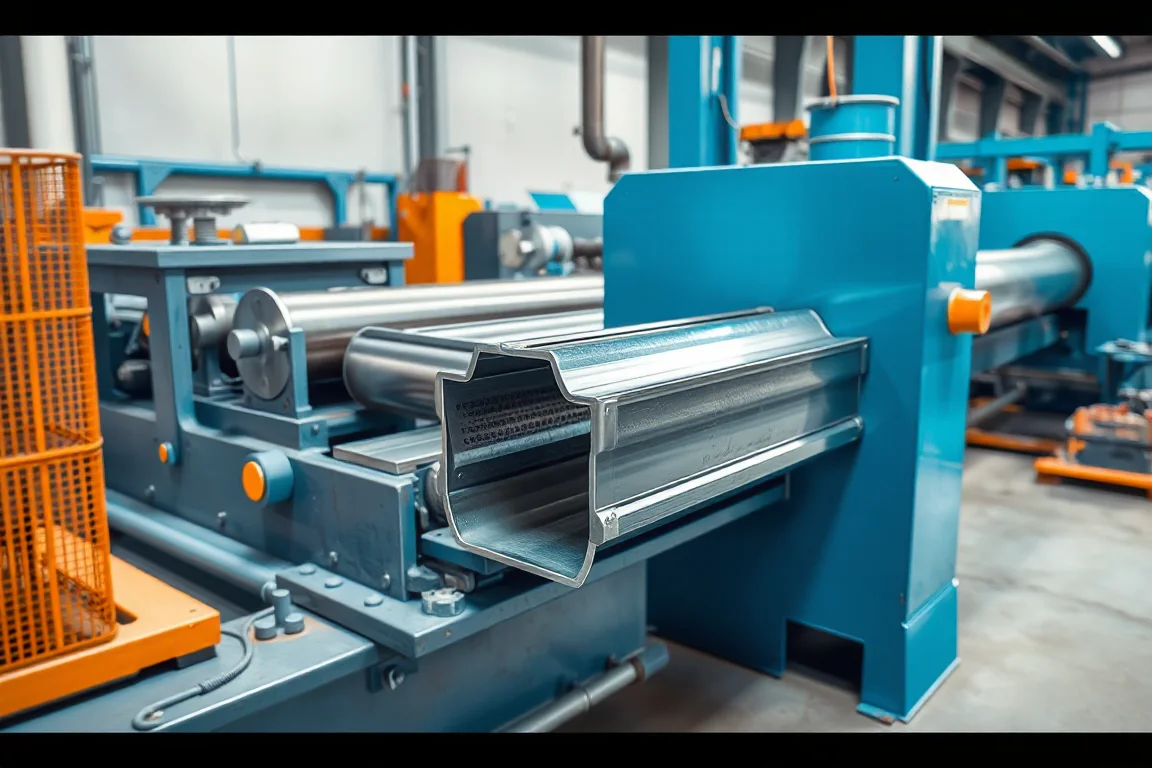
A box gutter is not simply a folded strip. It is a drainage channel with a rectangular or near-rectangular cross-section, an open top, a base, two sides and usually one or more edge treatments such as a bead, hem, stiffening fold or return lip. It collects rainwater along a roof edge or valley and must join to outlets, stop ends, brackets and supports. A box gutter roll forming machine is therefore judged by how well it reproduces the drawing and produces consistent connections, not by the number of passes alone.
The machine family sits within gutter and downspout roll forming equipment, but it should not be confused with K-style, half-round, round downspout, square downspout or rectangular downpipe lines. Each of those has a different cross-section and a different closure logic. A box gutter line forms an open section. Downpipe lines often form a closed or seamed tube. Elbows and outlets are usually secondary components, and a gutter former alone does not create them.
What the profile drawing must define before tooling is discussed
The starting document is the complete gutter cross-section. It should show the outside width across the open top, the base width, side height, corner radii, material thickness and any edge detail. A bead adds stiffness and gives a safer or neater edge. A hem folds material back on itself and can hide a cut edge. A stiffening rib or return lip changes the bending sequence and may require additional forming stations.
Support details belong on the same drawing set because they often dictate features that the roll former must produce. Brackets, hangers, clips, stop ends and outlet collars engage the gutter in specific ways. If the gutter has a rolled lip, the bracket may hook over it. If the gutter is a plain open channel, the support may wrap underneath or clamp the sides. The roll former must reproduce the mating geometry consistently enough for those attachments to fit without field drilling or deformation.
Material also changes the forming route. Coated steel and aluminum can be formed on tooling designed for their thickness, yield behaviour and coating durability. Copper is a different case. It work-hardens, marks easily and may need different lubricants, roll finishes and springback allowances. Copper should be reviewed as its own process rather than treated as a colour change on a steel line.
Open section forming versus closed seam forming
A box gutter remains open. The forming train progressively bends the strip into a channel, but it does not close a tube seam. The critical interfaces are the two upper edges, the internal corners, the base and any joining feature. Edge closure means completing the bead, hem or return lip, not welding a tube shut.
A downpipe line has a different task. Round and square downspouts often require a seam that closes along the length. That changes the roll sequence, the use of seam guides, the cutoff support and the inspection criteria. When a supplier offers both gutter and downspout capabilities, the two should be quoted as separate forming duties even if they share a decoiler or a common line frame.
The distinction matters in production planning. An open gutter section can be stacked and nested to some extent. A closed downpipe is a tube that must be handled without crushing. Outlets and elbows are separate operations. An elbow is normally produced by a defined secondary forming process, not by the gutter line. Outlet holes and collars may be punched or formed on a separate press or workstation. If the intended business sells complete rainwater systems, those secondary operations must appear in the equipment scope.
Coil payoff, section forming, edge closure and cutoff
A typical process route is coil payoff, section forming, edge or seam closure, then cutoff. On a box gutter line, the sequence after forming is edge completion and cutting to length. The decoiler feeds the strip. The forming stations create the cross-section. Additional stations or a separate unit complete the bead or hem. The cutoff then separates the finished length.
The cutoff deserves attention because an open box section is less rigid than a closed tube. A flying shear or stationary cut can distort the profile if the die does not support the inside and outside of the section. The cut quality matters at the ends, because those ends meet stop ends, outlets, joint sleeves or adjoining gutter lengths. A burr, flare or crushed corner can compromise the joint. The buyer should confirm that the proposed cutoff is profile-supported, that cut lengths can be set for the intended range, and that any secondary operations such as notching or punching are identified.
Straightness is another practical output. A gutter that curves or twists will not sit correctly on brackets or line up with the next length. Straightness depends on the forming sequence, the strip condition, the alignment of the roll stands and the way the part is supported as it leaves the line. The machine alone does not correct a coil with edge-wave or poor flatness.
How box gutters differ from K-style, half-round and downpipe profiles
K-style gutter has a decorative front face and a shaped back, and it usually hangs from a fascia. Half-round gutter is a semicircular channel with a rolled front edge. Both are open, but their cross-sections and hanging methods differ from a box gutter. A box gutter often sits in a valley or behind a parapet, and its supports may be concealed. The profile drawing reflects that.
Downpipe and downspout lines produce tubes that carry water vertically. Round downspout lines form and seam a circular tube. Square or rectangular downpipe lines form a closed box section with a seam. A box gutter line forms an open box channel and usually leaves the ends open for outlets and stop ends. None of these lines should be assumed to produce elbows, shoes or outlet fittings without a separate process. A buyer comparing a box gutter machine with a downpipe machine should compare the complete part list for the intended rainwater system, not just the headline profile.
Where press braking competes with continuous roll forming
Press braking is a valid alternative for box gutters, especially where sections are long, building-specific or produced in low volume. A press brake can form a large open channel from flat sheet with adjustable tooling and can accommodate changes in width or depth by setup rather than new rolls. For a fabricator making a small number of bespoke gutters, that flexibility can be more practical than dedicated continuous tooling.
Roll forming becomes attractive when the same cross-section repeats in quantity and the business needs consistent lengths with less per-part labour. The trade-off is setup and tooling commitment. A dedicated line locks in a profile family. Changeover to a different width or depth may require different rolls or significant adjustment. A press brake can also form features that are difficult on a roll former, such as large tapered transitions or very deep sections.
The decision should follow the order book and the profile range. If the business expects a few standard box gutter widths in repeatable runs, a roll forming line can support steady output. If every job is a different size and quantity is low, a press brake route may be more realistic. Hybrid approaches also exist, where roll forming produces the main section and secondary press work creates outlets, stop ends or special transitions.
Assembly boundaries: what the line does and does not make
The roll forming line makes formed lengths of gutter. It does not make the complete roof drainage installation. Outlets, stop ends, brackets, joint sleeves, downpipe connections and elbows are separate components. Some may be formed on the same line with additional tooling, but they are not automatically included in a basic gutter line.
This boundary affects quotation comparison. Two offers may look similar if both describe a forming line and a cutoff, yet one may exclude the punching of outlet holes or the supply of joining clips. The buyer should list every component in the intended product catalogue and mark which ones the proposed scope will produce, which will be bought in, and which will be fabricated on other equipment.
Certification and in-service performance are also separate from the forming process. A machine does not certify a gutter for a building. Drainage capacity, structural support, fire performance, wind loading and local code compliance belong to the installation design and the responsible designer. The roll former's contribution is dimensional consistency, edge quality and the ability to reproduce the specified profile.
Inspection and acceptance checks for box gutter production
First-off inspection should confirm the cross-section against the drawing. Check the open width, base width, side height, corner form and edge detail. Check squareness of the ends and straightness along the length. Check that the bead or hem is closed consistently and that the cut end is clean enough to accept the intended joint.
For any downpipe or closed seam component produced on a related line, check the seam, the tube dimensions and the fit with mating outlets or elbows. For gutter lengths, check how the open section is supported at takeoff and packing, because handling can distort an unsupported channel. Verify that joint components supplied with the system match the formed ends.
Hydraulic drainage sizing belongs to the installation design and should not be inferred from a machine's width adjustment. A wider former does not prove a gutter will carry a given flow. The acceptance test should use the agreed material and profile, not an easier substitute. Inspect a first-off piece and a representative sample from steady production with the agreed gauges. Record changeover steps, setup scrap and unloading time so that the production target reflects real conditions.
Practical procurement checklist
- Provide the complete cross-section drawing, including bead, hem or return lip, and identify all mating components.
- State the base-metal thickness and grade for each material, and ask how the proposed line handles that range without assuming universal capacity.
- Confirm the process route from coil payoff through forming, edge closure and cutoff, and identify any secondary operations.
- Ask how the cutoff supports the open profile and what end quality results.
- List the electrical supply characteristics and request a confirmed equipment schedule for installed power.
- Define accepted output per shift using the actual profile and material, not a demonstration substitute.
- Check how the open section is supported at takeoff and packing.
- Verify squareness, straightness and the fit of joint components.
- Confirm whether outlets, elbows or stop ends are in scope or supplied separately.
- Compare the written equipment scope with all secondary operations needed for a finished saleable part.
Comparison of production routes for box gutter components
A dedicated roll forming line suits a repeating cross-section and a business that sells formed lengths in quantity. It can reduce per-part labour and produce consistent long runs. Its limitations are tooling commitment and changeover time when the profile changes. A press brake route suits low volume, bespoke sizes and large or awkward sections. It offers flexibility but higher labour per part and less consistency over long runs. A hybrid route uses roll forming for the main gutter profile and press or secondary operations for outlets, stop ends and transitions. That can match a wider product catalogue, but it requires clear process ownership and inspection at each stage.
None of these routes establishes drainage capacity, support spacing or code compliance. Those are design decisions. The machine choice should follow the part definition, the expected order pattern and the secondary component strategy.
Frequently asked questions
Can a box gutter roll forming machine also make downpipes?
Not as a rule. A box gutter line forms an open channel. A downpipe line forms and often seams a closed tube. Some suppliers build combination lines, but the forming duties, cutoff support and inspection criteria differ. Treat gutter and downpipe production as separate requirements unless the proposed scope specifically includes both with their own tooling.
Does the machine produce elbows and outlets?
Usually not. Elbows normally require a defined secondary forming process, and outlets may be punched, collared or assembled on separate equipment. A gutter line produces formed lengths and cuts them to length. If the intended business sells complete rainwater systems, those secondary operations must be quoted and inspected separately.
How do I decide between roll forming and press braking for a box gutter?
Compare the order pattern and the profile range. A repeating cross-section in quantity favours a dedicated roll forming line. Low volume, large sections or frequent dimensional changes may favour press braking. The decision should follow the complete part list, not just the gutter channel, because outlets and joints may need separate processes in either route.
What should be inspected on a first-off box gutter length?
Check the cross-section dimensions against the drawing, the bead or hem, corner form, straightness, squareness of the ends and the cut quality. Then check the fit with the intended joints, brackets and any outlet or stop end. Do not rely on a demonstration piece made from a different material or thickness.
Why does copper require a separate process review?
Copper behaves differently from coated steel and aluminum. It work-hardens, marks readily and has different springback characteristics. Tooling, lubrication and roll finish may need to change, and forming sequences that work for steel may not transfer directly. Copper should be assessed as its own material case rather than as a finish option.
How should output be defined when comparing machines?
Output should be defined as accepted lengths per shift using the actual profile and material, including coil loading, changeover, setup scrap and unloading. A line speed figure alone does not describe installed productivity. The buyer should record the steps and time for a realistic production cycle and compare that with the written equipment scope.

Continue your research
- Gutter & Downspout Roll Forming Machines
- Gutter Roll Forming Machine
- Downspout Roll Forming Machine
- K Style Gutter Roll Forming Machine
- Half Round Gutter Roll Forming Machine
- Round Downspout Roll Forming Machine
- How Gutter roll forming machine Works
- How To Choose a Gutter roll forming machine
- Gutter roll forming machine Price: What Affects the Cost?
Configuration & specification inputs
Match the configuration to your section drawing, material and production requirements.
| Parameter | Requirement / confirmation needed |
|---|---|
| Profile geometry | A box gutter has a drainage cross-section and often building-specific support details. Large or low-volume sections may favor press braking over dedicated continuous tooling. |
| Material | Coated steel or aluminum; copper requires its own process review |
| Thickness & grade | Buyer to specify base-metal thickness and grade; operating range requires supplier verification. |
| Process route | Coil payoff → section forming → edge/seam closure → cutoff → outlets or elbows as separate operations |
| Cutting | Confirm profile-supported cutoff, cut lengths, end quality and any secondary operations. |
| Output | Define accepted output per shift with the actual profile and material. |
| Electrical supply | Buyer to state voltage / frequency / phase. Installed power requires a confirmed equipment schedule. |
| Acceptance | Check how the open section is supported at takeoff and packing. Verify squareness and matching joint components. Hydraulic drainage sizing belongs to the installation design and should not be inferred from a machine's width adjustment. |