
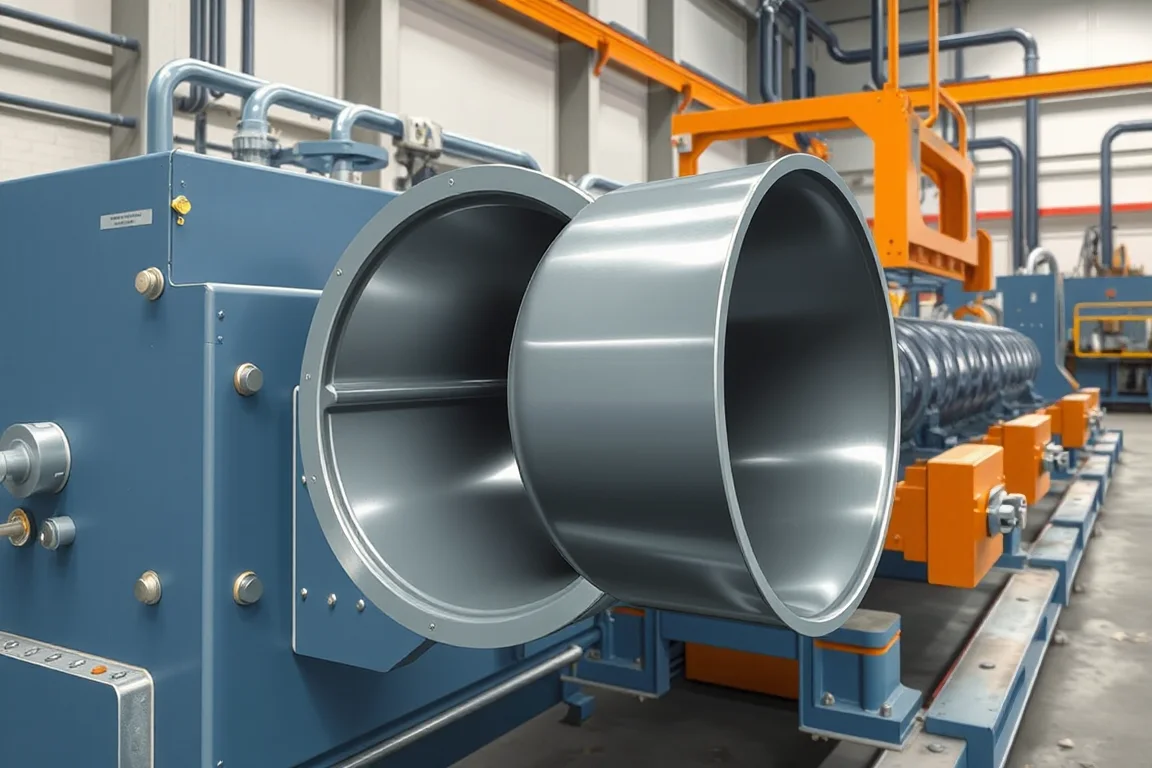
A round downspout roll forming machine produces the cylindrical or near-cylindrical downpipe that carries water from a roof gutter or outlet down to a drainage point. Unlike a gutter former, which shapes an open section that stays open, a downspout line must form a closed profile and join its edges into a seam. That seam and the roundness of the finished pipe are the two features that most affect how the downpipe fits elbows, outlets and brackets in service.
The machine is only part of a rainwater system. The complete roof drainage detail still has to be designed for the building; the former does not establish drainage capacity. This article explains the component interfaces, the production route, where assembly and secondary operations begin, and how to inspect what the line actually produces.
Profile and Interface Basics for a Round Downspout
A round downspout is defined by its outside diameter or its formed circumference, its wall material, its seam type and its end conditions. The roll formed body is a tube with a longitudinal joint. Depending on the design, that joint may be a locked seam, a folded seam, a snap seam or a simple butt seam prepared for a separate closing step. Each seam style changes how the forming rolls must guide the strip, and each changes what the operator must inspect at the exit end.
The interfaces around the pipe matter as much as the pipe itself. An outlet connects the gutter or hopper to the top of the downpipe. Elbows change direction. Brackets or clips hold the pipe against the wall. A shoe or spreader discharges water at the bottom. All of these mating parts have their own inside or outside dimensions and their own tolerance needs. A line can form a perfectly round pipe that still does not fit an outlet because the two were not designed as a pair.
Why Seam Closure and Roundness Are the Defining Challenges
An open gutter section can tolerate slight variation in edge position because nothing has to close. A round downspout cannot. The strip edges must meet in a controlled way along the full length, and the seam must stay closed after cutoff, handling and stacking. If the seam opens, the pipe loses stiffness and can leak at the joint. Roundness control is related: if the rolls overform one area, the cross-section becomes oval, and oval pipe does not seat cleanly in round sockets or elbows.
Seam closure is usually achieved by dedicated closing rolls or a separate closing station after the main forming passes. The correct sequence depends on the seam type and material. Coatings change the picture: a coated steel or aluminum strip can be formed, but the coating at the seam may be compressed, and a copper strip requires its own process review because its forming behavior and surface handling differ from coated steel or aluminum.
Material Choices and What They Change
Coated steel and aluminum are common substrates for round downspouts. Coated steel offers stiffness and takes a seam well, but the coating must survive the forming and closing passes without cracking at the bend radii. Aluminum is lighter and easier to form in some gauges, but it is softer and can mark or deform during handling. Copper is sometimes selected for appearance and durability, but it should not be assumed to run on the same tool set as coated steel or aluminum. Copper requires its own process review because the material flow, springback and surface protection needs differ.
The buyer should specify the base-metal thickness and grade. A machine's operating range is not a claim that every thickness in that range will produce an acceptable round downspout with a given seam. Thickness affects roll pressure, seam formation and cutoff quality. The material and the profile should be reviewed together, not as independent choices.
Production Route: From Coil to Cut Length
A representative round downspout production route is: coil payoff, then section forming, then edge or seam closure, then cutoff. Outlets or elbows are separate operations, not part of this main sequence. The payoff stage feeds strip at a controlled rate and keeps it aligned. The forming stations progressively bend the strip into an open or nearly closed round section. The closure stage joins the edges into the intended seam. The cutoff separates the finished pipe at the required length.
This route produces a cut length of round downspout. It does not produce a complete drainage assembly. That distinction matters when comparing quotations, because a line described only as a former may leave the buyer to source elbow forming, outlet punching, end crimping or swaging elsewhere. The written equipment scope should be compared with every secondary operation needed for a finished part.
Where Assembly and Secondary Operations Begin
Assembly begins after the downspout leaves the line. Crimping or swaging an end so it slips into the next fitting is typically a separate operation. Punching or drilling for outlets, brackets or fasteners is usually separate as well. Elbows are normally made on dedicated equipment or purchased as fittings. Outlets may be formed, cast or fabricated depending on the system. Each of these steps has its own tooling, its own setup and its own inspection needs.
Certification and in-service performance also sit outside the forming line. A former does not certify a drainage system, and it does not establish that a building meets local requirements. The line produces a component; the designer, installer and authority having jurisdiction establish the system. Keeping production, assembly, certification and in-service performance separate prevents overclaiming what a machine can do.
Cutoff Requirements and End Quality
Cutoff for a round downspout must be profile-supported. The cut must leave an end that is square enough to mate with the next fitting and clean enough that the seam does not unravel. Cut length accuracy matters when pipes are joined in a run, because cumulative error shows up at the outlet or the shoe. Some lines use a flying cutoff that moves with the strip; others use a stationary cut after the line stops. The right choice depends on the profile, the material and the intended production rhythm.
End quality is easy to overlook. A burr at the cut can interfere with a slip joint. A crushed end can make an elbow impossible to seat. The cutoff station and the handling after it should be reviewed together, because a good cut can still be damaged by how the pipe is removed and stacked.
Comparing Production Alternatives for Round Downspouts
There are several ways to make round downspouts, and they differ in flexibility, tooling and the kind of work they suit.
- Dedicated roll forming line. Forming stations are built around one profile family and one seam style. This route suits repeat production of a known downspout size where setup time per piece is low. It offers less flexibility if the profile or seam must change often.
- Convertible or adjustable line. Some stations can be repositioned or swapped to cover more than one diameter or seam. This increases flexibility but adds setup steps, changeover scrap and operator skill requirements. It can be a reasonable choice when a fabricator offers several downspout sizes.
- Purchased tube or pipe. Buying preformed round tube and cutting, seaming or finishing it separately avoids roll forming investment but gives up control over seam type, coating condition and cut length. It may suit low volume or a business that primarily installs rather than manufactures.
- Bench or job-site forming. Portable or site-based forming can reduce transport of long pipes but usually has a narrower profile range and lower output. It may suit repair and small custom work rather than volume production.
The comparison should be made against the actual business: what downspout sizes are offered, what materials are run, how often changeover occurs, and whether elbows and outlets are made in-house or bought. A line that is fast on one profile but slow to change over may not suit a business that quotes many small custom jobs.
What to Inspect on a Round Downspout Line
Inspection should follow the finished component. For a round downspout, check the seam consistency along the length, not just at one point. Check roundness after the normal handling process, because a pipe that is round at the cutoff can become oval after being moved or stacked. Check cut length against the drawing. Check the end for burrs, deformation or a partially opened seam. Then trial the intended elbows, outlets and sleeves, since fit is an assembly property, not a line property on its own.
For gutters, the equivalent checks focus on the bead or hem, straightness and joining fit. A downspout line's checks focus on seam and roundness. Where a line is claimed to cover both open and closed profiles, the inspection plan should include both sets of features.
Electrical Supply and Installed Power
The buyer should state the voltage, frequency and phase available at the intended site. Installed power requires a confirmed equipment schedule, because the total load includes the main drive, any auxiliary motors, the cutoff and any separate secondary equipment. A quotation that lists only the main former may not include the power needed for closing rolls, handling or extraction. Reviewing the supply against the full schedule avoids a mismatch at installation.
Practical Checklist Before Approving a Round Downspout Line
- State the downspout profile drawing, including diameter or formed circumference and seam type.
- State the base-metal thickness and grade, and the material family, including whether copper is involved.
- Confirm which operations the line performs: forming only, forming plus seam closure, or forming through cutoff.
- List every secondary operation needed for a finished part: crimping, swaging, punching, elbow forming, outlet fitting.
- Run the agreed material and profile, not an easier demonstration substitute.
- Inspect a first-off piece and a steady-production sample with agreed gauges.
- Check seam consistency along the length and roundness after normal handling.
- Trial the intended elbows, outlets and sleeves on the produced pipe.
- Record changeover steps, setup scrap, punching time and unloading time.
- Compare the written equipment scope with all secondary operations for a finished part.
- Confirm the electrical supply and the full installed power schedule.
FAQ: Round Downspout Roll Forming Machines
Does a round downspout roll forming machine also make elbows?
Usually not. Elbow production normally requires a defined secondary forming process or purchased fittings. The main line forms the straight pipe body and closes the seam. If a quotation does not clearly state elbow capability, the buyer should treat elbows as a separate item and confirm where they will be sourced.
Can the same line run coated steel, aluminum and copper?
Not automatically. Coated steel and aluminum are often both considered, but each has different forming behavior, coating sensitivity and springback. Copper requires its own process review because its material flow and surface handling differ. A tool set validated for one material should not be assumed to produce an acceptable round downspout in another.
Why does seam type affect the forming sequence?
The seam type determines how the strip edges must be guided and closed. A locked seam needs specific closing geometry, while a snap seam needs a different final pass. The forming stations before closure must deliver the edges in the right position and angle for that seam. Changing seam type without reviewing the sequence can produce an open or distorted joint.
What does profile-supported cutoff mean for a round downspout?
It means the cutoff is designed to act on the round profile without collapsing or distorting it. A cut that works on a flat strip may crush a closed tube. The cutoff should support the section during the cut so the end remains round, the seam stays closed and the cut length stays accurate for joining and fitting.
How should output be defined for a downspout line?
Output should be defined as accepted pieces per shift with the actual profile and material, not as a standalone line speed. Changeover steps, setup scrap, handling and unloading time all reduce usable output. Comparing line speed alone can overstate what a business will actually produce in a working day.
What should be checked before accepting a produced downspout?
Check the seam along the full length, roundness after normal handling, cut length, and end quality for burrs or deformation. Then trial the intended elbows, outlets and sleeves, because fit depends on the pipe and the mating parts together. The drainage design itself remains a building and local-requirements matter, not something the machine verifies.

Continue your research
- Gutter & Downspout Roll Forming Machines
- Gutter Roll Forming Machine
- Downspout Roll Forming Machine
- K Style Gutter Roll Forming Machine
- Half Round Gutter Roll Forming Machine
- Box Gutter Roll Forming Machine
- How Gutter roll forming machine Works
- How To Choose a Gutter roll forming machine
- Gutter roll forming machine Price: What Affects the Cost?
Configuration & specification inputs
Match the configuration to your section drawing, material and production requirements.
| Parameter | Requirement / confirmation needed |
|---|---|
| Profile geometry | A round downspout requires seam closure and roundness control. Include elbows and outlets in the fit check, while confirming which are made on separate equipment. |
| Material | Coated steel or aluminum; copper requires its own process review |
| Thickness & grade | Buyer to specify base-metal thickness and grade; operating range requires supplier verification. |
| Process route | Coil payoff → section forming → edge/seam closure → cutoff → outlets or elbows as separate operations |
| Cutting | Confirm profile-supported cutoff, cut lengths, end quality and any secondary operations. |
| Output | Define accepted output per shift with the actual profile and material. |
| Electrical supply | Buyer to state voltage / frequency / phase. Installed power requires a confirmed equipment schedule. |
| Acceptance | Trial the intended elbows, outlets and sleeves. Identify separate crimping, swaging or end-forming operations where needed. Inspect seam consistency along the length and roundness after the normal handling process. |