
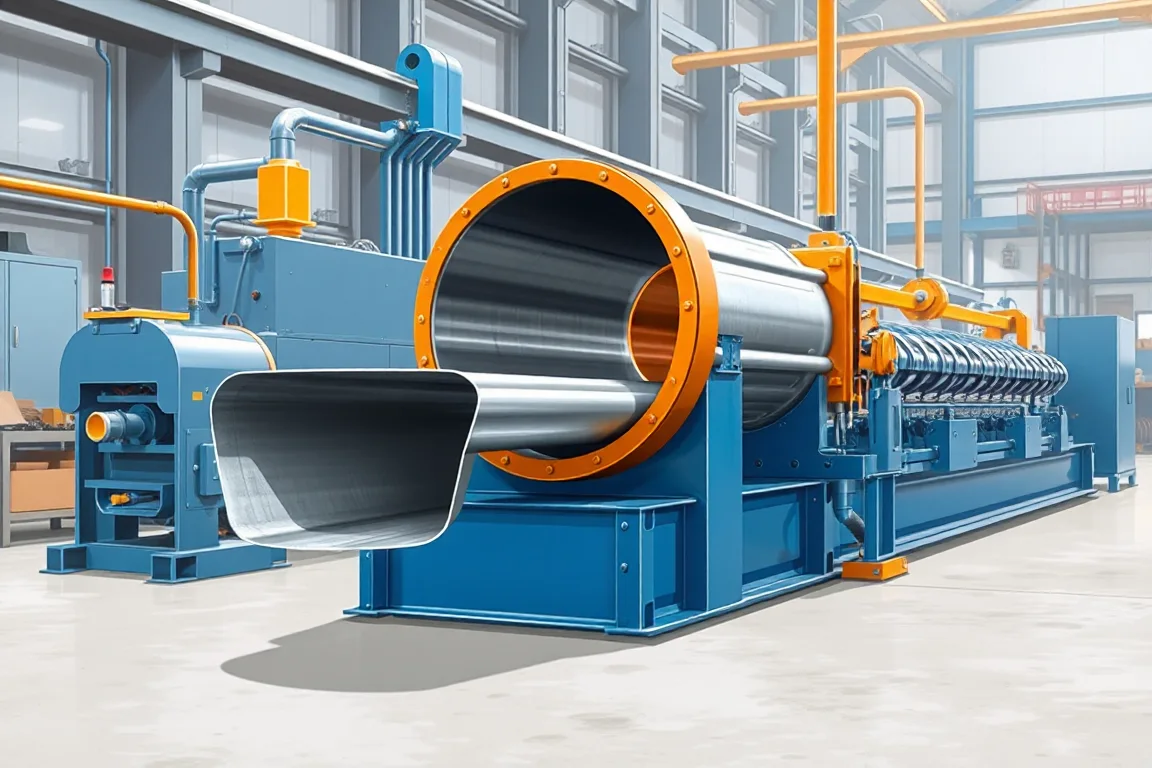
A downspout roll forming machine produces the closed longitudinal sections used to convey rainwater in a specified drainage system. The cross-section can be round, square, rectangular or another defined shape, and its seam, ends and accessory fit are central parts of the manufacturing requirement.
The equipment should be selected around the complete straight downspout product. Elbows, offsets, outlets and connection fittings usually need their own operations or supply routes. A straight-section former is not automatically a complete rainwater-pipe and fitting factory.
Which downspout profile is intended?
Provide the complete cross-section, including corner radii, stiffening ribs where required and the longitudinal seam. Nominal size alone is insufficient because different products can have different internal clearances, seam positions and mating-end arrangements.
Identify the intended elbows, outlets and couplers. Their fit should guide the dimensional references used in tooling and inspection. A similar-looking pipe from another system should not become the acceptance reference without a controlled comparison.
What should the seam specification show?
Define how the strip edges meet and how the seam is closed. The seam construction affects tool development, access and the final section. Its location can also matter to appearance, accessory fit or later elbow manufacture.
- Complete seam geometry and closing method.
- Section dimensions and corner details.
- Material, thickness and finish.
- Required end preparation and overlap relationship.
- Length range and accessory references.
- Inspection criteria for the completed section.
Do not assume that any closed-looking joint meets the selected product requirements. The production trial should inspect the specified seam condition and the complete formed section.
How does the forming route work?
The strip is guided from the coil, developed through the required walls or curvature, and brought toward the defined longitudinal closure. The seam is completed by the proposed method, then the product is cut and prepared for its next operation.
- Confirm the released profile, material and finish.
- Guide the strip and develop any specified ribs or edge preparation.
- Progressively form the round or polygonal section.
- Complete the longitudinal seam.
- Cut the ordered lengths without unacceptable section damage.
- Perform included end preparation, inspect and identify accepted downspouts.
The detailed sequence depends on the machine. Ask which operations are integrated and which require separate equipment, especially where the delivered product needs a particular mating end.
How should material and finish be reviewed?
Specify grade or alloy, base-metal thickness, strip width and coating for each profile. Material response affects corners, seam formation and later fitting operations. Aluminum, coated steel and other metals should not be treated as equivalent solely because the section size is similar.
Use the actual finish in trials and inspect broad surfaces, ribs, corners and seam areas. Surface damage can arise during closure or handling after the main shape is formed. Record those stages separately to locate the source.
Retain coil and color identity with the order. Similar downspouts with different materials or finishes need clear labels, particularly when they are paired with elbows or fittings made on another route.
What changes between round and rectangular sections?
The forming progression and seam presentation differ with the geometry. Rectangular products need defined corners and wall relationships, while round products have their own diameter and roundness targets. A nominally adjustable machine should not be assumed to cover both without the required tools.
Request a configuration matrix showing rolls, guides, seam tools, cutting parts and end-forming equipment for each profile. Demonstrate a relevant change and return to the original accepted setup.
Include accessory fit in the changeover trial. A newly formed section can satisfy a broad outside measurement while failing to mate with the intended elbow or outlet.
How should end connections be specified?
Show the relationship between adjoining parts, including any reduced, expanded, crimped or otherwise prepared end required by the system. Identify which end receives that treatment and the finished references used for measurement.
End preparation may occur on a separate machine. Include its cycle, tooling and inspection in the production plan if ready-to-connect downspouts are the required output. A cut straight tube is a different deliverable from a finished mating section.
Assemble representative downspouts and fittings without improvised reshaping. Check alignment and the defined overlap or engagement. Do not assume that a loose or forced fit is acceptable merely because the pieces can eventually be connected.
Why should elbows be considered before buying the straight former?
The straight section may become input for a separate elbow process, or elbows may be purchased from another source. In either case, their geometry and seam relationship should be compatible with the straight product.
If elbow manufacture is planned in-house, review the actual blank requirements with that equipment. Cross-section, material, seam orientation and end condition can matter to the downstream operation. A generic straight-pipe sample is not enough to establish compatibility.
Keep the supply boundary explicit. Producing straight downspout does not mean the line bends every angle or offset required by a drainage installation.
What should section and seam inspection include?
Measure the completed section at representative locations and inspect the seam condition along its length. Check corners or roundness, straightness and local end distortion separately. A short selected sample may not represent a full commercial piece.
Where the product specification requires an additional functional seam or assembly check, define it before the trial. Avoid inventing a generic pressure or watertightness claim from visual closure alone. The acceptance method should match the selected rainwater product.
Record whether deviations appear before or after cutting and end preparation. That sequence helps distinguish main forming issues from later operations.
How should cutting and handling protect the section?
If the product includes longitudinal ribs, check their condition at the cutting and end-preparation stages as well as their shape along the body. A rib can influence how a fitting seats or how a part nests in its transport support. Keep those details in the accessory trial instead of measuring only the plain-wall envelope. Where ribs differ between product families, identify the corresponding cutting and handling parts in the configuration matrix.
The cutoff arrangement must support the closed profile without unacceptable crushing, flare or seam damage. Inspect the cut end and compare it with the middle of the same piece. Use the intended length range in trials.
Define collection, nesting or bundling so finished surfaces and mating ends remain protected. Round and rectangular sections may need different supports. Labels should identify profile, material, finish, length and end configuration.
Keep unfinished sections awaiting end work distinct from accepted completed products. A piece counter at the former should not conceal missing downstream operations.
How should practical output be measured?
Use accepted finished downspouts for a stated profile, material and length mix. Seam closure, cutting, end preparation and collection can govern the complete cycle. A forming-speed demonstration that stops before mating-end work is incomplete for a ready-to-install product.
For planning only, 300 accepted straight sections at 3 metres each contain 900 metres of manufactured downspout. The number of buildings served or elbows required depends on the drainage layout and cannot be inferred from that total alone.
Compare quotations with equivalent seam, cutting, end and handling scope. Identify elbow equipment, fitting production, finishing and installation accessories separately.
What should acceptance demonstrate?
- Complete section and specified seam geometry.
- Material and finish condition.
- Length, straightness and cut-end quality.
- Required mating-end preparation.
- Fit with intended outlets, elbows or couplers.
- Required profile changes and recovered production.
- Identified packed output with all included operations complete.
Retain matched sections and fittings with the setup record. They provide a useful baseline for repeat orders and help avoid adjusting the former around an incorrect accessory.
Frequently asked questions
Does a downspout former make elbows?
Not automatically. Elbows require their own defined process or purchased supply. Coordinate their input and connection requirements with the straight section before selecting equipment.
Can one machine make round and square downspouts?
Only where the tooling and associated seam, cutting and end equipment support both. Request the actual configuration matrix and demonstrate the required transitions.
Is a closed seam automatically acceptable?
No. It must match the selected product's geometry and inspection requirements. Visual closure alone does not establish every functional property or accessory relationship.
Are mating ends included?
Only if the required reduction, expansion or other preparation is in the scope. A cut straight section and a ready-to-connect product are different deliverables.
Why test actual fittings?
The completed section and ends must fit the intended system. Similar nominal dimensions can conceal different corners, seams or engagement details. Controlled assembly checks complement dimensional inspection.
What should an enquiry contain?
Provide section and seam drawings, materials, finishes, lengths, end preparation and fitting references. Add the expected order mix and elbow-production plan. This defines the complete downspout route.

Continue your research
- Gutter & Downspout Roll Forming Machines
- Gutter Roll Forming Machine
- Downspout Elbow Machine
- K Style Gutter Roll Forming Machine
- Half Round Gutter Roll Forming Machine
- Box Gutter Roll Forming Machine
- How Gutter roll forming machine Works
- How To Choose a Gutter roll forming machine
- Gutter roll forming machine Price: What Affects the Cost?
Configuration & specification inputs
Match the configuration to your section drawing, material and production requirements.
| Parameter | Requirement / confirmation needed |
|---|---|
| Profile geometry | Round or polygonal downspout with controlled seam and end interfaces |
| Material | Specified metal, thickness and finish compatible with downstream fittings |
| Thickness & grade | Trial actual material/section/seam combinations |
| Process route | Section development, seam closure, cutoff, included end preparation and inspection |
| Cutting | Avoid section crushing and preserve seam and mating-end condition |
| Output | Accepted ready-to-connect straight sections for the stated product mix |
| Electrical supply | Confirm utilities for section forming, seam work, cutoff and end equipment |
| Acceptance | Measure section and seam, inspect ends and assemble intended outlets, elbows or couplers |