
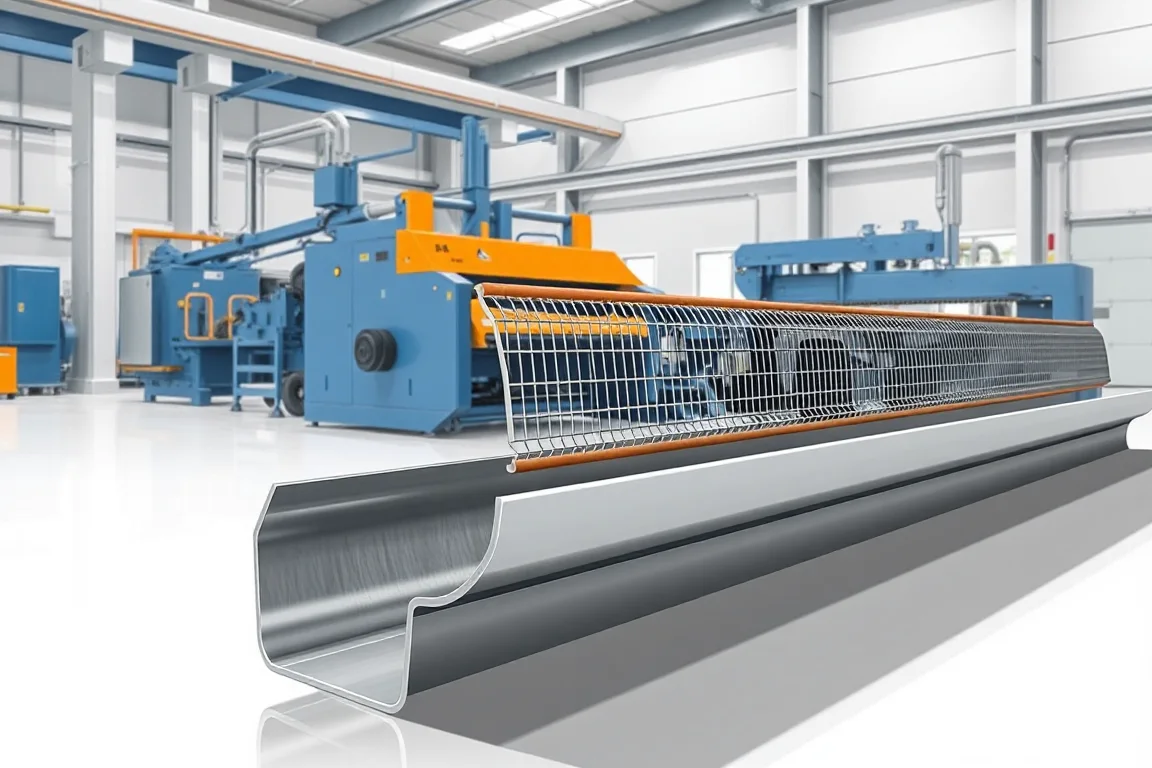
A gutter guard roll forming machine produces the shaped metal covers or support profiles used by a specified debris-screening product. The finished guard may be a perforated sheet, a formed support carrying mesh or another defined construction. Its edge attachment and relationship with the gutter are as important as its visible opening pattern.
The manufacturing project should begin with the actual guard design and target gutter family. Roll forming shapes the longitudinal section, but perforation, mesh preparation, joining and end details may require separate operations. Those steps need to be included before the line can be described as producing a finished guard.
Which guard construction is intended?
Separate perforated sheet covers from mesh-based assemblies and other screen or cover designs. They can have different raw materials, edge forms and joining methods. A line that bends a metal support profile does not automatically manufacture the mesh or attach it.
Identify the way the guard connects to the gutter or surrounding roof detail. The machine should reproduce that interface exactly. A cover of the correct overall width can still fit poorly if its front engagement or rear edge differs from the intended system.
What should the profile drawing establish?
- Guard width, crown or slope geometry and longitudinal stiffening.
- Front gutter-engagement detail.
- Rear edge and any specified attachment interface.
- Perforation or mesh construction.
- Material, thickness and finish.
- Lengths, end overlap or joint details and packing format.
Provide the actual gutter and fastening references used for acceptance. A nominal gutter size is not enough to establish compatibility because front beads, backs and installation details can differ.
How do perforated-sheet and mesh products differ in production?
A perforated-sheet route needs the specified hole or slot pattern and its relationship to the formed edges. The strip may be perforated before the main forming operation or processed through another defined sequence. The equipment proposal should explain the actual arrangement.
A mesh-based product can require separate support forming, mesh supply and retention or joining. Identify the materials and connection method between those elements. A successful metal profile sample does not demonstrate a completed mesh assembly.
Do not select a pattern simply because it is easy to manufacture. The openings and supporting geometry belong to the product design and its intended performance assessment.
What does the complete manufacturing sequence include?
- Confirm the released guard profile, material and screening construction.
- Prepare the strip or support material.
- Create the required perforations or supply the specified mesh component.
- Form longitudinal edges and stiffening details.
- Cut and complete the required end or joining operations.
- Attach mesh or other components where the design requires them.
- Inspect fit, surface condition and finished assembly before packing.
The supply boundary should identify whether the output is a support profile, perforated cover or complete assembled guard. Those are different deliverables.
How should material and finish be reviewed?
Specify grade or alloy, thickness, input width and finish for every component. A formed aluminum cover, coated-steel support and mesh assembly can have different production and handling needs. Do not assume that matching the outside shape establishes equivalent behavior.
Trial the actual perforated or assembled material. Openings can influence forming response, and mesh retention can change during bending or handling. Inspect edges, contact areas and visible surfaces after the complete route.
Keep material and finish identification connected to the order. Similar guards for different gutter systems or environments should remain distinguishable through storage and dispatch.
What should the opening-pattern specification include?
Provide hole or slot shape, spacing, orientation and clear zones at bends and attachment edges. For mesh, define the actual component and its retention arrangement rather than a generic fine-screen description. The production team needs a measurable target.
Inspect the completed guard for damaged openings, burrs, local distortion and loose or unevenly retained mesh where applicable. A pattern can look regular from a distance while having defects at the edge or a joined region.
Manufacturing the specified pattern is separate from proving drainage or debris-screening performance. Avoid deriving a universal rainfall or maintenance claim from opening size alone.
How should gutter fit be tested?
Use the intended gutter, fasteners and installation references in a controlled assembly. Check the front engagement, rear relationship and the way neighboring guard sections meet. Inspect representative lengths rather than only a short hand-adjusted sample.
Record unplanned bending, trimming or force. If fit is poor, compare the guard and gutter dimensions separately before adjusting tools. A wrong gutter sample can lead the former away from the intended guard design.
The trial should follow the selected product's installation method. It should not invent a universal roof-edge attachment arrangement that may be unsuitable for other roof or gutter constructions.
What changes between gutter sizes?
A wider guard may need a different strip width, perforation layout, crown shape or edge relationship. Separate simple width adjustments from changes in the functional attachment details. A line may support one while requiring tools for another.
Request a configuration matrix covering rolls, guides, punching tools, mesh handling and cutoff parts. Demonstrate a meaningful change through to an accepted guard on the intended gutter, then recover the original product.
If one machine is expected to make several guard constructions, identify the additional assembly equipment. An adjustable support former does not automatically change from perforated sheet to a finished mesh product.
How should end joints and accessories be scoped?
Define how guard sections meet at their ends and how the product handles corners or other specified transitions. End notches, overlaps and accessory pieces may need separate operations. A constant longitudinal profile does not complete every installation detail.
Include those features in sample assemblies where they are part of the commercial product. Check that end preparation does not damage mesh retention or deform the attachment edge. The finished joint should match the drawing without improvised correction.
What should collection and packing protect?
Protect shaped edges and screening surfaces through cutoff and stacking. Perforated or mesh products can catch on neighboring parts if nesting is poorly planned. Define separators or orientation where needed and inspect the packed result after handling.
Labels should identify the target gutter family, size, material, finish and construction. Two guards with similar width but different front engagement should not be mixed. Keep incomplete supports awaiting mesh or end work separate from finished products.
How should output and cost be compared?
Measure accepted finished guards for a stated size and construction. Perforation, mesh attachment, end work, inspection and packing can govern the route. A bare-support forming speed does not describe complete mesh-guard output.
For planning only, 600 accepted sections at 1.2 metres each contain 720 metres of manufactured guard. Installed coverage can differ where the product requires overlaps or special corner pieces. Keep manufacturing length and installation takeoff separate.
Compare quotations with equivalent pattern, assembly and handling scope. Identify purchased mesh, fasteners, accessories and product-performance evaluation separately so a low-cost profile former is not mistaken for a complete guard-production package.
What should acceptance demonstrate?
- Complete profile and attachment-edge geometry.
- Specified perforation or mesh construction.
- Length and end-joint preparation.
- Fit with the intended gutter and fastening references.
- Integrity of mesh retention or other joining where included.
- Required size changes and recovered production.
- Surface condition and identified packed output.
Retain the guard, gutter reference and setup record together. They provide a concrete baseline for repeat manufacture and later fit investigations.
Frequently asked questions
Does the machine also make the gutter?
Not automatically. Gutter and guard profiles have different tools and processes. They can be coordinated in a wider equipment project, but each route needs its own scope.
Can a roll former manufacture micro-mesh?
Do not assume so. A mesh-based guard may use purchased or separately manufactured mesh attached to a formed support. Define the mesh supply and joining route explicitly.
Does a smaller opening always make a better guard?
Performance depends on the complete product and conditions, not one opening dimension alone. The machine should reproduce the selected design while its drainage and debris-screening claims follow relevant product evaluation.
Can one guard fit every gutter of the same size?
Not necessarily. Front beads, backs and attachment details vary. Use the actual target gutter references during tooling and acceptance rather than relying only on nominal width.
Why inspect after packing?
Edges and mesh can be damaged or caught during nesting and transport. The delivered guard should remain acceptable after normal handling, not only when it first leaves the machine.
What should an enquiry include?
Provide the guard and gutter-interface drawings, screening construction, materials, finishes, lengths and end details. Add expected order mix and assembly boundary. This defines the complete production requirement.

Continue your research
- Gutter & Downspout Roll Forming Machines
- Gutter Roll Forming Machine
- Downspout Roll Forming Machine
- K Style Gutter Roll Forming Machine
- Half Round Gutter Roll Forming Machine
- Box Gutter Roll Forming Machine
- How Gutter roll forming machine Works
- How To Choose a Gutter roll forming machine
- Gutter roll forming machine Price: What Affects the Cost?
Configuration & specification inputs
Match the configuration to your section drawing, material and production requirements.
| Parameter | Requirement / confirmation needed |
|---|---|
| Profile geometry | Guard crown, attachment edges and specified screening construction |
| Material | Component-specific sheet/support/mesh materials and finishes |
| Thickness & grade | Review actual guard-construction and material combinations |
| Process route | Screening preparation, longitudinal forming, end work, required mesh joining and packing |
| Cutting | Preserve attachment geometry and specified end overlaps or joints |
| Output | Accepted complete guards with screening and assembly work included |
| Electrical supply | Confirm utilities for forming, perforation or mesh assembly, cutoff and handling |
| Acceptance | Inspect pattern/mesh integrity, fit actual gutters, verify end joints and check packed condition |