
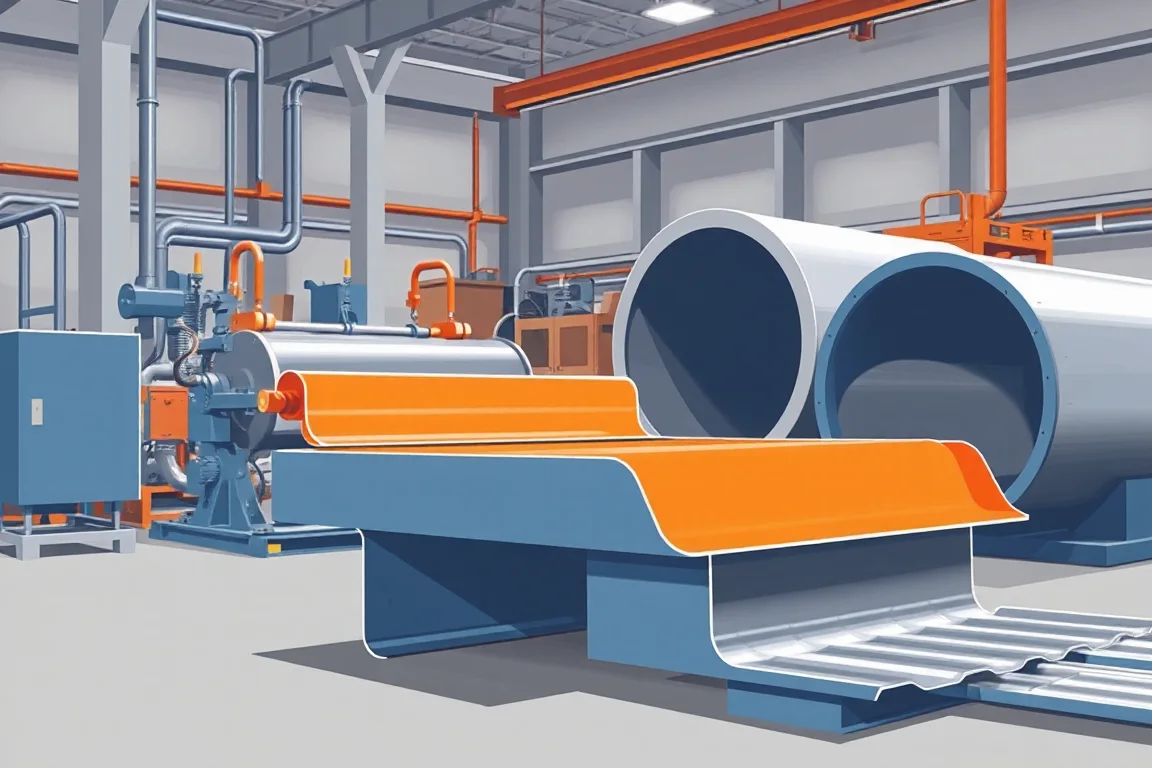
A gutter roll forming machine transforms flat metal coil into a continuous, shaped profile by passing the strip through a series of driven rolls. Each roll station bends the material a little more until the cross-section reaches the required gutter or downpipe shape. The machine does not create the design; the roll tooling and sequence do. Understanding how the machine works means following the strip from the payoff reel to the cut finished part and knowing which operations are integrated, which are manual, and which happen on separate equipment.
Process sequence: from coil to cut length
The basic sequence is coil payoff, strip feeding, section forming, edge or seam closure, and cutoff. The payoff reel or decoiler holds the coil and pays it out as the line demands. A straightener or feeder may be present to flatten coil set and control the strip as it enters the first forming station. The forming section consists of a series of roll stands. Each stand has upper and lower rolls that progressively bend the strip. The number of stations depends on the profile complexity: a simple open gutter section may require fewer stations than a closed downpipe seam with a lock or a hem.
After forming, the strip edges may be brought together or closed. For an open gutter, this may mean finishing a bead or hem along the top edge. For a downpipe, this may mean closing a seam that joins two edges of the strip into a tube. The closed seam may be a lock seam or a simple overlap, depending on the profile and tooling. After the profile is formed and closed, a cutoff press or shear cuts the continuous strip to the required length. The cutoff tooling is profile-specific: it must support the section internally or externally to prevent collapse during cutting and produce a clean, square end.
Interfaces: where the line stops and other operations begin
Not every operation is integrated into the roll forming machine. A gutter line may form the gutter profile but not punch the outlet hole or attach the end cap. A downpipe line may form and seam the tube but not produce elbows or crimp the ends. These operations are often separate manual or semi-automatic steps. The interface between the roll forming machine and these secondary operations is a critical point in the layout. If the part must be transferred to another machine, the method of referencing and clamping the part after cutting matters. A part that loses its reference may not align correctly in the next operation.
Outlets and elbows are frequently made on separate presses or forming machines. An elbow former may take a straight tube section and bend it, or it may form elbows from flat strip in a dedicated die. The roll forming machine does not automatically produce these features unless the line is specifically designed and tooled for them. When evaluating a machine, clarify which operations are included in the base line and which require additional equipment or manual labor.
Material behavior and its effect on forming
Coated steel and aluminum are common materials for gutters and downpipes. Each behaves differently in roll forming. Steel has higher strength and springback than aluminum. Springback means the material tends to return partially to its original shape after bending, so the roll tooling must overbend the strip slightly to compensate. Aluminum is softer and more prone to scratching, so roll surfaces and handling must be appropriate. Copper requires its own process review because it work-hardens differently and may need different roll materials and lubrication.
The base-metal thickness and grade influence the forming sequence. Thicker material requires more bending force and may need larger roll diameters or more stations to avoid cracking or excessive thinning at bends. The coating also matters: a paint or metallic coating can crack if the bend radius is too tight relative to thickness. The roll forming machine's capability is not a single number; it depends on the specific profile, material, and tooling design. The buyer should specify the intended material and thickness range, and the machine builder should confirm the tooling can handle it without defects.
Cutoff, end quality, and secondary operations
The cutoff is not just a shear. It must cut the formed profile without distorting it. For an open gutter, the cutoff may use a die that supports the inside of the section. For a closed downpipe, the cutoff may require a mandrel inside the tube to prevent the walls from collapsing. The quality of the cut end affects how the part fits into outlets, elbows, or hangers. A burr or deformation can cause assembly problems later.
Secondary operations include punching holes for outlets, notching for end caps, and crimping for joints. These may be integrated into the roll forming line or performed offline. Integrated operations require additional stations and tooling, increasing line complexity and cost. Offline operations require handling and re-referencing. The decision depends on production volume and the acceptable cost per part. High-volume production often justifies integration; low-volume or varied production may favor manual operations.
How to assess a proposed line for your profile
Start with a complete drawing of the finished part. Walk through the proposed process and mark every point where the strip is gripped, referenced, punched, bent, cut, joined, or inspected. For each step, identify whether it is part of the roll forming machine or a separate operation. Ask who supplies the tooling for each step and who is responsible for the interface. An operation omitted from a quotation still needs to happen somewhere. If it is not in the line, it will be done manually or on another machine.
Request a detailed station-by-station description of the forming sequence. This should show the shape of the strip after each station and the rolls that produce it. The sequence should demonstrate that the material can be formed without excessive strain. If the builder cannot provide this, the tooling design is not mature. Also, ask for the expected line speed and the basis for that speed. Line speed is not a fixed rating; it depends on the profile, material, and cutoff method. A speed quoted for one profile may not apply to another.
Acceptance checks for formed gutters and downpipes
Acceptance should be based on the actual profile and material. For gutters, check the bead or hem for consistent shape and no cracking. Check straightness along the length. For downpipes, check the seam for closure and uniformity. The seam should not open under light handling. Check the mating fit with outlets and elbows. The cut ends should be square and free of deformation that would prevent assembly. These checks are visual and dimensional; they do not require destructive testing. If the line is intended for multiple profiles, each profile should be checked separately.
Common troubleshooting: symptoms and diagnostic evidence
When a profile is out of tolerance, the symptom may be dimensional (wrong angle, wrong width) or visual (twist, bow, cracks). The diagnostic evidence is in the part and the process. For twist, check if the strip is entering the first station level and centered. Twist can also come from uneven roll pressure or a misaligned stand. For bow, check the straightener settings and the strip tension between the payoff and the first station. For cracks at bends, check the bend radius relative to material thickness and the condition of the roll edges. For seam problems in downpipes, check the alignment of the closing rolls and the strip edge condition. Always investigate with the machine stopped and isolated from power. Do not attempt to adjust rolls while the line is running.
Diagnostic evidence includes measurements of the finished part, observations of strip tracking, and inspection of roll wear. Keep a record of settings for each profile so you can return to a known good condition. If a problem appears after a material change, compare the new material's properties with the previous one. Springback, yield strength, and coating can all affect forming.
Checklist for specifying a gutter roll forming machine
- Provide a detailed cross-section drawing with dimensions and tolerances.
- Specify the material type, grade, and thickness range.
- Define which operations are integrated and which are separate.
- Confirm the cutoff method and end quality requirements.
- Ask for the forming sequence and station layout.
- Clarify the method for referencing parts after cutting or secondary operations.
- State the required output per shift based on the actual profile and material.
- Confirm voltage, frequency, and phase for the installed equipment.
- Agree on acceptance criteria for the bead, seam, straightness, and fit.
- Identify who supplies tooling for secondary operations and who is responsible for interfaces.
Alternatives: integrated versus separate operations
An integrated line performs forming, punching, and cutoff in one machine. This reduces handling and labor but increases initial cost and changeover time. A separate approach uses a roll forming machine for the profile and separate presses or manual operations for holes and ends. This offers flexibility for varied products and lower initial cost but higher labor per part. The choice depends on volume, part variety, and labor cost. A third alternative is a modular line that can be reconfigured with different tooling for different profiles. This can be cost-effective if the same base machine can run multiple products with quick changeover.
FAQ
What is the first station in a gutter roll forming machine?
The first station typically guides and begins to bend the strip edges. It sets the initial reference for the strip's position. Its design depends on the profile: an open gutter may start by forming the bottom curve, while a downpipe may start by forming a partial tube.
Can a gutter roll forming machine produce both gutters and downpipes?
Only if the machine is designed with interchangeable tooling for both profiles. The forming sequences differ, and the cutoff and seam closing may also differ. A machine set up for one profile may not be able to run the other without significant modification.
How is the seam closed on a downpipe?
The seam is closed by rolls that bring the two edges of the strip together and lock or overlap them. The closing rolls are part of the forming section or a separate closing station. The seam quality depends on strip edge condition and roll alignment.
What determines the line speed?
Line speed is determined by the forming process, the material, and the cutoff method. It is not a fixed machine rating. The builder should calculate the speed based on the specific profile and material, considering the time needed for forming and cutting.
How do I check if the cut length is accurate?
Measure the finished part after it has cooled and stabilized. Check the cut end for squareness. If the length varies, check the measuring system, the feeder, and the cutoff timing. Consistent variation may indicate a slipping feed roll or an issue with the encoder.
Why does the profile twist after forming?
Twist often comes from uneven strip entry, misaligned rolls, or differential springback. Check that the strip is level and centered at the first station. Inspect roll wear and alignment. A twist can also be caused by the cutoff if it does not support the profile symmetrically.
Conclusion
A gutter roll forming machine works by progressively bending metal strip through a series of rolls, then cutting it to length. The machine is only part of the manufacturing route; outlets, elbows, and end features may be made separately. Success depends on matching the tooling and sequence to the specific profile and material, and on clearly defining the interfaces between operations. By focusing on the part drawing and the process boundaries, you can specify a line that produces acceptable gutters and downpipes without over- or under-buying capability.
Continue your research
- Gutter & Downspout Roll Forming Machines
- Gutter Roll Forming Machine
- Downspout Roll Forming Machine
- K Style Gutter Roll Forming Machine
- Half Round Gutter Roll Forming Machine
- Box Gutter Roll Forming Machine
- How To Choose a Gutter roll forming machine
- Gutter roll forming machine Price: What Affects the Cost?
- Materials and Thickness for Gutter roll forming machine