
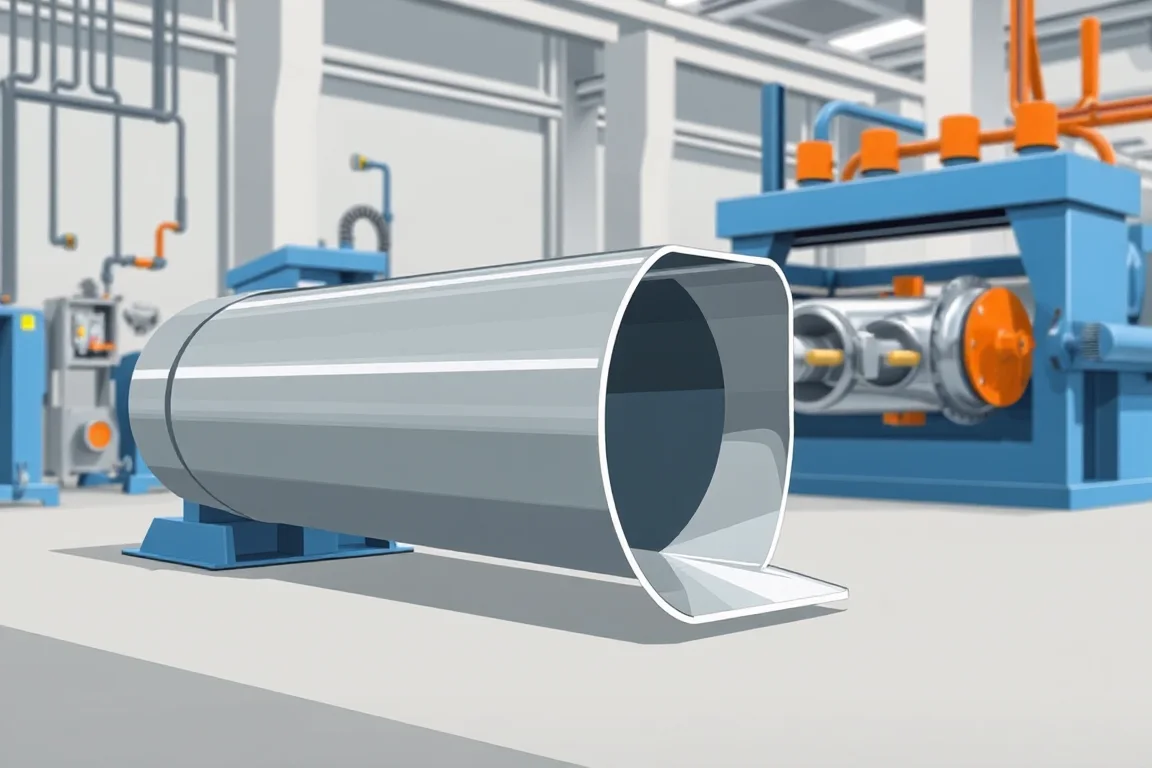
A rectangular downpipe roll forming machine is built around a specific closed profile with unequal face widths and a seam whose position matters in service. The machine forms and closes that profile from coil; it does not, by itself, create elbows, outlets or drainage capacity. This page explains the component interfaces, the production route, where assembly boundaries fall, and what to inspect before accepting a line.
What the rectangular downpipe profile actually is
A rectangular downpipe is a closed, hollow section with four faces, but the two pairs of faces are not equal. The broader face is usually oriented toward the wall or the building face, while the narrower face carries the seam. The seam is not random; it is placed so that the folded or locked edge sits where it can be supported and where water does not sit against an open edge. If a section is rotated during installation, the seam may face outward, the mating outlet may not align, and the visual line of the pipe changes.
Because the profile is closed, the forming sequence differs from an open gutter section. A gutter is formed as an open channel and needs no seam closure. A rectangular downpipe must be formed progressively and then closed along one edge. That closure is the operation that distinguishes a downpipe line from a gutter line and from a round downspout line, where the seam is typically a different lock or a welded or folded overlap.
Drawing inputs before any machine discussion
The drawing should show the cross-section with face widths, corner radii, seam type and seam position, plus the installation orientation relative to the wall. It should also show the mating elbow or outlet socket so that the machine's formed section can be checked against the fitting that receives it. A rectangular downpipe does not stand alone; it connects to a gutter outlet, an elbow, a shoe or a drainage connection, and those interfaces have their own tolerances.
Material and finish belong with the drawing. Coated steel and aluminum behave differently in forming, springback and edge treatment. Copper is sometimes requested for architectural work, but it is not a simple substitution: it work-hardens, it may require different lubricants and tool clearances, and its joining methods differ. A process review for copper is a separate exercise from a line set up for coated steel.
Production route: forming, closure, cutoff and secondary operations
The general route is coil payoff, section forming, edge or seam closure, cutoff, and then outlets or elbows as separate operations. Each stage has a boundary that determines what the line can deliver. The payoff handles coil weight and coil width; the forming stations create the corners and faces; the closure section brings the seam together; the cutoff separates the finished length.
The cutoff is not a commodity. A closed rectangular section needs a cutoff that supports the profile during the cut, controls end distortion and produces an end that can accept the next component. If the end is crushed or flared, the seam can open at the cut and the fit to an elbow or sleeve suffers. The cutoff may also need to handle secondary operations such as notching or punching if the drawing calls for them. Those operations are part of the scope and should be listed explicitly.
Elbows and outlets are normally produced on separate equipment. A straight-pipe former makes straight sections; it does not create a bend with a controlled radius, nor does it form the socket geometry that connects to a gutter outlet. If the intended business includes complete rainwater goods, the equipment scope should include the fitting operations or a clear decision to buy them elsewhere.
Assembly boundaries and what the line does not do
The machine's boundary ends at the cut length. Everything downstream — elbows, shoes, outlets, sleeves, brackets — is assembly, and those parts come from other processes or suppliers. This boundary matters commercially: a quotation for a downpipe line that does not include fitting equipment will not produce a finished drainage system on its own. It also matters technically: the straight section's seam and end quality determine whether the fitting assembly closes cleanly, so the two sides must be designed against the same interface drawing.
Supports and fixings are also outside the line. The building structure, wall spacing and local drainage requirements determine how the pipe is fixed and where it discharges. A roll forming machine makes the pipe; it does not establish drainage capacity or compliance with local rules.
Application-specific inspection and acceptance
Acceptance should use the agreed material and the agreed profile, not a substitute that is easier to run. The first-off piece and a steady-production sample should be checked with the same gauges. For the rectangular downpipe itself, inspect the seam closure for completeness and consistency, the straightness of the section over its length, the corner definition and the face widths against the drawing. For the interface, check that a production elbow, outlet or sleeve fits the formed end without forcing, and that the seam orientation matches the installation drawing.
The broad face is often the appearance face. Handling marks, roll marks and coating damage on that face may be acceptable or not depending on the specification, so protective packing and careful unloading belong in the acceptance discussion. Surface finish, bendability and joint compatibility should be reviewed together because a coating that survives forming but fails at a folded joint is not a successful combination.
Choosing between rectangular, square and round downpipe lines
A square downpipe line is close to a rectangular downpipe line in principle, but a true square has equal faces, so the seam orientation and corner design differ. A rectangular section with unequal faces often has a preferred installation orientation and a seam placed for the wall side; a square section may be installed with any face outward, which changes how the drawing and the inspection are set up.
A round downspout line forms a circular section, usually with a different seam or lock and different cutoff and fitting requirements. Round and rectangular profiles cannot share a tool set without a complete change, and the fittings are not interchangeable. If a business needs both, the decision is usually two lines or a line with a dedicated changeover scope, not one universal set of rolls.
Gutter formers are a separate family. K-style, half-round and box gutters are open profiles; they do not close a seam and they do not produce a downpipe. A gutter line and a downpipe line can serve the same project, but they are not substitutes.
Comparing machine configurations and what the price reflects
When comparing configurations, the meaningful variables are the profile scope, the material range, the cutoff type, the degree of automation and the included secondary operations. A line described as a rectangular downpipe roll forming machine may be a single-profile line with a simple cutoff, or a line with additional stations for a second profile, or a line with integrated punching and a more controlled cutoff. These are different pieces of equipment even if the description is the same.
Price differences usually track those variables: profile complexity, number of forming stations, material thickness range, cutoff design, control system and the inclusion of fitting or punching operations. A lower-cost line may require more manual handling, slower changeover, or separate equipment for every fitting. A higher-cost line may reduce handling and setup time, but only if the actual profile and material are within its intended scope. The right comparison is the written scope against the production need, not a single headline figure.
Output and productivity in context
Output should be defined as accepted pieces per shift with the actual profile and material, not as a bare line speed. Coil loading, changeover, setup scrap, punching, cutoff and unloading all consume time. A line that runs quickly but needs frequent adjustment or produces a high scrap rate at startup may deliver less accepted output than a slower, more stable line. Workshop throughput is only part of the picture; for site work, portability, coil handling and support of long runs also matter.
Practical checklist before approving a line
- Confirm the drawing shows the full cross-section, seam position, corner radii and installation orientation.
- Confirm the material and finish for production, and separate copper from coated steel or aluminum in the review.
- Confirm the cutoff produces an end that fits the agreed elbow, outlet or sleeve.
- Run the agreed material and profile, then inspect a first-off piece and a steady-production sample.
- Record changeover steps, setup scrap and unloading time with the real profile.
- Compare the written equipment scope with every secondary operation needed for a finished part.
- Identify which fittings come from the line and which come from elsewhere.
- Check that protective packing suits the appearance face.
- State the electrical supply requirements so the installed power schedule can be confirmed.
FAQ
Can one rectangular downpipe line also run square downpipe?
Only within the profile scope the line is designed for. Square and rectangular sections have different face proportions, corner designs and seam positions. A change from one to the other usually requires different forming stations or a different tool set, and the fittings are not shared. Treat it as a separate profile review rather than a simple adjustment.
Does the machine produce elbows and outlets?
Normally not. The roll forming line produces straight cut lengths. Elbows and outlets are separate forming operations, often on different equipment. If a complete system is the goal, include those operations in the equipment scope or decide how they will be sourced.
How do I specify the material and thickness for the line?
The buyer specifies the base-metal thickness and grade, and the supplier verifies the operating range. That is a selection requirement, not a machine rating. The drawing and the intended finish should be fixed first, then the forming and cutoff scope checked against them.
What should be inspected on the seam?
Check that the seam is closed along the full length, that it is consistent from piece to piece, and that it is positioned as the drawing shows. An incomplete or inconsistent seam can affect stiffness, appearance and the fit at a joint. Inspection should use the same gauges throughout.
How is output measured for acceptance?
Measure accepted pieces per shift with the actual profile and material, including changeover, setup scrap and unloading. A line speed figure alone does not describe delivered output.
Can the same line run copper?
Copper requires its own process review. It behaves differently in forming and joining, and the tooling, lubrication and edge treatment may differ. Do not assume a line set up for coated steel or aluminum will handle copper without a dedicated assessment.

Continue your research
- Gutter & Downspout Roll Forming Machines
- Gutter Roll Forming Machine
- Downspout Roll Forming Machine
- K Style Gutter Roll Forming Machine
- Half Round Gutter Roll Forming Machine
- Box Gutter Roll Forming Machine
- How Gutter roll forming machine Works
- How To Choose a Gutter roll forming machine
- Gutter roll forming machine Price: What Affects the Cost?
Configuration & specification inputs
Match the configuration to your section drawing, material and production requirements.
| Parameter | Requirement / confirmation needed |
|---|---|
| Profile geometry | Rectangular downpipe has unequal face widths and an oriented seam. Show installation orientation and the mating elbow or outlet so sections are not inadvertently rotated. |
| Material | Coated steel or aluminum; copper requires its own process review |
| Thickness & grade | Buyer to specify base-metal thickness and grade; operating range requires supplier verification. |
| Process route | Coil payoff → section forming → edge/seam closure → cutoff → outlets or elbows as separate operations |
| Cutting | Confirm profile-supported cutoff, cut lengths, end quality and any secondary operations. |
| Output | Define accepted output per shift with the actual profile and material. |
| Electrical supply | Buyer to state voltage / frequency / phase. Installed power requires a confirmed equipment schedule. |
| Acceptance | Check matching elbows, outlets and sleeve joints using production samples. Separate the straight-pipe former from equipment for fittings. Include protective packing when the broad face is appearance-sensitive. |