
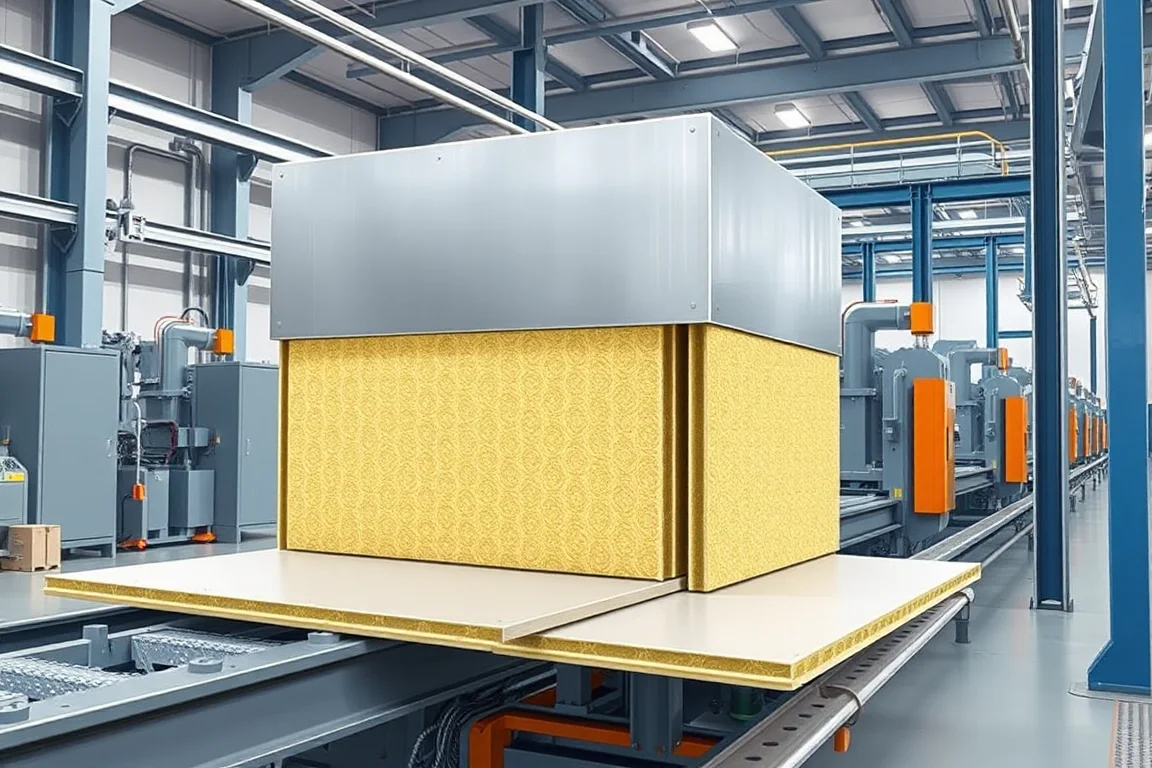
A rockwool wall sandwich panel production line is not a single machine but an integrated process that turns coil-fed metal facings, mineral wool core and a bonding system into a finished wall panel. The line must handle the specific challenges of mineral wool: it is denser and less compressible than foam cores, it does not flow or expand, and it can shed dust and fibres during handling. The line's job is to prepare facings, place and stabilise the core, bond the layers, cure the bond and cut panels to length without damaging the joint profile or the core. This article explains the component interfaces, distinguishes appropriate production routes, clarifies where line responsibility ends and panel verification begins, and provides application-specific inspection guidance.
What the wall panel construction actually requires
A wall sandwich panel typically consists of two metal facings with a profiled joint along the longitudinal edges and a mineral wool core between them. The joint geometry — often a tongue-and-groove, concealed-fix or overlapping profile — determines how panels interlock, how loads transfer and how weather sealing is achieved. The line must produce that joint consistently along the full panel length, which requires coordinated forming of both facings and controlled alignment during core placement and bonding.
Mineral wool core for wall panels is usually supplied as rigid or semi-rigid boards or lamella strips. Its density, binder content and fibre orientation affect how it compresses, how it bonds and how it cuts. Unlike a foam core that is dispensed as a liquid and expands to fill the cavity, rockwool must be placed as a solid insert. That difference drives the mechanical layout of the line and the sequence of operations. The core itself is not a finished insulation product until it is bonded into the panel and the assembly is verified as a complete construction.
Facing preparation and roll forming
The facings begin as coated steel or aluminium coil. The line uncoils, flattens where necessary, and feeds the strip through a roll former that creates the panel's surface profile and edge joint geometry. For wall panels, the profile may include micro-ribs, striations or a flat surface with a defined joint. The roll former must be set for the specified base-metal thickness, coating type and yield strength. If the material changes, the forming stations may need adjustment to avoid edge cracking, oil-canning or loss of joint fit.
After forming, the facings often pass through a pre-treatment or adhesive application stage. The adhesive system — whether a reactive polyurethane, a hot-melt or another bonding chemistry — must be compatible with the metal coating, the mineral wool surface and the curing conditions on the line. The method of application, whether sprayed, rolled or extruded as a bead or film, affects bond coverage and open time. The line's speed and the distance between adhesive application and pressing must match the adhesive's working characteristics.
Core placement and stabilisation
Mineral wool core is placed onto the lower facing either as full-width boards, as strips laid side by side, or as pre-assembled blocks. The line must position the core so that it fills the panel cavity without gaps at the edges or joints. Because rockwool does not expand, any void remains a void unless the core is sized and placed accurately. Some lines use slight compression of the core during pressing to ensure contact with the adhesive, but excessive compression can crush the fibres or distort the facing.
Core placement interacts directly with the joint design. The core must not interfere with the joint's mating surfaces, and it must not protrude into the space needed for the joint's sealant or gasket. The line may include edge-filling stations, side guides or core trimming units to manage this. Dust and loose fibres generated during cutting or handling should be controlled, because they can contaminate the adhesive bond or the joint surface. Extraction and cleaning provisions are part of the line scope, not an afterthought.
Bonding, pressing and curing
Bonding is the step that turns separate components into a composite panel. The adhesive must wet both the metal facing and the mineral wool surface, then cure to a strength that transfers shear between the layers. Pressing applies pressure to bring the layers into contact and to hold them while the adhesive develops handling strength. The press may be continuous, such as a double-belt press, or discontinuous, such as a multi-daylight press. The choice depends on the adhesive chemistry, the panel geometry and the required output.
Curing continues after the panel leaves the press. The line must provide a controlled curing zone or a defined stacking time before the panel is cut or handled. If the panel is cut before the adhesive has sufficient strength, the cut can tear the core or delaminate the facings. The curing method — ambient, heated or a combination — must be compatible with the adhesive and the facing coating. Temperature and time are process parameters that the supplier and the panel producer must establish for the specific materials and panel construction.
Cutoff and end finishing
After curing, the continuous panel is cut to length. The cutoff saw or shear must be designed for the panel's profile and the mineral wool core. Cutting through mineral wool produces dust and can leave a rough edge if the blade or saw speed is unsuitable. The cutoff must also preserve the joint geometry at the panel ends, because those ends will mate with adjacent panels or fittings. Some lines include end-milling, notching or punching stations to prepare the panel ends for installation.
The cutoff's accuracy affects the panel's length tolerance, squareness and edge quality. A flying cutoff that moves with the panel can maintain production flow, while a stationary cutoff requires the line to stop and start. The choice depends on the required output and the acceptable cut quality. After cutting, panels may be stacked, packaged or moved to a secondary operation. The line scope should clearly define which of these operations are included and which are separate.
Production routes: continuous, discontinuous and lamination
Three main production routes are used for rockwool wall sandwich panels. A continuous line uses a double-belt press or a continuous laminator to bond the facings and core in one uninterrupted process. This route suits high-volume production of a consistent panel profile and requires careful coordination of all stations. A discontinuous line uses a stationary press, often with multiple panels loaded at once, and suits lower volumes or frequent profile changes. A lamination route may bond pre-formed facings to a pre-cut core board using a separate press or vacuum table, which can be suitable for small batches or specialised panels.
The appropriate route depends on the panel's joint complexity, the adhesive system, the required output and the acceptable changeover time. A continuous line can achieve high output but may be less flexible for short runs. A discontinuous line can handle varied panel lengths and thicknesses but may have higher labour input per panel. The line's layout also affects how the core is placed: a continuous line may require the core to be fed as a continuous strip or as abutting boards, while a discontinuous line can accept individual boards. The supplier and panel producer should agree on the route based on the actual product mix, not on a general preference.
Assembly boundaries: what the line does and does not cover
The production line covers the operations from coil handling through cutoff. It does not cover the building's structural design, the panel's installation method, or the verification of the finished panel's thermal or fire performance. Those are separate concerns. A fire classification, for example, applies to a complete tested assembly of facings, core, joints and fixings, not to the production line or to the mineral wool core alone. The line can produce a panel that meets a specification, but the evidence for that performance must come from testing the assembled construction.
Similarly, the line does not include the chemical safety controls for the adhesive system beyond the equipment needed to handle it. Adhesive handling, storage, ventilation and personal protection are part of the production facility's safety management, not the line's mechanical scope. The line supplier may provide equipment for adhesive application, but the panel producer remains responsible for safe operation. The line scope should clearly list all secondary operations, such as punching, notching, end-milling or packaging, so that the project's boundaries are understood.
Inspection for rockwool wall panels
Inspection should focus on the features that the line controls and that affect the panel's fit and function. Facing geometry, including profile depth, joint dimensions and surface finish, should be checked against the drawing. Joint fit should be assessed by mating sample panels and checking for gaps, interference or misalignment. Bond quality should be inspected for delamination, voids or adhesive starvation, especially at the panel edges and around the joint. Core arrangement should be checked for gaps, compression and alignment with the joint.
Panel dimensions, including length, width, thickness and squareness, should be measured with suitable gauges. The cut ends should be examined for core tear-out, facing burrs and joint damage. If the panel is intended for a specific application, such as a cold-store or a fire-rated wall, the relevant performance evidence should come from testing the complete assembly under the agreed test plan. The production line's output should be evaluated after the process has stabilised, using a representative sample that reflects the actual materials and profile.
Checklist for specifying a rockwool wall panel line
- Define the panel construction: facing material and coating, core type and density, joint design, finished thickness and panel length range.
- Provide the profile drawing, including joint dimensions and tolerances, and confirm that the roll former is designed for the specified base-metal thickness and grade.
- Specify the adhesive system and its curing requirements, and confirm that the line's pressing and curing provisions are compatible.
- Confirm the core placement method and how the line handles mineral wool dust, loose fibres and edge filling.
- Review the cutoff method for the profile and core, including cut quality, length tolerance and any secondary operations.
- Define the production target in accepted panels per shift for the actual profile and material, not just the roll-former speed.
- State the electrical supply, including voltage, frequency and phase, and obtain a confirmed equipment schedule for installed power.
- Agree on the inspection plan for facing geometry, joint fit, bond quality, core arrangement and panel dimensions.
- Clarify the line scope: coil handling, forming, adhesive application, core placement, pressing, curing, cutoff, dust extraction and any end-finishing equipment.
- Confirm the boundaries: line responsibility ends at the finished panel; assembly performance, fire classification and thermal ratings require separate verification of the complete construction.
Comparing production route alternatives
When comparing continuous, discontinuous and lamination routes, consider the product mix, the required output, the adhesive system and the available floor space. A continuous line typically offers higher output and consistent quality for a fixed profile, but it can be capital-intensive and less flexible for frequent changes. A discontinuous line can accommodate varied panel lengths and thicknesses with lower capital cost, but it may require more labour and have longer cycle times. A lamination route can be suitable for small batches or for panels with complex facings, but it may have limitations on core density and bond strength.
The choice also depends on the adhesive. Reactive polyurethane adhesives may require a heated press or a controlled curing zone, which can be easier to integrate into a continuous line. Hot-melt adhesives may set quickly and suit a discontinuous press. The core's compressibility and surface texture affect how much pressure is needed and how the core is fed. The line layout should allow for the required curing time without creating bottlenecks. The panel producer and the line supplier should review the complete process, including material handling and quality control, before selecting a route.
Frequently asked questions
How does a rockwool wall panel line differ from an EPS wall panel line?
EPS is typically expanded or moulded as a foam block or bead and can be cut or shaped to fit the panel cavity. It is relatively light and can be compressed or bonded with adhesives that suit foam. Rockwool is a mineral fibre board that is denser and does not expand; it must be placed as a solid insert and may require different adhesive coverage and pressing pressure. The line's core handling, dust extraction and cutoff systems must be adapted to mineral wool's properties. The joint design and facing forming may be similar, but the core interface is fundamentally different.
Can a single line produce both rockwool and foam-core wall panels?
A line can be designed to handle multiple core types, but the changeover involves more than swapping the core feed. The adhesive system, pressing parameters, curing method, dust control and cutoff may need adjustment or substitution. Foam cores may be dispensed as liquids, which requires different equipment than solid board placement. The panel producer should define the full range of products and confirm with the line supplier that the equipment and process can accommodate each core type without compromising bond quality or panel performance.
What determines the achievable production rate for rockwool wall panels?
The achievable rate is limited by the slowest mandatory step in the process. For rockwool panels, curing or bonding requirements often set the pace, because the adhesive needs time to develop strength before the panel can be cut or handled. Core placement and pressing may also be slower than facing forming. The roll-former speed alone is not a reliable indicator. The production target should be expressed as accepted panels per shift for the actual profile and material, measured after the process has stabilised.
How is the joint quality controlled on the line?
Joint quality is controlled by the roll former's tooling, the alignment of the facings during core placement and pressing, and the cutoff's ability to preserve the joint at the panel ends. The line should include guides or fixtures that keep the facings in the correct relative position. Inspection involves mating sample panels and checking for gaps, interference or misalignment. The joint's sealant or gasket provisions, if any, must also be compatible with the panel's intended application. The joint is part of the finished panel, so its performance depends on the complete assembly.
What inspection is needed before accepting a new rockwool wall panel line?
Acceptance should be based on running the agreed material and profile, not a simpler demonstration substitute. Inspect first-off pieces and a representative steady-production sample with the agreed gauges. Check facing geometry, joint fit, bond quality, core arrangement and panel dimensions. Record changeover steps, setup scrap, punching and unloading time. Compare the written equipment scope with all secondary operations needed for a finished part. Fire-performance or thermal claims should be supported by evidence for the complete tested construction, not by the line's capabilities.
How should mineral wool dust and fibres be managed on the line?
Mineral wool dust and loose fibres can be generated during core cutting, trimming and panel cutoff. The line should include extraction or collection provisions at these points to prevent dust from contaminating the adhesive bond, the joint surfaces or the working environment. The extraction system must be compatible with the core material and the line's layout. Safe handling of mineral wool and adhesives requires appropriate personal protection and facility ventilation, which are part of the production facility's safety management. The line supplier can provide equipment for dust control, but the panel producer remains responsible for safe operation.
Bringing the application into focus
A rockwool wall sandwich panel production line is defined by the panel it must produce: a mineral-wool-cored wall panel with a specific joint, facing profile and performance requirement. The line integrates facing preparation, core placement, bonding, curing and cutoff, but it does not replace the need for a verified panel assembly. The production route should be selected for the actual product mix and adhesive system, and the line scope should be clear about what is included and what is separate. Inspection should focus on the interfaces that the line controls, and performance claims should rest on evidence for the complete construction.

Continue your research
- Sandwich Panel Production Lines
- EPS Sandwich Panel Production Line
- Rockwool Sandwich Panel Production Line
- EPS Wall Sandwich Panel Production Line
- EPS Roof Sandwich Panel Production Line
- Rockwool Roof Sandwich Panel Production Line
- How Sandwich panel production line Works
- How To Choose a Sandwich panel production line
- Sandwich panel production line Price: What Affects the Cost?
Configuration & specification inputs
Match the configuration to your section drawing, material and production requirements.
| Parameter | Requirement / confirmation needed |
|---|---|
| Profile geometry | A mineral-wool wall panel needs controlled facing preparation, core placement and bonding. Finished-panel classification and performance must come from relevant verification, not the core name. |
| Material | Specified metal facings with EPS, mineral wool or formulated foam core as applicable |
| Thickness & grade | Buyer to specify base-metal thickness and grade; operating range requires supplier verification. |
| Process route | Facing preparation/forming → core preparation or dispensing → bonding/pressing → curing → cutoff |
| Cutting | Confirm profile-supported cutoff, cut lengths, end quality and any secondary operations. |
| Output | Define accepted output per shift with the actual profile and material. |
| Electrical supply | Buyer to state voltage / frequency / phase. Installed power requires a confirmed equipment schedule. |
| Acceptance | Use the specified inspection plan for bonding, core arrangement and panel dimensions. Review the finished joint with intended fittings. Fire-performance claims require evidence for the complete tested construction. |