
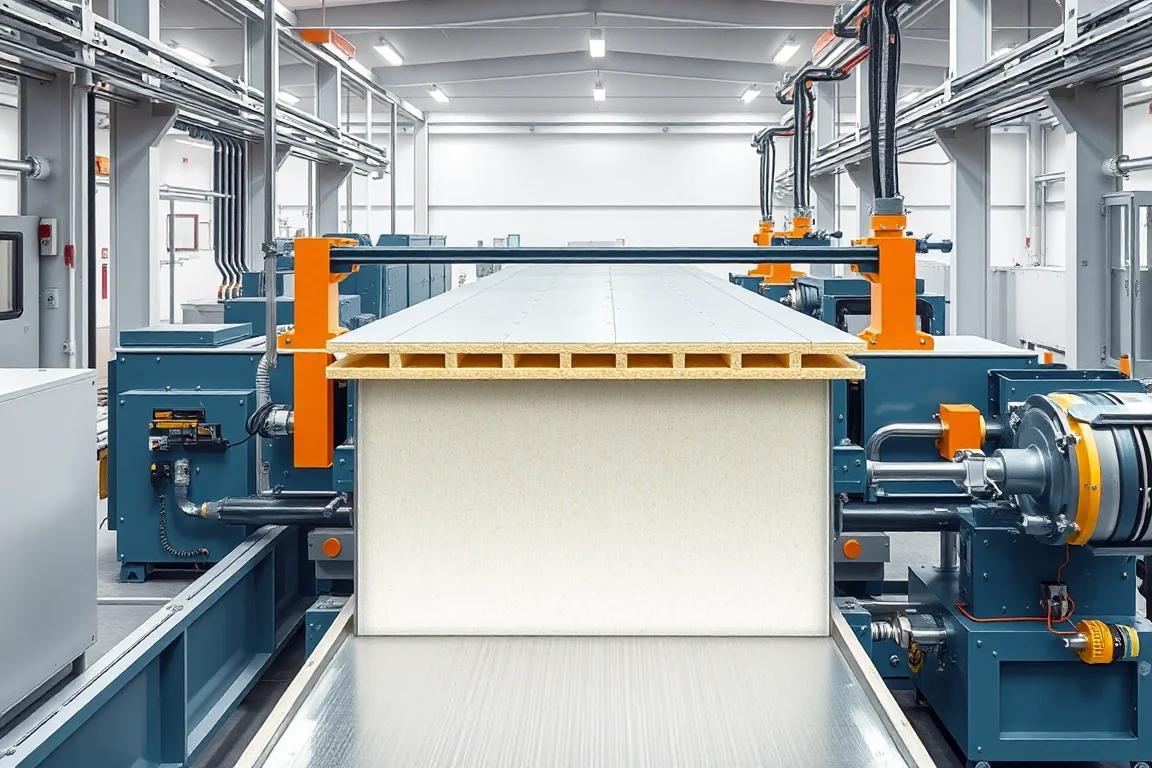
A rockwool roof sandwich panel production line is configured around a roof panel construction, not simply a wider version of a wall line. The finished panel combines two profiled metal facings with a mineral-wool core, and the roof application adds joint geometry, spanning behaviour and handling expectations that a wall panel does not carry. This page explains the component interfaces, the production routes worth comparing, where line supply ends and panel assembly begins, and what to inspect under an agreed test plan.
What distinguishes a rockwool roof panel from a wall panel
A roof panel is normally installed across supports with the joint running along the span, so the longitudinal joint has to shed water and resist wind uplift while the panel carries load between purlins. That pushes the design toward a raised, interlocking edge profile, often with a concealed fixing arrangement and a crown that can accept a fastener without crushing the core edge. A wall panel, by contrast, is usually judged on vertical joint appearance and face flatness, with different tolerance priorities.
Because of these differences, the facing roll geometry, the way the core edge is contained, and the cutoff method all change together. Treating a roof-to-wall change as a width setting alone misses the fact that the joint is the part of the panel doing most of the application-specific work.
How the mineral-wool core changes the process
Mineral wool behaves differently from a foam core or from a rigid foam board. It is fibrous, relatively heavy for a given volume, and does not flow or expand to fill the cavity. In a continuous route, the wool is usually laid in as pre-cut lamella or strips, or fed as a prepared board, and the facings are bonded to it rather than foamed around it.
That means the line needs to control core alignment, compress or fit the wool into the profile, and apply adhesive in a pattern that suits an open, fibrous surface. Chemical systems, including any reactive adhesive, require specialist handling and extraction provisions; those are project-scope items, not afterthoughts.
Facing preparation and forming
Both facings are unwound, levelled and roll-formed to the roof profile before they meet the core. The lower facing typically receives the structural rib and the joint detail; the upper facing may receive a different rib or a flat pan, depending on the joint design. Embossing and any coating protection belong to this stage.
The drawing should fix the base-metal thickness and grade. Buyers need to state these, and the operating range for the roll-former requires supplier verification rather than assumption. Edge quality, rib height consistency and joint fit all originate here, so a defect seen at the finished panel often traces back to a forming setup.
Core preparation and adhesive application
Core preparation for mineral wool covers cutting the wool to the strip width and thickness, orienting the fibres, and presenting the core so the facings close around it without gaps at the joint. Adhesive is typically applied to the facing and to the wool faces so the bond bridges the open surface.
Because the core is not self-adhesive and does not expand, adhesive coverage and open time matter more than they do in a foaming line. The specification should name the adhesive or chemical system, the coverage pattern and the storage conditions, since these determine whether the bond holds after curing.
Bonding, pressing and curing route
Three layouts are commonly compared for rockwool roof panels:
- Continuous pressing. The facings and core travel together through a heated or unheated press section at a controlled speed, so bonding and curing set the line rhythm.
- Discontinuous pressing. Panels are pressed in batches in a fixed press; the route suits lower volume and heavier or longer panels but introduces more handling moves.
- Core-board lamination. Pre-formed mineral-wool board is bonded to facings on a laminating line, which shifts the emphasis from core forming to adhesive and press control.
The right choice depends on panel thickness range, joint complexity and the accepted output per shift with the actual profile and material. Curing or bonding requirements can set the achievable production rate, so the press and curing section deserve as much attention as the roll-former speed.
Cutoff and finished edges
After bonding, the panel is cut to length. For a roof profile, the cutoff has to support the joint form and produce clean ends. Confirm profile-supported cutoff, the range of cut lengths, end quality and any secondary operations such as notching, punching or sealing the cut edge.
End quality is application-relevant because a damaged joint end can compromise the installed lap between panels. Cutting also generates dust from the mineral wool, so extraction and safe handling arrangements should be part of the equipment scope.
Where the production line ends and panel making begins
A production line produces a cut, bonded panel blank that meets an agreed geometry and bond condition. It does not by itself certify a roof assembly. Certification, thermal classification and fire classification belong to the engineered and tested panel assembly, and those results are tied to a defined construction, not to a label on the line.
Buyers should keep three things separate: component production on the line, panel assembly and its documented build-up, and in-service performance such as load, thermal and fire behaviour. A supplier can support the line scope and the process; the assembly-level evidence comes from the agreed construction and test plan.
Comparing production routes and equipment scope
The important comparison is not between brands but between process routes. Continuous pressing tends to suit higher volume with a fixed profile and adhesive system. Discontinuous pressing can handle heavier panels and larger thickness steps with simpler tooling changes. Core-board lamination separates wool preparation from bonding, which can simplify core handling but adds an upstream board supply step.
For each route, the written equipment scope should list facing handling, forming, adhesive or chemical handling, presses, curing, extraction, cutting, quality-control equipment and any secondary operations. Utilities and safe-handling provisions can materially change the project scope, so they belong in the comparison rather than in a later addendum.
A practical evaluation checklist
- Panel width, facing profile, joint design, core type and finished thickness stated on a drawing.
- Base-metal thickness and grade specified by the buyer, with operating range requiring supplier verification.
- Process route matched to volume, thickness range and joint complexity.
- Adhesive or chemical system, coverage and storage conditions defined in the process specification.
- Cutoff method and end quality agreed for the roof profile, including any secondary operations.
- Accepted output per shift defined with the actual profile and material, not an easier substitute.
- Voltage, frequency and phase stated by the buyer; installed power confirmed from an equipment schedule.
- Acceptance test plan agreed for facing geometry, joint fit, bond quality and relevant core properties.
Acceptance inspection for roof panels
Inspection should cover the joint, the bond and the core arrangement using the agreed methods, plus finished edges and package protection. Check facing geometry and joint fit first, since a misaligned joint is visible and functional. Then examine bond quality, including bond continuity along the panel and around the joint area.
Core properties covered by the test plan should be checked on the finished panel, not inferred from incoming wool. Thermal and fire classifications remain conclusions about a verified panel assembly, so any claim in that area should point to the assembly and method, not to the production line.
Commissioning and changeover discipline
Run the agreed material and profile during trials rather than an easier demonstration substitute. Inspect first-off pieces and a representative steady-production sample with the agreed gauges. Record changeover steps, setup scrap, punching and unloading time so the changeover cost is visible alongside the running rate.
Compare accepted panels after the process has stabilised, rather than judging the line by facing roll-former speed alone. This keeps the assessment focused on the product the buyer actually intends to sell.
Frequently asked questions
Can the same line make wall and roof rockwool panels?
Often the same platform can be adapted, but the change is more than width. Roof panels need roof-specific joint geometry, different cutoff support and often different core edge containment. The facing rolls and joint tooling usually have to change, so treat it as a tooling and setup conversion rather than a simple setting adjustment.
Why is mineral wool handled differently from foam cores?
Mineral wool does not flow or expand, so it cannot fill a cavity the way a reactive foam does. It is placed as prepared strips or board, and the bond depends on adhesive applied to an open fibrous surface. That is why adhesive pattern, open time and core alignment carry more weight on a rockwool line.
What determines the achievable output of a rockwool roof line?
Curing or bonding requirements frequently set the pace, because the panel must reach handling strength before cutoff and stacking. Roll-former speed alone is not a reliable indicator. The honest figure is the accepted output per shift with the actual profile and material after the process stabilises.
How should cutoff be specified for a roof profile?
Specify that the cutoff supports the joint form, then state the required cut length range, end quality and any secondary operations such as notching or edge sealing. For a roof panel the lap between adjacent panels depends on clean, repeatable ends, so end quality is a functional requirement rather than cosmetic.
Where does responsibility for thermal and fire performance sit?
Those classifications describe the engineered and tested panel assembly, not the production line. The line must produce a panel that matches the specified construction, and the assembly-level evidence comes from the agreed build-up and test plan. Buyers should keep the two clearly separated in contracts and documentation.
What belongs in the equipment scope beyond the main line?
Facing handling, forming, adhesive or chemical handling, presses, curing, extraction, cutting, quality-control equipment and secondary operations. Utilities and safe-handling provisions also belong in the scope, because they can change the project substantially if added later.
Summary
A rockwool roof sandwich panel production line succeeds when the roof joint, fibrous core handling and bonding route are designed together, and when acceptance is judged on the agreed material, profile and assembly rather than on a headline rate.

Continue your research
- Sandwich Panel Production Lines
- EPS Sandwich Panel Production Line
- Rockwool Sandwich Panel Production Line
- EPS Wall Sandwich Panel Production Line
- EPS Roof Sandwich Panel Production Line
- Rockwool Wall Sandwich Panel Production Line
- How Sandwich panel production line Works
- How To Choose a Sandwich panel production line
- Sandwich panel production line Price: What Affects the Cost?
Configuration & specification inputs
Match the configuration to your section drawing, material and production requirements.
| Parameter | Requirement / confirmation needed |
|---|---|
| Profile geometry | A mineral-wool roof panel has roof-specific joints and handling requirements. Compare its facing geometry and bonding route with a wall panel instead of assuming a product switch is only a width setting. |
| Material | Specified metal facings with EPS, mineral wool or formulated foam core as applicable |
| Thickness & grade | Buyer to specify base-metal thickness and grade; operating range requires supplier verification. |
| Process route | Facing preparation/forming → core preparation or dispensing → bonding/pressing → curing → cutoff |
| Cutting | Confirm profile-supported cutoff, cut lengths, end quality and any secondary operations. |
| Output | Define accepted output per shift with the actual profile and material. |
| Electrical supply | Buyer to state voltage / frequency / phase. Installed power requires a confirmed equipment schedule. |
| Acceptance | Check the joint, bond and core arrangement using the agreed methods. Include finished edges and package protection. Keep roof-system load, thermal and fire requirements tied to the engineered and tested assembly. |