
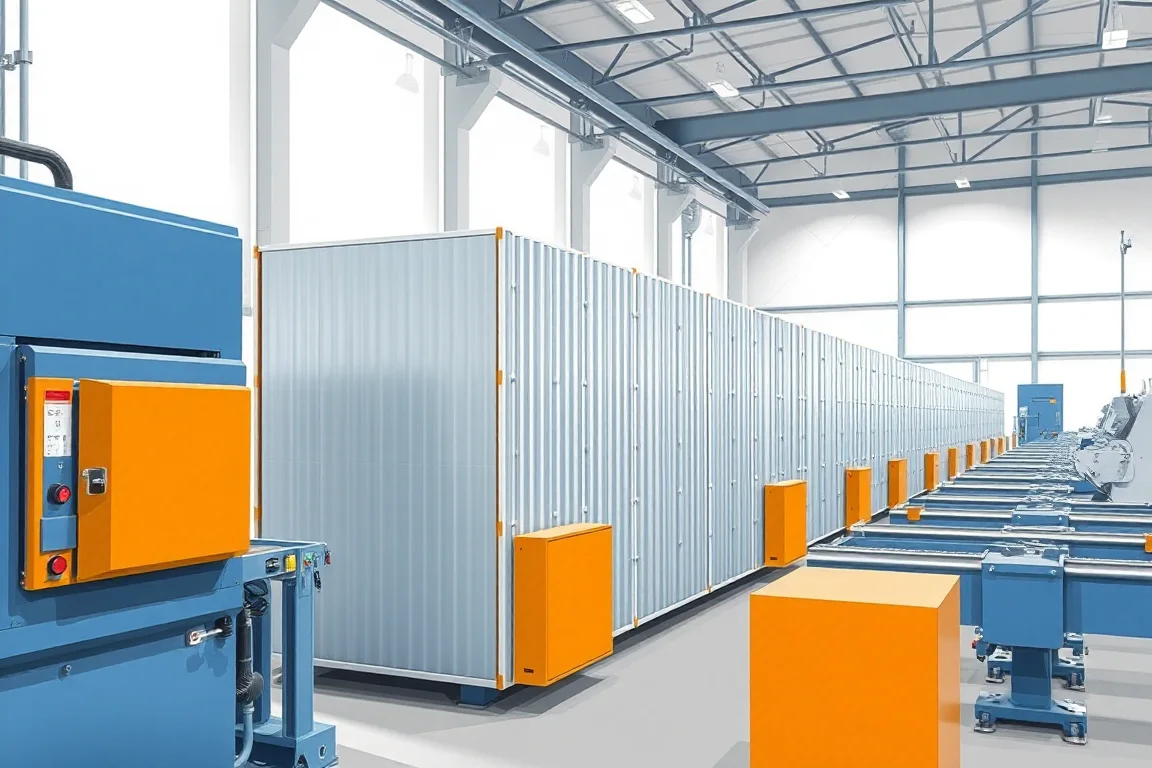
A cold room sandwich panel production line is an application-specific manufacturing system. It is not defined by insulation alone. The finished panel is judged by how its facings, core, joint and sealing details perform together in a refrigerated enclosure. The production line must therefore support the panel construction, not simply a generic sandwich. Buyers who begin with equipment discussions before defining the cold-room system often receive a line that cannot produce the required joint geometry or seal strategy.
Why joint, seal and vapor-control strategy drives line specification
A cold-room panel needs a defined joint, seal and vapor-control strategy. Vapor drive is typically from the warm side toward the cold side. If the panel joint does not include a continuous sealing path and the facing does not control vapor movement, moisture can reach the core or condense within the assembly. The production line therefore must form facings with the correct edge profile, accommodate the intended seal or gasket, and produce a joint that closes consistently. Thermal and hygienic performance cannot be claimed from the line itself; they must be confirmed through the finished panel-system specification. The line’s role is to make the specified geometry and bond repeatable.
Component interfaces: facings, core and bonding system
The main interfaces on a cold-room sandwich panel line are the facing-to-core bond, the panel-edge joint, and the interface between the panel and cold-room details such as corners, ceilings and openings. The facing must be the specified metal type and thickness, prepared so the adhesive or foam chemistry can wet and bond correctly. The core can be EPS, mineral wool or a formulated foam. Each core type behaves differently: EPS is a pre-expanded bead board, mineral wool is a fibrous board, and reactive foams are dispensed as liquids that expand and cure in place. These are not interchangeable on one universal line layout. The bonding method therefore follows the core choice and the required joint design.
Production routes for cold-room panels
Three broad routes appear in cold-room panel production: continuous pressing, discontinuous pressing and core-board lamination. Continuous pressing is often chosen for long runs of a stable panel profile, because the facings and core move through a continuous bonding and curing section before cutoff. Discontinuous pressing suits lower volume or greater flexibility in panel length and core type, because panels are assembled and pressed in batches. Core-board lamination starts with pre-formed core boards that are bonded to facings, which can simplify handling for some mineral wool and EPS constructions but still requires attention to joint and seal geometry. The appropriate route depends on the required panel construction, joint design, core type, finished thickness and the acceptable production rhythm, not on a single preferred layout.
Process sequence and what each stage must achieve
The process sequence is facing preparation or forming, then core preparation or dispensing, then bonding or pressing, then curing, then cutoff. Facing preparation includes handling, cleaning where required, and roll-forming the panel edge. Core preparation differs by material. For expanded foams, dispensing equipment mixes and deposits reactive chemicals; for board cores, cutting and placement are more prominent. Bonding or pressing applies pressure and temperature, if the chemistry requires it, so the facing and core stay in contact while the bond develops. Curing gives the bond time to reach handling strength. Cutoff supports the specific profile and provides clean ends. These stages must be specified as a connected process because a weakness in one changes the achievable output of the line.
Continuous pressing vs. discontinuous pressing vs. core-board lamination
Continuous pressing offers steady movement and can be matched to a roll-former’s speed, but it constrains changeover flexibility and may demand careful control of foam rise and cure. Discontinuous pressing interrupts flow, which can suit mixed production and thicker panels, but it creates more handling and longer floor occupancy per press cycle. Core-board lamination can reduce chemical handling when the core arrives as board, but it adds a lamination bonding step and may limit the joint geometries that can be produced from a board edge. None of these routes is universally superior. The selection should be driven by the cold-room panel drawing, the required joint, the core material, the range of lengths and the acceptable finish. Output comparisons should be made in accepted panels after process stabilization, not by facing roll-former speed alone.
Cutoff, end quality and secondary operations
Cutoff requirements follow the panel profile and the end detail. For cold-room panels, cut ends must be clean enough for sealing and for fitting into corners or openings. A cutoff that crushes the facing or leaves a ragged core edge complicates vapor sealing. The line may need secondary operations such as punching, notching, edge trimming or unloading. These operations belong in the equipment scope even if they are not the central press. Buyers should confirm the profile-supported cutoff method, the supported cut lengths and the end quality expected under the agreed test plan. Cutting is not a simple add-on; it affects joint fit and waste.
Assembly boundaries: what the panel producer controls and what belongs to the cold-room system
The panel production line controls panel geometry, bond quality, joint molding and cutoff ends. The cold-room system controls how those panels are joined at corners, ceilings, floors and openings. Thermal bridging, vapor-control continuity and hygienic detailing are system decisions, not line capabilities. A line can produce a panel with a good joint, but if the cold-room design leaves a metallic path or a vapor leak at a corner, the assembly performance suffers. For this reason, wall, ceiling, corner and opening details should be reviewed together with the panel drawing before the line is finalized. The line should be able to produce the panel edges that those details require.
Inspection and acceptance for cold-room panel production
Acceptance should cover facing geometry, joint fit, bond quality and the relevant core properties under an agreed test plan. Thermal or fire classifications concern a verified panel assembly, not a label on the production line. Practical checks include first-off pieces and a representative steady-production sample, measured with the agreed gauges. Joint fit checks should confirm that the seal path can be completed. Bond checks should look at the facing-to-core interface, not only surface appearance. Core density, dimensional stability or other properties need their own agreed methods where they matter to the cold-room system. The buyer should record changeover steps, setup scrap and punching or unloading time, because these affect the accepted panel output that can be expected in normal operation.
Material and chemical handling considerations
Reactive polyurethane-family foams and adhesives require specialist safety controls. Chemical processing needs attention to ventilation, spill containment, fire precautions and material storage. These are not optional additions; they can materially change project scope. Mineral wool and EPS also require dust and handling controls. The line specification should state which hazardous materials are present and what extraction, containment or interlocks are provided. Buyers should not accept a generic utility list without a confirmed equipment schedule. Electrical supply should be stated by the buyer as voltage, frequency and phase. Installed power requires a confirmed equipment schedule rather than an assumption from a similar line.
Output definition and quotation scope
Production target should be defined as accepted output per shift with the actual profile and material. Curing or bonding requirements can set the achievable production rate, so a line may be limited by press time rather than by the speed of the facing roll former. The quotation scope should include chemical or adhesive handling, presses, extraction, cutting and quality-control equipment where required. Secondary operations, safe-handling provisions and utilities can materially change the project scope. Comparing quotations therefore requires aligning the written equipment scope with all secondary operations needed for a finished part, not only the main forming and pressing equipment.
Practical checklist before approving a cold-room sandwich panel line
- Start from the panel drawing: panel width, facing profile, joint design, core type and finished thickness.
- Confirm the joint, seal and vapor-control strategy for the finished cold-room system, including corner and ceiling details.
- Match the production route to the core type: EPS, mineral wool and reactive foams do not share one universal route.
- Specify facing preparation, adhesive or chemical system, core properties and storage conditions in the process specification.
- Confirm the cutoff method supports the profile and delivers ends suitable for sealing and fitting.
- Define accepted output per shift with the actual profile and material after process stabilization.
- Include chemical handling, extraction, presses, cutting and quality-control equipment in the written scope.
- State voltage, frequency and phase, and require a confirmed equipment schedule for installed power.
- Plan first-off and steady-production inspection for facing geometry, joint fit, bond quality and relevant core properties.
- Record changeover steps, setup scrap and secondary operation times as part of the acceptance discussion.
Frequently asked questions
Can one cold room sandwich panel production line make EPS, mineral wool and foam-core panels?
Not usually in the same configuration. EPS boards, mineral wool boards and reactive foam systems have different feeding, dispensing, pressing and curing requirements. A line may be designed for changeover between some constructions, but the changeover steps, setup scrap and validation must be defined. The buyer should specify which core types are required and confirm how the line handles each one, rather than assuming a single universal route.
How do I compare a continuous pressing line with a discontinuous pressing line for cold-room panels?
Compare them on the panel construction, the required joint geometry, the core type, the range of lengths and the changeover frequency. Continuous pressing suits stable long runs; discontinuous pressing offers batch flexibility. Both should be assessed by accepted panels after process stabilization, not by facing roll-former speed. The comparison should also include floor space, handling labor, curing strategy and the secondary operations needed for finished parts.
What does cutoff quality have to do with cold-room performance?
Cut ends are where sealing and joint closure often occur. If cutoff crushes the facing or leaves a loose core edge, the vapor-control and seal strategy becomes harder to complete. Cutoff must support the profile and produce ends that fit the cold-room details. The buyer should inspect first-off and steady-production cut ends as part of acceptance, using the agreed gauges and test plan.
Which inspection checks belong to the production line and which belong to the finished cold-room assembly?
Line inspection covers facing geometry, joint fit, bond quality and core properties as produced. Finished-assembly performance includes thermal bridging, vapor-control continuity and hygienic detailing at corners, ceilings and openings. Thermal or fire classifications concern a verified panel assembly, not a label on the production line. This separation matters because a good panel can still be installed in a system that does not manage vapor and thermal paths correctly.
Why is chemical handling part of the production line scope?
Reactive foams and adhesives bring ventilation, storage, spill control and fire precautions into the project. These provisions can change the equipment layout, utilities and operating procedures. If they are omitted from the quotation, the buyer may face unbudgeted scope later. The line specification should identify which hazardous materials are present and what extraction, containment or interlocks are included.
How should production output be defined for a cold-room panel line?
Define it as accepted output per shift with the actual profile and material, after the process has stabilized. Curing or bonding requirements can set the achievable rate, so press cycles may govern rather than the roll former. The definition should include changeover time, setup scrap and secondary operation time so that the figure reflects normal production rather than a demonstration run.

Continue your research
- Sandwich Panel Production Lines
- EPS Sandwich Panel Production Line
- Rockwool Sandwich Panel Production Line
- EPS Wall Sandwich Panel Production Line
- EPS Roof Sandwich Panel Production Line
- Rockwool Wall Sandwich Panel Production Line
- How Sandwich panel production line Works
- How To Choose a Sandwich panel production line
- Sandwich panel production line Price: What Affects the Cost?
Configuration & specification inputs
Match the configuration to your section drawing, material and production requirements.
| Parameter | Requirement / confirmation needed |
|---|---|
| Profile geometry | A cold-room panel needs a defined joint, seal and vapor-control strategy. Confirm thermal and hygienic requirements through the finished-system specification rather than a generic insulation claim. |
| Material | Specified metal facings with EPS, mineral wool or formulated foam core as applicable |
| Thickness & grade | Buyer to specify base-metal thickness and grade; operating range requires supplier verification. |
| Process route | Facing preparation/forming → core preparation or dispensing → bonding/pressing → curing → cutoff |
| Cutting | Confirm profile-supported cutoff, cut lengths, end quality and any secondary operations. |
| Output | Define accepted output per shift with the actual profile and material. |
| Electrical supply | Buyer to state voltage / frequency / phase. Installed power requires a confirmed equipment schedule. |
| Acceptance | Review wall, ceiling, corner and opening details together. Inspect the specified joint and bond properties on finished panels. Thermal bridging and vapor-control decisions belong to the cold-room system design. |