
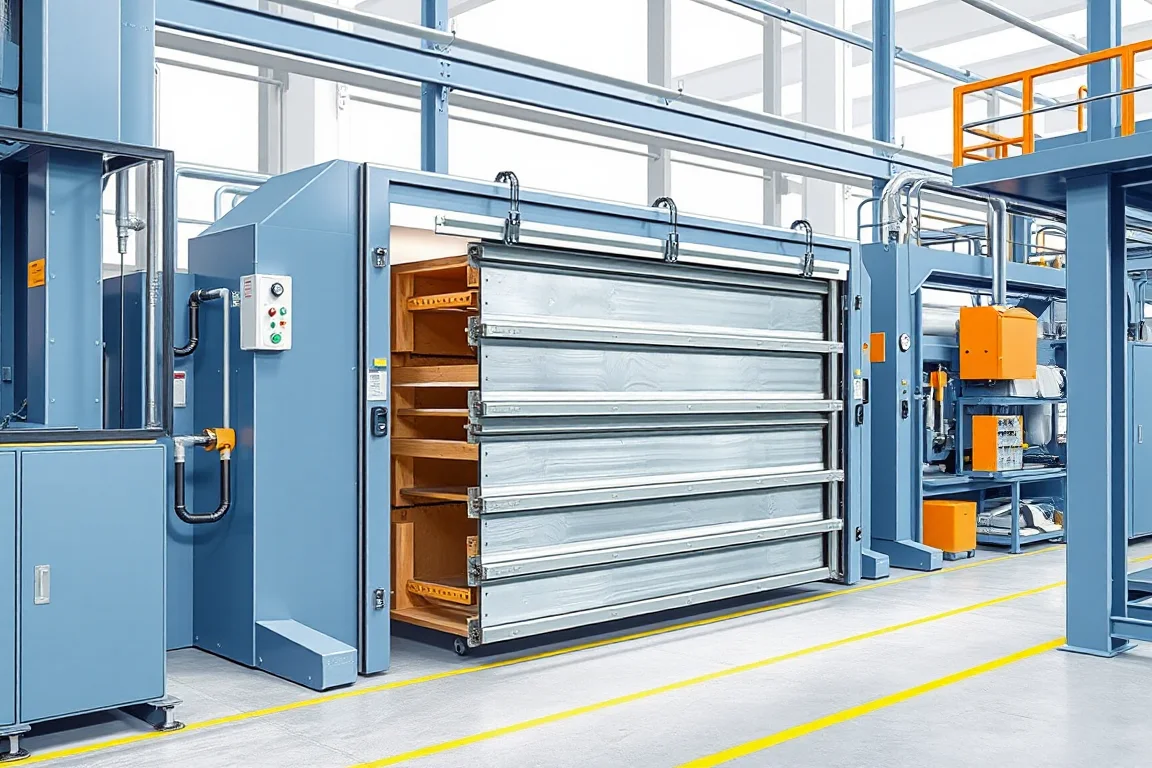
What Makes a Garage Door Panel Different from a Wall or Roof Panel
A garage door sandwich panel is not simply a flat insulated board. It is a structural and moving component of a sectional door. When the door opens, each panel rotates about hinges and travels along tracks. The panel edges, facing geometry and core bonding therefore have to work together through repeated articulation. A wall or roof panel is normally fixed in place and its primary duties are spanning, weather sealing and insulation. A garage door panel also has to align with adjacent panels, accept hinges and rollers, compress or slide against seals, and present a face that remains visually consistent across the closed door.
That difference changes what a production line must control. The line still combines facings, a core and a bonding process, but the profile it produces must match the door system's joint design, hardware interfaces and travel envelope. A panel that is geometrically correct as a flat sandwich can still fail as a door component if the edge joint does not close cleanly, if hinge locations are not consistent, or if the core bond is damaged by repeated flexing.
Panel Interfaces: Joints, Hinges and End Conditions
The most important interface on a garage door panel is the edge joint. Sectional doors use a joint that allows adjacent panels to rotate relative to each other while limiting air and water passage. The joint may be formed into the metal facing itself, or it may involve separate profiles. In either case, the joint geometry has to be produced consistently along the full panel length. Variation in the joint affects how the door hangs, how seals contact, and how the door looks when closed.
Hinge and roller interfaces are equally specific. Hinges are usually attached at defined positions along the panel edges, and those positions must be repeatable from panel to panel. If the facing is too thin or the core too soft at the attachment point, the hardware may not hold or may crush the panel. Producers therefore need to consider where fasteners will be placed and how the panel construction supports them. End conditions matter too: the top and bottom edges of the door may use different profiles or reinforced areas, and the production line must be able to cut and form those ends without degrading the joint or the core.
Core Types and Why They Do Not Share One Production Route
Expanded polystyrene, mineral wool and reactive polyurethane-family foams behave differently during production. EPS is typically supplied as pre-expanded blocks or boards that are cut or shaped and then bonded to facings. Mineral wool is denser, often supplied as boards or batts, and may require different handling to avoid crushing or dust generation. Reactive foams are dispensed as liquids that expand and cure in place between facings, which means the line must manage mixing, dispensing, rise and cure as part of the process.
These differences are not minor variations on a single theme. A line configured for continuous lamination of EPS boards may not be suitable for dispensing reactive foam. A line set up for reactive foam may not have the board handling and dust control needed for mineral wool. The production route has to follow the core material, not the other way around. The core also affects bonding: some cores bond readily with common adhesives, while others need surface preparation or a specific adhesive system to achieve a reliable bond.
Production Routes: Continuous, Discontinuous and Core-Board Lamination
Continuous pressing is common for long runs of a consistent profile. Facings are fed from coils, core material is introduced, and the assembly passes through a continuous press or double-belt system that applies heat and pressure while the bond develops. The line then cuts panels to length. This route suits high-volume production of a stable panel design, but it requires careful control of facing tension, core feed and press conditions.
Discontinuous pressing uses a press that opens and closes on a batch of panels. It can be more flexible for varied lengths, thicknesses or small batches, and it may be easier to change over between profiles. The trade-off is that cycle time includes loading, pressing, curing and unloading, so output is measured in batches rather than continuously.
Core-board lamination is different again. Pre-formed core boards are bonded to facings, often with an adhesive, and the assembly may pass through a press or roller system. This route can suit EPS and some mineral wool constructions, but it depends on the core board already having the correct thickness and surface quality. Each route has its own cutoff and handling requirements, and each places different demands on the panel joint and facing geometry.
Facing Preparation and Forming
Metal facings for garage door panels are usually roll-formed to create the joint profile, stiffening ribs and any hinge landings. The roll-former must produce a consistent profile across the coil width and along the length. Facing preparation may also include cleaning, primer application or adhesive application, depending on the bonding system. If the facing is painted or coated, the coating must be compatible with the adhesive or foam, and the forming process must not damage the coating at the joint.
The facing gauge and grade are specified by the buyer and verified by the supplier for the intended operating range. Thinner facings can reduce weight but may be more prone to oil-canning or deformation at hinge points. Heavier facings add stiffness but affect roll-forming loads and handling. The production line must be set up for the specified facing, and the roll-former should be capable of producing the required profile without excessive thinning at bends.
Core Preparation, Dispensing and Bonding
For reactive foam cores, core preparation is a chemical process. Two or more components are metered, mixed and dispensed onto the facing or into the cavity. The foam then expands and cures. The line must control temperature, mix ratio and dispensing pattern so that the foam fills the cavity consistently and bonds to both facings. Chemical processing requires specialist safety controls, ventilation and waste handling, and the equipment must be appropriate for the specific foam system.
For board cores, bonding may use an adhesive applied to the facing or the core. The adhesive must be compatible with both materials and with the production speed. In continuous lamination, the press applies pressure while the adhesive sets. In discontinuous pressing, the press closes on a stack and holds it until the bond is strong enough to handle. Bond quality is affected by surface cleanliness, adhesive spread, press pressure and cure time. A weak bond may not show immediately but can lead to delamination in service, especially where the panel flexes at the joints.
Cutoff Requirements and End Quality
Garage door panels are cut to length after bonding. The cutoff must be able to cut the full sandwich without crushing the core or distorting the joint. For some profiles, a flying cut-off is used; for others, the panel may be stopped and cut. The cut end quality matters because it may be visible or may need to accept end caps, seals or hardware. The cutoff also affects the panel length tolerance, which in turn affects how the door fits together.
Secondary operations may include punching or drilling for hinges, notching for locks or handles, and forming reinforced areas. These operations should be considered part of the production line scope if they are needed to produce a finished panel. If they are omitted, the buyer may need separate equipment or manual operations, which can affect output and consistency.
Inspection and Acceptance for Garage Door Panels
Acceptance checks should focus on the features that matter for a moving door panel. Facing geometry should be inspected against the drawing, including joint profile, rib dimensions and hinge landings. Joint fit should be checked by assembling adjacent panels or by using a gauge that represents the mating profile. Bond quality should be assessed under an agreed test plan, which may include peel or shear tests on samples, or non-destructive checks such as tap testing. Core properties relevant to the application, such as density or compressive strength, should be verified for the specified core material.
Thermal or fire classifications concern a verified panel assembly, not a label on the production line. If the door requires a specific rating, the complete assembly, including facings, core, joints and hardware, may need to be tested or certified. The production line itself does not confer a rating; it must be capable of producing panels that meet the assembly's requirements consistently.
It is also useful to fit representative hinges, seals and other specified components to a sample panel and inspect the joint after bonding and cutoff. Door-system operation and performance require the finished assembly rather than approval of an isolated panel face. A panel that passes a flat bond test may still fail when assembled into a door and cycled.
Output and Quotation Scope
Curing or bonding requirements can set the achievable production rate. In continuous lamination, the line speed may be limited by the time needed for the foam to rise or the adhesive to develop strength. In discontinuous pressing, cycle time includes press time. Comparing only the facing roll-former speed can be misleading. The realistic output is the number of accepted panels per shift after the process has stabilized, using the actual profile and material.
A quotation should be compared against the written equipment scope. This includes not only the main line but also chemical or adhesive handling, presses, extraction, cutting and quality-control equipment where required. Utilities and safe handling provisions can materially change the project scope. The buyer should state the electrical supply, including voltage, frequency and phase, and the installed power should be confirmed from a complete equipment schedule rather than assumed.
Practical Checklist for Evaluating a Production Line
- Panel drawing and joint design: Confirm the profile, joint geometry and hinge interfaces are fully defined.
- Core type and bonding route: Match the line configuration to the specific core material and adhesive or foam system.
- Facing specification: Verify the base-metal thickness and grade, and confirm the roll-former is set for that facing.
- Process sequence: Check that facing preparation, core introduction, bonding, curing and cutoff are all included.
- Cutoff and secondary operations: Confirm the cutoff method suits the profile and that any required punching or notching is in scope.
- Output definition: Define accepted panels per shift with the actual profile and material, not just line speed.
- Inspection plan: Agree on checks for facing geometry, joint fit, bond quality and core properties.
- Assembly testing: Plan to fit hinges, seals and other components to a sample panel and assess the joint after bonding and cutoff.
- Utilities and safety: Include chemical handling, ventilation, extraction and waste provisions in the scope.
- Documentation: Obtain a clear equipment schedule and a written scope that matches the quotation.
Comparison of Alternative Production Approaches
Continuous lamination is often chosen for high-volume production of a single panel design. It can produce long runs with consistent quality, but changeover between profiles or core types can be time-consuming. Discontinuous pressing offers more flexibility for varied lengths and smaller batches, but output is lower and depends on press cycle time. Core-board lamination can be simpler for EPS or mineral wool, but it relies on pre-formed core boards and an adhesive system that works with both the core and the facing.
When comparing these routes, consider the intended product mix, the required output, the core material and the level of automation. A line that is flexible may have lower peak output, while a high-output line may be less adaptable. The right choice depends on the door designs to be produced, the expected order pattern and the available labor and technical support. It is also worth considering how each route handles the specific joint and hinge interfaces of the garage door panel, because those details often determine whether the finished door operates smoothly.
FAQ
Can a garage door sandwich panel production line also make wall or roof panels?
Some equipment may be adaptable, but the profile and joint design are different. Garage door panels require specific edge geometry and hinge interfaces. A line configured for wall or roof panels may not produce the correct joint without changing roll tooling and cutoff. It is better to evaluate the line against the garage door drawing rather than assume cross-application.
Which core type is easiest to produce on a garage door panel line?
There is no universal easiest. EPS and mineral wool board cores may use simpler adhesive bonding, but they require board handling and dust control. Reactive foams require chemical dispensing and curing control. The choice depends on the required panel properties, the available safety provisions and the production route. Each core type has its own process requirements.
How should I define the output of a garage door panel line?
Define output as accepted panels per shift using the actual profile and material, after the process has stabilized. Include the time for core preparation, bonding, curing and cutoff. Do not rely on the roll-former speed alone, because the slowest step often sets the real rate.
What should be inspected on a finished garage door panel?
Inspect facing geometry, joint fit, bond quality and core properties under an agreed test plan. Fit representative hinges and seals to a sample panel and inspect the joint after bonding and cutoff. Door-system operation and performance require the finished assembly, not just an isolated panel face.
Do thermal or fire ratings come from the production line?
No. Thermal or fire classifications concern a verified panel assembly. The production line must be capable of producing panels that meet the assembly's requirements, but the rating is established by testing or certification of the complete assembly, including facings, core, joints and hardware.
What electrical information should I provide for a quotation?
The buyer should state the voltage, frequency and phase. Installed power requires a confirmed equipment schedule from the supplier, because it depends on the specific line configuration. Providing the supply details early helps ensure the quotation matches the site infrastructure.

Continue your research
- Sandwich Panel Production Lines
- EPS Sandwich Panel Production Line
- Rockwool Sandwich Panel Production Line
- EPS Wall Sandwich Panel Production Line
- EPS Roof Sandwich Panel Production Line
- Rockwool Wall Sandwich Panel Production Line
- How Sandwich panel production line Works
- How To Choose a Sandwich panel production line
- Sandwich panel production line Price: What Affects the Cost?
Configuration & specification inputs
Match the configuration to your section drawing, material and production requirements.
| Parameter | Requirement / confirmation needed |
|---|---|
| Profile geometry | A garage-door sandwich panel must articulate and connect within a sectional door. Edge joints, hinges, facing geometry and core bonding should be evaluated together. |
| Material | Specified metal facings with EPS, mineral wool or formulated foam core as applicable |
| Thickness & grade | Buyer to specify base-metal thickness and grade; operating range requires supplier verification. |
| Process route | Facing preparation/forming → core preparation or dispensing → bonding/pressing → curing → cutoff |
| Cutting | Confirm profile-supported cutoff, cut lengths, end quality and any secondary operations. |
| Output | Define accepted output per shift with the actual profile and material. |
| Electrical supply | Buyer to state voltage / frequency / phase. Installed power requires a confirmed equipment schedule. |
| Acceptance | Fit representative hinges, seals and other specified components. Inspect the joint after bonding and cutoff. Door-system operation and performance require the finished assembly rather than approval of an isolated panel face. |