
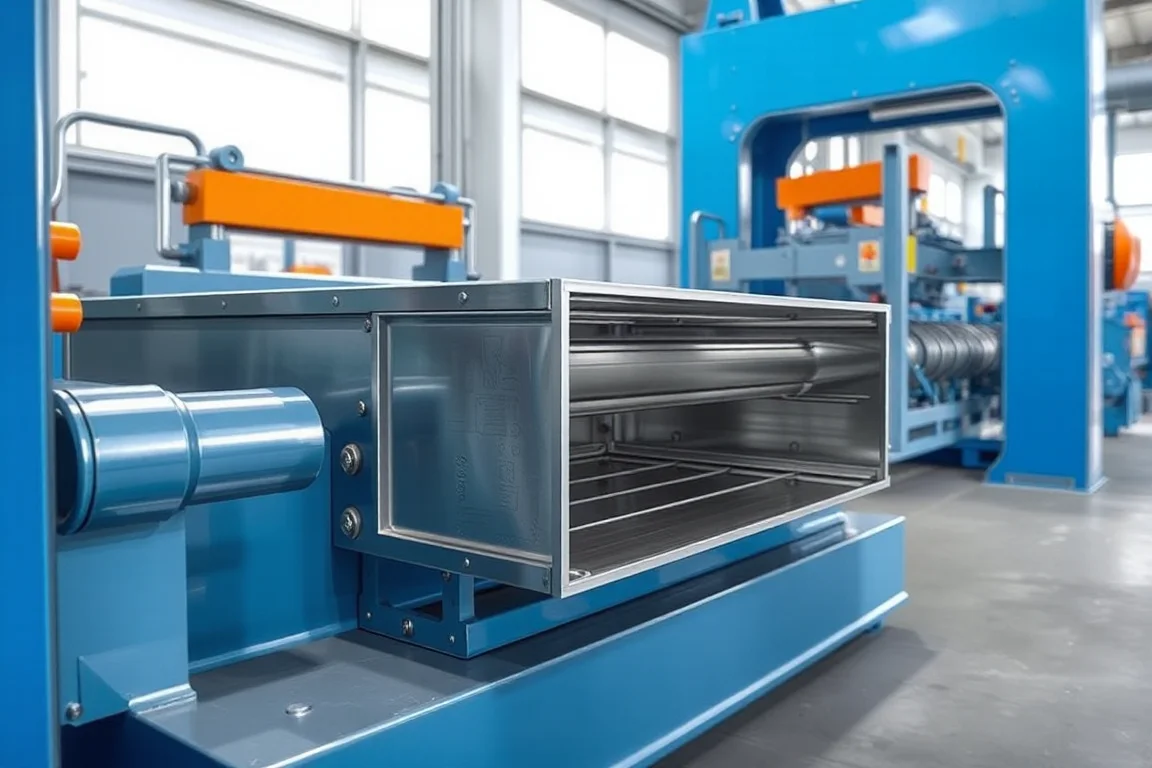
What an electrical cabinet frame roll forming machine produces
An electrical cabinet frame roll forming machine converts metal strip into a constant-cross-section profile that becomes a structural member of an enclosure frame. Typical frame members are vertical posts, horizontal rails and door or panel support sections. These profiles are not simple angles or channels: they often integrate functional interfaces such as a door seal groove, a hinge mounting land, a panel-fixing flange or a return leg that stiffens the section. The roll forming machine forms these features progressively from a flat strip, then cuts the profile to length. The result is a repeatable member that can be assembled into a cabinet frame.
The machine is an application-specific production tool, not a general-purpose fabricator. Its value depends on whether the profile geometry is suitable for continuous forming and whether the expected batch sizes justify dedicated tooling. The machine itself does not create the cabinet enclosure performance; that is determined by the assembled frame, the attached panels, gaskets, fasteners and the joining methods used.
Profile and interface features that drive tooling design
The starting point is a complete cross-section drawing that defines every bend, flange, hole and mating surface. For a cabinet frame, functional datums usually include the face where a door seal compresses, the plane where a hinge mounts, and the surfaces that locate side or rear panels. These interfaces must be controlled because they affect door alignment, seal compression and panel fit. Other dimensions, such as decorative radii or non-critical edge distances, may be less important for function but still affect forming feasibility.
Roll forming develops bends sequentially. The tooling designer reviews each bend for its forming angle, bend radius and whether the strip can be supported through the passes. Features that enclose a space, such as a hemmed return or a re-entrant groove, can restrict roll access and may require special tooling or a different production method. Holes and notches are usually created by punching stations integrated into the line or by a separate operation before forming. The sequence matters: punching after forming can distort the profile, while punching before forming can cause hole deformation during bending.
Material and thickness inputs
The buyer specifies the base-metal grade and thickness. Roll forming can process mild steel, stainless steel and some nonferrous strip, but each material behaves differently. Stainless steel work-hardens and may require more forming stages or larger bend radii. Coated steel needs tooling that does not damage the coating. Incoming strip variation, such as thickness tolerance, yield strength range and surface condition, affects the consistency of the finished profile. The operating range for a given machine is not a fixed rating; it must be verified against the actual strip and profile during feasibility review.
Production route for cabinet frame members
A typical route begins with a feasibility review that checks whether the profile can be formed continuously and whether the required interfaces can be produced reliably. Coil preparation follows, which may include joining coils or feeding strip through a straightener. Progressive forming then bends the strip in a series of roll stands. Secondary features such as holes, slots or embosses may be added by punching stations before or after forming. Finally, a cutoff station separates the profile into the required lengths. The cutoff method must suit the profile; some sections need support during cutting to avoid collapse or distortion. If the frame member requires additional operations such as tapping, welding or notching, those steps are usually outside the roll forming line and must be planned separately.
Assembly boundaries: what the roll former does not do
The roll forming machine produces frame members, not a finished cabinet. Assembly involves joining the members with connectors, welding or fasteners, then attaching doors, panels, gaskets and hinges. The interfaces on the roll formed profile must match the chosen joining method. For example, a hinge mounting land needs a flat area and often pre-punched holes that align with the hinge pattern. A seal groove must accept the specified gasket and provide the intended compression when the door closes. These are assembly requirements, and the roll former must be specified to produce the geometry that supports them. The cabinet's ingress protection or structural performance is assessed on the assembled enclosure, not on the roll forming machine alone.
Comparing production routes: roll forming versus press braking and other methods
Roll forming is economical when the profile has a constant cross-section, the production volume is high enough to amortize dedicated tooling, and the geometry can be formed progressively. It offers consistent repeatability and can integrate punching and cutoff in one line. However, it requires a larger upfront investment in rolls and setup. Press braking is more flexible for low volumes and variations because it uses standard tooling and can produce different shapes with the same machine. It is slower for long runs and less repeatable for complex profiles. Stamping can produce features faster but is usually limited to flat parts or simple bends. Extrusion is suitable for aluminum or plastic profiles but not for formed steel strip. Welded fabrication from standard sections may be appropriate for very small batches or when the frame geometry changes frequently. The decision should consider batch size, expected product variations, profile complexity and the cost of future changes.
Inspection and acceptance for cabinet frame profiles
Inspection should focus on functional datums and mating features rather than tolerancing every dimension equally. For a cabinet frame, that means checking the seal groove width and position, hinge mounting hole pattern, panel-fixing flange location, and the overall straightness and twist that affect assembly. The section should be inspected in a defined free or restrained state, and the measurement method must be documented. For example, a profile measured in a free state may show springback that disappears when clamped. Inspectors should also check cutoff length, end squareness and any secondary features. Joined members should be checked with their specified connectors or joining method, including coating allowances and the intended gasket where relevant. A first-off piece and a representative steady-production sample should be inspected with the agreed gauges.
Practical checklist for specifying a cabinet frame roll forming line
- Provide a complete cross-section drawing with functional datums, bends, holes and mating interfaces.
- State the base-metal grade, thickness and incoming strip tolerances.
- Confirm the expected batch sizes and product variations to evaluate tooling amortization.
- Decide which secondary operations (punching, notching, tapping) must be integrated or done offline.
- Specify cutoff length, end quality and any profile support required during cutting.
- Define the electrical supply available at the installation site (voltage, frequency, phase).
- Agree on acceptance criteria for critical interfaces and the measurement method.
- Request a feasibility trial using the actual material and profile, not a substitute.
- Review the written equipment scope against all operations needed for a finished frame member.
Common questions about cabinet frame roll forming
Can one roll forming machine produce different cabinet frame sizes?
A single machine can be designed to produce a family of profiles if the cross-sections share similar forming requirements. However, changing profile dimensions often requires changing roll tooling or adjusting roll stands. If the frame sizes vary only in length, the same tooling can cut different lengths. If the cross-section changes, new tooling is typically needed. The practical answer depends on how many distinct profiles are required and whether the machine is configured for quick changeover.
What material thickness can be roll formed for cabinet frames?
The feasible thickness range depends on the material grade, bend radii and profile complexity. A supplier must verify the operating range for the specific profile. Very thin strip may be difficult to feed and form without wrinkling, while thick strip requires more forming power and may limit tight bend radii. The buyer should specify the base-metal thickness and grade, and the feasibility review should confirm whether the machine can handle it.
How are door seal and hinge interfaces created on the profile?
These interfaces are formed into the cross-section by the roll tooling. A seal groove is typically a channel or return leg that holds a gasket. A hinge mounting land is a flat area, often with pre-punched holes that match the hinge pattern. The tooling design must ensure these features are formed accurately and consistently. After forming, the interfaces are checked against the gasket and hinge specifications to confirm fit.
What is the difference between roll forming and press braking for cabinet frames?
Roll forming is a continuous process that uses dedicated rolls to form a constant profile from coil. It is efficient for high volumes and produces consistent parts with integrated punching and cutoff. Press braking is a batch process that bends flat blanks using standard tooling. It is more flexible for low volumes and design changes but slower and less repeatable for complex profiles. The choice depends on batch size, profile complexity and the cost of tooling.
How should the cutoff be specified for a cabinet frame profile?
The cutoff must separate the profile cleanly without crushing or distorting the cross-section. Some profiles need internal support or a shear that matches the shape. The buyer should specify the required cut length tolerance and end quality, such as whether a burr-free end is needed for assembly. The cutoff method may also need to accommodate holes or features near the cut. These requirements should be confirmed during the feasibility review.
What acceptance checks matter most for cabinet frame members?
Functional datums and mating features matter most. Check the seal groove, hinge hole pattern, panel-fixing flanges and overall straightness. Inspect the section in a defined free or restrained state and document the method. Verify joined members with the specified connectors or joining method, including coating allowances and the intended gasket. These checks help ensure the frame assembles correctly and performs as intended.
Output and quotation scope
When evaluating a quotation, separate engineering, roll tools, punch dies, cutoff tools and any future size changes. The cheapest initial arrangement may make later product changes expensive if it lacks flexibility. Include changeover frequency and batch size in the economic evaluation. Define accepted output per shift using the actual profile and material, and record changeover steps, setup scrap, punching time and unloading time. The written equipment scope should match all secondary operations needed for a finished part. Output and power requirements are not verified model ratings; they must be defined and confirmed for the specific application.

Continue your research
- Custom & Industrial Profile Roll Forming Machines
- Custom Profile Roll Forming Machine
- Hat Channel Roll Forming Machine
- C Channel Production Line
- Z Channel Production Line
- Elevator Profile Roll Forming Machine
- How Custom profile roll forming machine Works
- How To Choose a Custom profile roll forming machine
- Custom profile roll forming machine Price: What Affects the Cost?
Configuration & specification inputs
Match the configuration to your section drawing, material and production requirements.
| Parameter | Requirement / confirmation needed |
|---|---|
| Profile geometry | An electrical cabinet frame may need door seals, hinges and panel-fixing interfaces. Review continuous forming against press-braked fabrication for the expected batch sizes and product variations. |
| Material | Specified steel, stainless steel or nonferrous strip after feasibility review |
| Thickness & grade | Buyer to specify base-metal thickness and grade; operating range requires supplier verification. |
| Process route | Feasibility review → coil preparation → progressive forming → secondary features → cutoff |
| Cutting | Confirm profile-supported cutoff, cut lengths, end quality and any secondary operations. |
| Output | Define accepted output per shift with the actual profile and material. |
| Electrical supply | Buyer to state voltage / frequency / phase. Installed power requires a confirmed equipment schedule. |
| Acceptance | Check joined members with their specified connectors or joining method. Include coating allowances and the intended gasket where relevant. Cabinet ingress or structural performance is assessed on the enclosure, not on the roll former alone. |