
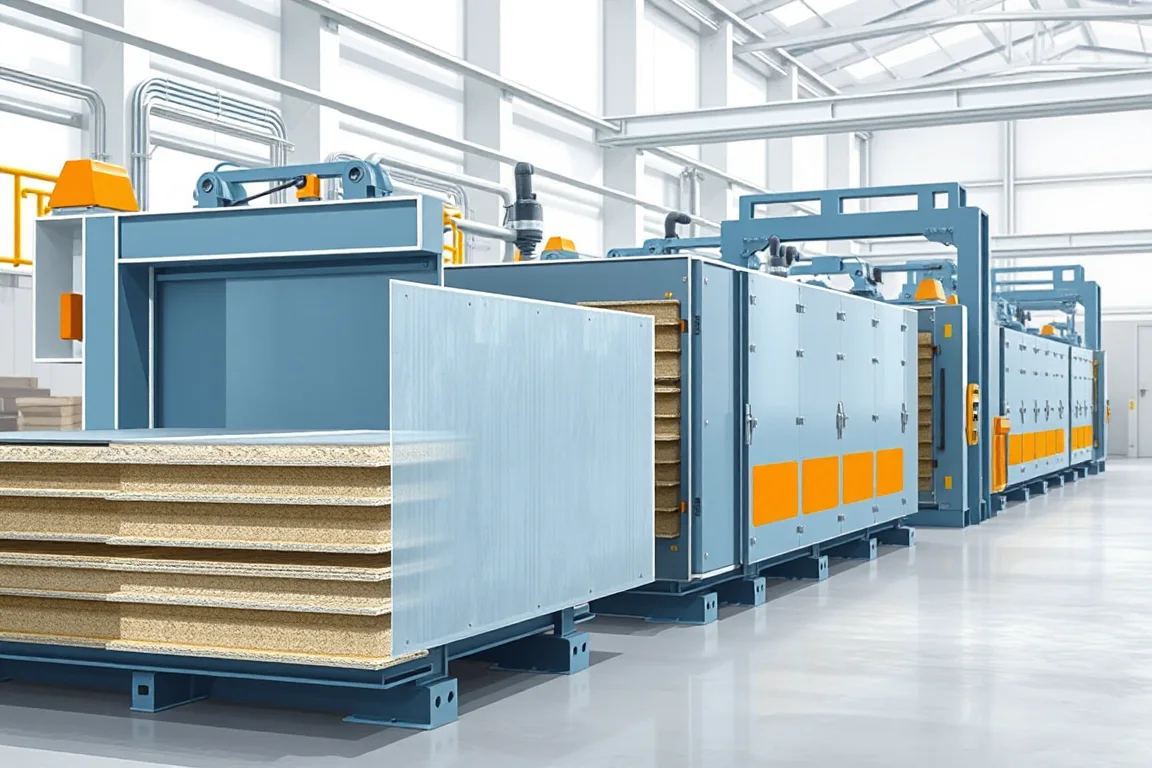
A rockwool sandwich panel production line is not a single machine but a coordinated set of operations that turns coiled metal facings and mineral wool core material into a finished insulated panel with a defined joint. The line must handle the specified core orientation and bonding system; the core material alone does not establish the finished panel’s fire classification. That classification concerns a verified panel assembly, not a label on the production line. This article explains the exact finished profile, interfaces, production route, tooling alternatives, separate operations, changeovers, inspection and accepted output so a buyer can compare quotations on equal footing with the real construction and performance evidence in view.
What the finished profile actually defines
The finished panel is defined by panel width, facing profile, joint design, core type and finished thickness. Every one of those choices travels backward through the line. The facing profile sets the roll forming stations and the edge geometry. The joint design sets the engagement features that must align during bonding and remain stable after curing. Core type and thickness determine how the mineral wool is presented to the facings and how the press or lamination stage closes the assembly. A seemingly small change in joint design can alter the forming rolls, the guide system and the cutoff tooling at the same time. The buyer should begin with a drawing that shows the finished cross-section, the joint in its engaged condition and the tolerance zones, rather than a nominal width alone. That drawing is the reference against which first-off pieces and steady-production samples are judged.
Facing preparation and forming interfaces
Metal facings arrive as coils and pass through a sequence of preparation and forming steps. Preparation covers decoiling, levelling where needed, cleaning or treatment for the adhesive system and, in many layouts, embossing or profiling that gives the visible surface its texture. Forming then produces the edge geometry and the joint features. The interface between preparation and forming matters because surface condition affects bond quality later, while forming accuracy affects joint fit. An embossing roll that is set too aggressively can disturb the flatness a joint needs; inadequate cleaning can leave the adhesive with a surface it cannot reliably grip. The roll former is often the easiest part of the line to discuss, yet it is only one contributor to accepted output. The profile-supported cutoff, the bonding system and the core handling all constrain what the finished panel can be.
Core preparation and orientation for mineral wool
Mineral wool is not a free-flowing core like a reactive foam. It arrives as boards or lamella and must be oriented deliberately. Orientation governs how the fibres sit relative to the facings and the joint, and it influences how the panel behaves in handling, cutting and service. Some constructions use the wool in its as-supplied board form; others use lamella strips set on edge. The chosen orientation has to be stable through bonding, pressing and curing, so the line needs a positive method of presenting the core without crushing it or leaving voids at the edges. Core preparation may include trimming to width, squaring ends, removing dust or loose fibre and staging boards so the bonding stage receives them consistently. Because mineral wool does not flow into shape after placement, the fit between core and facing must be established before bonding rather than corrected afterward. That is a fundamental difference from lines that dispense a liquid or foamed core.
The bonding and pressing route
Bonding is the operation that turns separate facings and a core into one assembly. Adhesive or a chemical bonding system is applied to the facing or the core according to the process specification, and the assembly then passes into a pressing stage. Continuous pressing and discontinuous pressing are different layouts with different implications. A continuous press applies pressure and often heat over a moving bed, which suits steady production of a consistent profile. A discontinuous press closes on discrete lengths, which can suit varied thicknesses or a wider product mix but introduces cycle time and handling between closes. In both cases the press has to distribute pressure without crushing the mineral wool or starving the joint of bond. Curing follows or overlaps with pressing, depending on the system. Curing or bonding requirements can set the achievable production rate, so the facing roll-former speed alone is not a reliable indicator of accepted output.
Cutoff, end quality and secondary operations
After bonding and curing, the panel is cut to length. Cutoff requirements should confirm profile-supported cutoff, cut lengths, end quality and any secondary operations. Mineral wool core panels need a cutting method that severs the facings cleanly while cutting or shearing the core without tearing the joint edge. The cutoff has to be synchronised with the moving panel if the line runs continuously, or sequenced with the press cycle if it does not. End quality matters because the cut face is often visible and because ragged ends complicate jointing on site. Secondary operations can include punching or notching for fixings, edge sealing, labelling and stacking. These operations are sometimes quoted separately, so the written equipment scope should be compared with every operation needed to produce a finished part, not only the main line.
Tooling alternatives and changeover implications
Tooling choices determine how flexibly the line can move between products. Roll-formed joint profiles use dedicated forming rolls, so a new joint design usually means new or modified rolls. Cutoff tooling is also profile-specific. Embossing or surface-texture rolls are separate again. A line built around one profile and one thickness can be efficient for that product, while a line intended for several products needs quick-change or modular tooling and a documented changeover procedure. The practical comparison is not simply tooling cost. It is the combination of changeover time, setup scrap, first-off approval effort and the risk of damaging tooling during repeated changes. A line that claims wide flexibility but has no defined changeover steps will often lose usable time, so the buyer should record changeover steps, setup scrap, punching and unloading time as part of the evaluation. Where thickness changes, the press, guides and cutoff all need to accommodate the new dimension without compromising joint fit.
Separate operations: drawing, material and process specification
Three inputs sit outside the machine itself and should be settled before the line is assessed. The drawing defines panel width, facing profile, joint design, core type and finished thickness. The material specification covers base-metal thickness and grade for the facings, the mineral wool grade and orientation, and the adhesive or chemical system. The process specification covers facing preparation, adhesive or chemical system, core properties and storage conditions. Mineral wool and adhesive systems are sensitive to moisture and contamination, so storage conditions belong in the specification rather than being treated as a workshop detail. Chemical processing needs specialist safety controls, including handling, ventilation and extraction provisions where the adhesive system requires them. These separate operations materially affect project scope because utilities and safe handling provisions are part of the environment the line needs to run.
Production route to review and how output is defined
The route to review is facing preparation or forming, then core preparation or dispensing, then bonding or pressing, then curing, then cutoff. Output should be defined as accepted output per shift with the actual profile and material, not as a single headline rate. Curing or bonding requirements can cap the rate below the forming speed, and handling after cutoff can cap it further. The accepted output figure should state the profile, the core orientation, the facing specification and the thickness range in which that figure is expected to hold. Compare accepted panels after process stabilization rather than only the facing roll-former speed. The joining process and product handling can govern usable production. Panel support after cutoff should be included so the accepted assembly is not damaged during receiving, stacking or transfer.
Inspection and acceptance checks
Inspection should cover facing geometry, joint fit, bond quality and the relevant core properties under an agreed test plan. Facing geometry checks confirm that the profile matches the drawing and that edges are square and consistent. Joint fit checks confirm that panels engage as intended, which is a shop-floor test of the forming and bonding combination. Bond quality checks look for voids, weak zones and delamination at the facings and joint. Core property checks follow the agreed plan for the mineral wool and the finished assembly. Thermal or fire classifications concern a verified panel assembly, not a label on the production line, so any such claim should be tied to the tested assembly rather than to the equipment. First-off pieces and a representative steady-production sample should be inspected with the agreed gauges before production is accepted.
Practical checklist before approving a line
- Confirm the finished drawing, joint in engaged condition and tolerance zones.
- List facing base-metal thickness and grade, and core type and orientation.
- State the adhesive or chemical system and the storage conditions it needs.
- Define the production route from facing preparation through cutoff.
- Review cutoff requirements, end quality and every secondary operation.
- Record changeover steps, setup scrap, punching and unloading time.
- Compare the written equipment scope with all operations needed for a finished part.
- Run the agreed material and profile, not an easier demonstration substitute.
- Inspect first-off pieces and a steady-production sample with agreed gauges.
- Define accepted output per shift for the actual profile and material.
- Plan panel support after cutoff to protect the accepted assembly.
- Confirm the electrical supply voltage, frequency and phase, and request a confirmed equipment schedule for installed power.
Frequently asked questions
Does the core material alone determine the fire classification of a rockwool sandwich panel?
No. The fire classification belongs to a verified panel assembly, including the facings, the joint and the bonding system. The production line can form and bond the assembly, but the classification evidence comes from testing the finished construction, not from the equipment or from the core material in isolation.
Why is mineral wool handled differently from a foamed core on the same line concept?
Mineral wool arrives as boards or lamella and does not flow into shape after placement, so it must be oriented and fitted before bonding. A reactive foam is dispensed and expands into the cavity. The two require different core-preparation or dispensing stages, different press behaviour and different quality checks, which is why they do not share one universal production route.
What does the cutoff need to achieve on a mineral wool panel line?
Cutoff should sever the facings cleanly and cut or shear the core without tearing the joint edge. It must be synchronised with the moving panel or sequenced with the press cycle, produce acceptable end quality and support any required secondary operations such as punching or notching.
How should output be compared between quotations?
Compare accepted output per shift for the actual profile and material, after process stabilisation. Curing or bonding requirements can set the achievable production rate below the facing roll-former speed, and handling after cutoff can reduce it further.
What should be inspected before a line is accepted?
Inspect facing geometry, joint fit, bond quality and the relevant core properties under an agreed test plan. First-off pieces and a representative steady-production sample should be measured with the agreed gauges, and changeover steps, setup scrap and unloading time should be recorded.
How do tooling choices affect changeover and product mix?
Dedicated forming and cutoff tooling suits a single profile and thickness, while modular or quick-change tooling supports a wider mix at the cost of changeover procedure and setup scrap. The practical comparison is the combined effect on changeover time, first-off approval and tooling risk, not tooling cost alone.
Why the finished assembly, not the line, carries the claim
Thermal or fire classifications concern a verified panel assembly, not a label on the production line. That boundary should shape how a rockwool sandwich panel production line is specified, quoted and accepted. The buyer should define the drawing, material and process specification first, then review the production route, tooling alternatives, separate operations and inspection plan against the accepted output that the actual profile and material can deliver. When quotations are compared on that basis, the line is judged by the finished panel it reliably produces rather than by a headline rate or an equipment label.

Continue your research
- Sandwich Panel Production Lines
- EPS Sandwich Panel Production Line
- PU Sandwich Panel Production Line
- EPS Wall Sandwich Panel Production Line
- EPS Roof Sandwich Panel Production Line
- Rockwool Wall Sandwich Panel Production Line
- How Sandwich panel production line Works
- How To Choose a Sandwich panel production line
- Sandwich panel production line Price: What Affects the Cost?
Configuration & specification inputs
Match the configuration to your section drawing, material and production requirements.
| Parameter | Requirement / confirmation needed |
|---|---|
| Profile geometry | A mineral-wool panel line must handle the specified core orientation and bonding system. Core material alone does not establish the finished panel’s fire classification. |
| Material | Specified metal facings with EPS, mineral wool or formulated foam core as applicable |
| Thickness & grade | Buyer to specify base-metal thickness and grade; operating range requires supplier verification. |
| Process route | Facing preparation/forming → core preparation or dispensing → bonding/pressing → curing → cutoff |
| Cutting | Confirm profile-supported cutoff, cut lengths, end quality and any secondary operations. |
| Output | Define accepted output per shift with the actual profile and material. |
| Electrical supply | Buyer to state voltage / frequency / phase. Installed power requires a confirmed equipment schedule. |
| Acceptance | The joining process and product handling can govern usable production. Ask how the line accommodates changes in thickness and length. Include panel support after cutoff so the accepted assembly is not damaged during receiving. |