
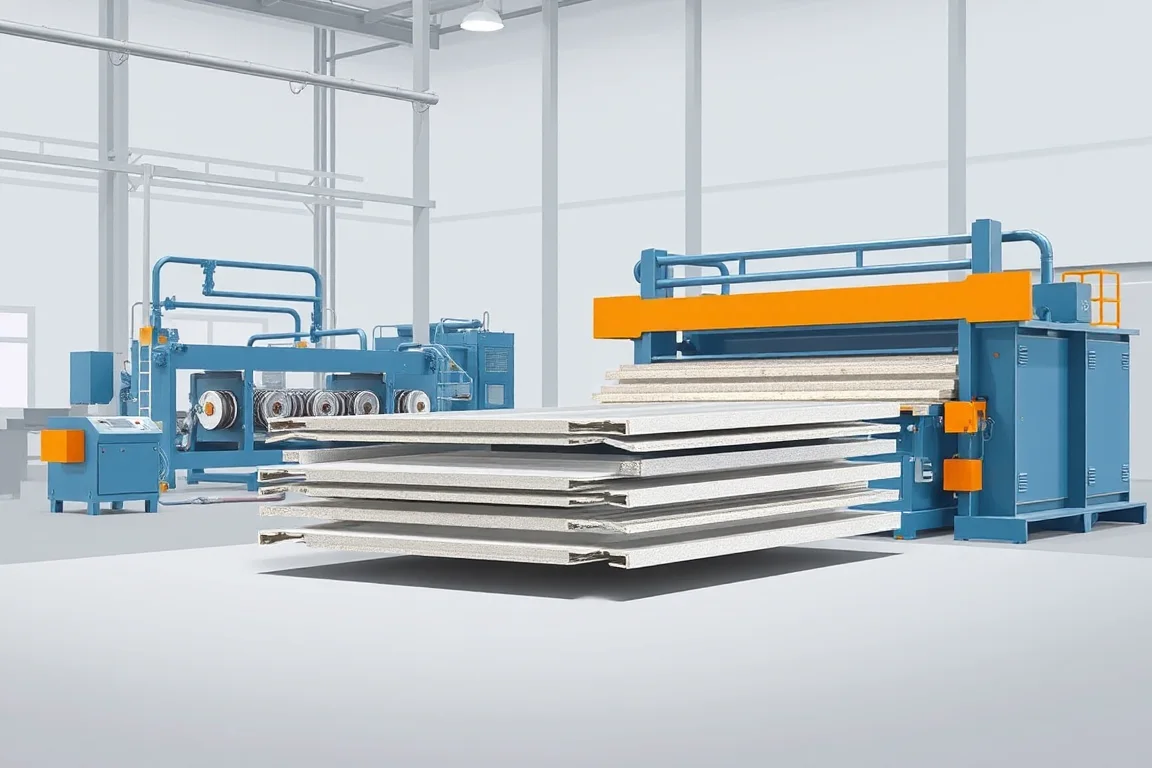
A continuous sandwich panel production line is not a single machine but a coordinated sequence that converts coil or sheet facings, an insulating core, and a bonding system into a finished panel with a defined edge profile. The line links facing preparation or forming, core delivery, pressing or bonding, curing, and cutoff. Because these stages interact, the practical output is set by the slowest required step—often curing or bonding rather than the speed of the facing roll former.
This article explains the exact finished profile and interfaces, the production route, tooling alternatives, separate operations, changeovers, inspection and accepted output. It treats the line as a system that must be matched to a specific panel drawing and material system. EPS, mineral wool and reactive polyurethane-family foams do not share one universal route, so the process sequence and equipment scope change with the core type and joint design.
What the line actually produces: finished profile and interfaces
The finished product is a panel with a defined width, thickness and edge joint. The joint may be a tongue-and-groove, a cam-lock or a hidden-fixing profile. These features are created by the facing geometry, not by the core alone. The line must therefore hold facing dimensions through forming, feeding and bonding so that panels engage consistently during installation.
Interfaces matter as much as the panel face. The line connects to coil handling or sheet feeding, adhesive or chemical supply, compressed air, extraction, electrical supply and control networks. Each interface has its own tolerance for position, speed and timing. If the facing feed is not synchronized with core delivery or cutoff, the finished cut length and joint fit will vary. A continuous line also has a length-control interface: the cutoff must follow the moving panel without disturbing the bond or distorting the profile.
Facing preparation and forming: what the roll former must achieve
Facing preparation may include decoiling, leveling, cleaning, pretreatment, adhesive application and roll forming. For profiled facings, the roll former creates the ribs, flanges and joint geometry. The quality of this step determines whether the panel closes correctly and whether the joint seals as intended.
Roll tooling is profile-specific. Changing panel width or joint design generally requires different forming rolls or adjustable tooling, not just a control setting. The line's forming section must also accommodate the specified base-metal thickness and grade without marking the coating or exceeding the material's forming limits. The buyer should specify base-metal thickness and grade; operating range requires supplier verification. The line's ability to run thinner or thicker facings is not universal and must be confirmed against the actual drawing.
Core delivery: EPS, mineral wool and reactive foam are different projects
The core is where continuous lines diverge most. Expanded polystyrene (EPS) can be supplied as pre-expanded blocks or boards that are cut and fed into the line, or as beads that are expanded and fused in a separate operation. Mineral wool is typically supplied as pre-formed lamella or board strips that are laid into the panel. Reactive polyurethane-family foams are dispensed as liquid components that expand and cure within the panel cavity.
These differences change the equipment scope. EPS board feeding needs accurate placement and edge control. Mineral wool needs dust extraction and a method for holding the wool in position during pressing. Reactive foam requires metering, mixing and dispensing equipment, plus ventilation and chemical handling provisions. The production route for reactive foam also includes a curing tunnel or holding section where the foam completes its reaction. The buyer should state the core type and whether it is supplied as board, strip or liquid system.
Bonding and pressing: continuous versus discontinuous layouts
Continuous pressing uses a moving stack or double-belt press that applies pressure and heat while the panel travels. Discontinuous pressing uses a stationary press that opens and closes for each panel or batch. Core-board lamination is a third layout, where pre-formed core boards are coated with adhesive and laminated to facings in a separate press.
The choice affects the finished profile and the production rate. Continuous pressing can produce long panels without interrupting the bond line, but the press must be matched to the curing behavior of the adhesive or foam. Discontinuous pressing may suit lower volumes or thicker panels that need longer pressing time, but it introduces start-stop handling and more transition scrap. The buyer should confirm the required curing method and length-control method, because these determine whether a continuous layout is appropriate.
Cutoff and end finishing: holding the profile while cutting
The cutoff is a flying saw or shear that travels with the panel and cuts it to length. Its design must support the specific profile. A cutter that works on a flat facing may crush or distort a deep rib or a joint flange. The cutoff also affects end quality: burrs, deformation or incomplete cuts create rework and can compromise joint engagement.
Length control is part of the cutoff interface. The line may use a measuring wheel, an encoder on the drive, or a marking system that triggers the cut. Any secondary operations—such as end milling, notching for corner details, or punching for fasteners—may be separate from the cutoff or integrated into it. The buyer should confirm profile-supported cutoff, cut lengths, end quality, and which secondary operations are included in the line scope and which are separate.
Changeovers: what changes when the panel does
Changeover is not only a matter of adjusting a few settings. A new panel width, thickness, joint design or core type can require different forming rolls, different core feeding or dispensing settings, different press gap and pressure, and different cutoff tooling. The time and scrap produced during changeover are part of the line's real performance.
Tooling alternatives range from dedicated fixed rolls to adjustable or interchangeable cassettes. Adjustable tooling can reduce changeover time for small variations, but it may not achieve the same profile accuracy as dedicated rolls. Interchangeable cassettes can speed a width change, but they add handling and alignment steps. The buyer should ask how a new panel type, thickness or material system is introduced and how transition output is identified. Include startup, changeover and accepted-product quantities in the production comparison.
Separate operations and the boundary of the line scope
A continuous sandwich panel production line does not necessarily include every operation needed to finish a panel. Coil coating, foam block production, board cutting, edge sealing, packaging and testing may be separate. Reactive foam requires chemical storage, metering and safety controls that may be outside the line supplier's scope. Mineral wool handling may require extraction and dust control equipment.
The buyer should compare the written equipment scope with all secondary operations needed for a finished part. A line that produces a cut panel may still require edge trimming, joint cleaning or end capping before the panel is accepted. Utilities—electrical supply, compressed air, water, extraction and drainage—can materially change the project scope. The buyer should state voltage, frequency and phase; installed power requires a confirmed equipment schedule.
Inspection and acceptance checks for the finished panel
Inspection should begin with the panel construction, not with the line's speed. The agreed test plan should cover facing geometry, joint fit, bond quality and the relevant core properties. Bond quality can be assessed by peel or shear tests on representative samples, and joint fit can be checked with the gauges or mating pieces used in installation. Core properties depend on the material: density, compressive behavior, fire performance and thermal performance are separate characteristics.
Thermal or fire classifications concern a verified panel assembly, not a label on the production line. A line that can produce a panel of a given thickness does not automatically confer a classification. The buyer should require the supplier to identify which tests are performed on the line and which are performed on the finished assembly by independent means. First-off pieces and a representative steady-production sample should be inspected with the agreed gauges. Compare accepted panels after process stabilization rather than only the facing roll-former speed.
Output: stable running speed versus whole-order efficiency
No verified model rating applies to a generic line. Accepted output per shift must be defined with the actual profile and material. The slowest required process, including curing, sets the practical production rate. A line may form facings quickly but still be limited by the curing time of the adhesive or foam, or by the time needed to place mineral wool accurately.
Whole-order efficiency includes startup, changeover, setup scrap, punch and unloading time, and any stops for quality checks. The buyer should compare accepted panels per shift after process stabilization, not the maximum speed of a single component. A production target should be expressed as accepted output per shift with the actual profile and material, and it should include the quantities lost during startup and changeover.
Practical checklist for specifying a continuous line
- Start with the panel drawing: width, thickness, joint design, facing profile and core type.
- State the facing material, base-metal thickness and grade, and any coating or pretreatment requirements.
- Specify the core system: EPS board, mineral wool board or strip, or reactive foam, and how it is supplied.
- Confirm the production route: facing preparation or forming, core preparation or dispensing, bonding or pressing, curing and cutoff.
- Check whether the cutoff supports the specific profile, and identify any secondary operations that are separate.
- Ask how a new panel type, thickness or material system is introduced and how transition output is identified.
- Review the written equipment scope against all secondary operations needed for a finished part.
- State voltage, frequency and phase, and require a confirmed equipment schedule for installed power.
- Agree on an acceptance test plan covering facing geometry, joint fit, bond quality and core properties.
- Compare accepted output per shift, including startup, changeover and accepted-product quantities.
Frequently asked questions
Can one continuous sandwich panel production line make EPS, mineral wool and foam panels?
Not in a universal way. The core delivery and bonding stages differ fundamentally. EPS board feeding, mineral wool placement, and reactive foam dispensing require different equipment and controls. A line configured for one core type may be adapted to another only with significant changes to feeding, pressing, curing and extraction. The buyer should specify the core type or clearly define which core systems the line must handle.
What determines the practical production rate of a continuous line?
The slowest required process sets the practical rate. In many cases this is curing or bonding, not the facing roll former. Reacting foam needs time to expand and cure, and mineral wool placement may need careful positioning. The buyer should define accepted output per shift with the actual profile and material, and compare accepted panels after process stabilization.
How is the finished profile controlled during cutoff?
The cutoff must follow the moving panel and support the specific profile. A flying saw or shear that is not matched to the joint geometry can deform ribs or flanges. Length control may use a measuring wheel or encoder, and secondary operations such as notching or punching may be separate. The buyer should confirm profile-supported cutoff, cut lengths and end quality.
What should be inspected on first-off and steady-production panels?
Inspection should cover facing geometry, joint fit, bond quality and the relevant core properties under an agreed test plan. Bond quality can be checked by peel or shear tests on representative samples. Joint fit can be checked with installation gauges or mating pieces. Core properties such as density and compressive behavior are separate from facing and bond checks, and thermal or fire classifications concern a verified panel assembly rather than a line label.
Does a continuous line include all secondary operations needed for a finished panel?
Often it does not. Edge trimming, joint cleaning, end capping, packaging and testing may be separate. Reactive foam may require chemical storage and safety controls outside the line supplier's scope. The buyer should compare the written equipment scope with every operation needed for a finished part and identify which are included and which are separate.
How should changeover time and setup scrap be treated in a quotation?
Changeover time and setup scrap are part of the line's real performance. A new panel width, thickness, joint design or core type can require different tooling, press settings and cutoff tooling. The buyer should ask how a new panel type is introduced and how transition output is identified, then include startup, changeover and accepted-product quantities in the production comparison.
Comparing tooling and layout alternatives
Dedicated forming rolls are matched to one profile and typically hold geometry well, but they must be replaced for a different width or joint. Adjustable tooling can accommodate small variations and may reduce changeover time, though profile accuracy can be less consistent. Interchangeable cassettes can speed a width change but add handling and alignment steps. The choice depends on the range of panels the line must produce and how often changeovers occur.
Continuous pressing suits long panels and a steady bond line, but it requires a press length and curing section matched to the adhesive or foam. Discontinuous pressing may suit lower volumes or thicker panels, but it introduces start-stop handling and transition scrap. Core-board lamination is a separate route for pre-formed cores and may be preferable when the core is supplied as a finished board. The buyer should confirm the required curing and length-control method before choosing a layout.
Material handling alternatives also matter. Coil feeding versus sheet feeding, manual versus automated core placement, and integrated versus separate cutoff and notching each change the labor, scrap and floor space required. The buyer should treat these as system choices, not as isolated machine features, because they affect the finished panel and the accepted output per shift.

Continue your research
- Sandwich Panel Production Lines
- EPS Sandwich Panel Production Line
- Rockwool Sandwich Panel Production Line
- EPS Wall Sandwich Panel Production Line
- EPS Roof Sandwich Panel Production Line
- Rockwool Wall Sandwich Panel Production Line
- How Sandwich panel production line Works
- How To Choose a Sandwich panel production line
- Sandwich panel production line Price: What Affects the Cost?
Configuration & specification inputs
Match the configuration to your section drawing, material and production requirements.
| Parameter | Requirement / confirmation needed |
|---|---|
| Profile geometry | A continuous panel line coordinates facing feed, core or chemical delivery, pressing and cutoff. The slowest required process, including curing, sets the practical production rate. |
| Material | Specified metal facings with EPS, mineral wool or formulated foam core as applicable |
| Thickness & grade | Buyer to specify base-metal thickness and grade; operating range requires supplier verification. |
| Process route | Facing preparation/forming → core preparation or dispensing → bonding/pressing → curing → cutoff |
| Cutting | Confirm profile-supported cutoff, cut lengths, end quality and any secondary operations. |
| Output | Define accepted output per shift with the actual profile and material. |
| Electrical supply | Buyer to state voltage / frequency / phase. Installed power requires a confirmed equipment schedule. |
| Acceptance | Ask how a new panel type, thickness or material system is introduced and how transition output is identified. Include startup, changeover and accepted-product quantities in the production comparison. Separate stable running speed from whole-order efficiency. |