
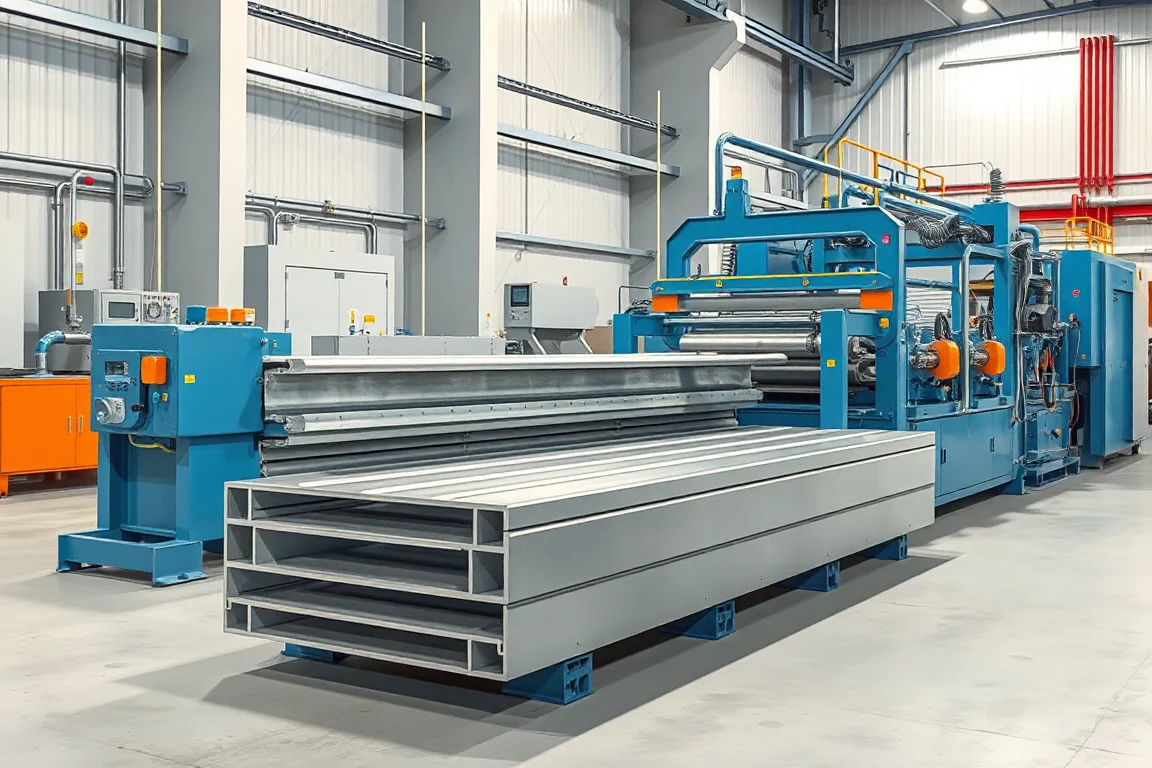
A PU sandwich panel production line is not a single machine but a sequence of operations that turns two prepared metal facings and a formulated polyurethane-family core into a rigid, dimensionally stable panel. The line's job is to hold facing geometry, control the reactive chemical system, bond the layers under controlled pressure and temperature, cure the assembly, and cut it to length without damaging the joint or the core. Because a reactive foam system changes state during production, the line behaves differently from a line that simply laminates pre-formed core boards. Understanding that difference is the first step in selecting equipment.
The finished profile defines the whole line
Selection starts with the panel drawing, not the machine. The drawing shows the facing profile, the joint design, the finished panel thickness and the core type. The facing profile determines the roll former stations, the number of forming passes and the way the panel edges interlock. The joint design determines whether a separate edge-forming station, a foaming dam or a post-cut operation is needed. Finished thickness determines the distance between the facing feed paths and the cavity height in the pressing section. Each of these choices feeds back into the line layout, so a profile change is not a simple die swap.
Facing material matters as much as geometry. Specified metal facings may be coated steel or aluminium in a grade and base-metal thickness the buyer states. The coating type affects forming behaviour, surface preparation and adhesion. A softer or thinner facing can deflect during pressing, which changes the achieved bond and the visual surface. The line therefore has to be configured around the facing the buyer intends to run, not a generic metal sheet.
Core chemistry and why it changes machine architecture
PU sandwich panels use a reactive polyurethane-family foam system: usually two or more liquid components that are metered, mixed and dispensed into the cavity between the facings. The foam expands, gels and cures. This is fundamentally different from EPS, which is typically supplied as pre-expanded blocks or boards that are cut and bonded, and from mineral wool, which is a fibrous board laminated with adhesive. A PU line therefore includes chemical storage, metering, mixing and dispensing equipment, plus extraction and worker-protection provisions. Those items are specialist scope, not generic roll-former options.
Because the foam reacts, timing becomes a process variable. The interval between dispensing and pressing, the temperature of the facings and the cavity, and the pressure profile all influence cell structure, density distribution and bond strength. A line layout that works for a slow-curing system may not suit a faster one, and vice versa. The chemical system, not just the mechanical line, defines the achievable cycle.
Interfaces between the sub-systems
A PU sandwich panel production line has several critical interfaces. The first is between the facing decoiler or feed and the roll former: coil handling, strip alignment and tension control affect profile consistency. The second is between the roll former exit and the dispensing station: the facing must arrive flat, clean and at the correct temperature for adhesion. The third is between dispensing and the press: the pour pattern and the time gap must match the foam reactivity. The fourth is between the press and the cutoff: the panel must be sufficiently cured to cut cleanly, or the cut end will tear or crush.
Control across these interfaces is what separates a workable line from one that produces variable output. The buyer should be able to describe, for each interface, what is measured and what is adjusted. If an interface is left to operator judgement alone, changeover and stabilisation times will be longer.
Production route options
PU panels can be produced on three broad configurations. Continuous pressing runs the facings and dispensed foam through a double-belt or similar continuously moving press, curing under heat and pressure as the panel travels. This suits high-volume, repeat-profile production but demands precise synchronisation of dispensing with line speed. Discontinuous pressing uses a stationary or reciprocating press, dispensing a batch and closing the press for a dwell period. It is more tolerant of slow-curing systems and lower volumes but has a longer cycle. Core-board lamination is a different family altogether: it bonds pre-formed core boards to facings with adhesive rather than dispensing reactive foam, and it belongs to EPS or mineral wool routes rather than PU foam.
The route choice follows the panel specification and the accepted output definition. A buyer who needs frequent profile changes or modest volumes may find discontinuous pressing easier to control. A buyer planning long runs of one profile may prefer continuous pressing. Neither is universally better; each has different changeover, scrap and quality-control implications.
Tooling and roll former alternatives
Roll formers for PU lines are normally dedicated to a facing profile. Alternative arrangements include a single-purpose roll former with fixed stations, or a convertible roll former with interchangeable cassettes for different profiles. Fixed tooling tends to give more stable geometry because stations are set once, but profile changes require commissioning effort or a second machine. Convertible tooling reduces the number of machines but introduces alignment steps and potential variation each time cassettes are changed. The choice depends on the profile mix and how often it changes.
Foam dispensing tooling also has alternatives: fixed pour heads, traversing heads and multi-point injection arrangements. Each distributes the reactive mixture differently across the panel width. The right choice depends on panel width, core thickness and the flow behaviour of the formulated system. A design that works for narrow panels may not fill a wide cavity evenly. Uniform distribution is a prerequisite for consistent density and bond.
Separate operations: forming, foaming, curing, cutting
It helps to treat four operations as distinct. Facing preparation and forming shapes the metal and sets the joint. Foaming meters, mixes and dispenses the reactive system. Bonding and curing hold the assembly under controlled conditions until the foam can carry load. Cutoff divides the cured panel to length. Each operation has its own acceptance criteria and its own failure modes. A defect in facing geometry cannot be corrected by adjusting the foam, and a curing problem cannot be hidden by a cleaner cut. Separating these operations in the project specification makes responsibility clearer and makes acceptance testing more meaningful.
Secondary operations may also be required: end profiling, joint forming, punching for fixings, labelling or stacking. These are sometimes assumed to be included but may sit outside the quoted equipment scope. The buyer should list every operation needed to deliver a finished, installable panel and confirm which are covered.
Changeovers and setup discipline
Changeover between profiles or panel thicknesses involves more than swapping a die. The operator may need to change roll former settings or cassettes, adjust the cavity height in the press, alter the pour pattern, reset the cutoff length and re-establish curing conditions. Each step introduces potential variation, so the first panels after a changeover should be treated as setup material until the process stabilises. Recording the changeover steps, the setup scrap and the time to reach stable output gives a realistic picture of flexible production. A line that runs well in steady state can still be uneconomical if changeovers are slow or produce excessive scrap.
Inspection plan and accepted output
Inspection should cover facing geometry, joint fit, bond quality and the relevant core properties under an agreed test plan. Facing geometry can be checked with gauges against the drawing. Joint fit is assessed by assembling sample panels. Bond quality may be examined by destructive or non-destructive methods agreed in advance. Core properties such as density distribution and cell structure are process outcomes that should be sampled after the line has stabilised, not only at first-off. Thermal or fire classifications concern a verified panel assembly, not a label on the production line, so any claim of that kind must rest on assembly testing rather than equipment marketing.
Accepted output should be defined per shift with the actual profile and material, after stabilisation. Declaring a rate from the roll former alone ignores curing and bonding time, which often set the achievable output. A realistic definition includes good panels, rework and scrap, and the time needed for changeovers and quality checks.
Utilities, safety and project boundaries
The buyer should state voltage, frequency and phase. Installed power requires a confirmed equipment schedule rather than an assumption. Reactive chemical handling requires extraction, spill provision and appropriate personal protection; these are specialist scope. The written equipment scope should be compared with all secondary operations needed for a finished part, and a machine price without those boundaries is not a complete production-system comparison. Follow supplier procedures for operating and cleaning, and treat chemical-system selection and process controls as specialist engineering decisions.
Practical selection checklist
- Panel drawing with facing profile, joint design, core type and finished thickness.
- Facing material grade, coating and base-metal thickness stated by the buyer.
- Reactive chemical system identified, with metering, mixing, dispensing and extraction scope.
- Process route chosen: continuous pressing, discontinuous pressing or a non-PU lamination route.
- Cutoff method matched to profile, cut length and required end quality.
- Secondary operations listed: end forming, punching, stacking, labelling.
- Changeover steps and setup scrap documented.
- Inspection plan covering facing geometry, joint fit, bond quality and core properties.
- Accepted output defined per shift after stabilisation.
- Utilities, supply details and safety provisions confirmed.
Comparison of main alternatives
Continuous pressing versus discontinuous pressing versus core-board lamination is the central comparison. Continuous pressing offers steady flow and suits long runs, but its output depends on synchronising dispensing with line speed and its changeovers can be involved. Discontinuous pressing gives a defined dwell and suits slower systems or smaller batches, but cycle time and press utilisation limit throughput. Core-board lamination uses pre-formed cores and adhesive, which removes reactive chemistry but is a different product family and does not produce a foamed PU core. Within each route, fixed tooling versus convertible tooling and fixed versus traversing pour heads are further choices that trade flexibility against stability. The right combination follows the panel specification and the accepted output definition, not a universal rule.
Frequently asked questions
What determines the achievable output of a PU sandwich panel line?
Curing and bonding requirements often set the achievable rate more than roll former speed. The foam must reach a state where it can carry load and be cut cleanly, and that state depends on the chemical system, facing temperature and press conditions. Accepted output should be measured after stabilisation with the actual profile and material.
Can one line run both PU foam and mineral wool panels?
These are different production routes. PU foam requires metering, mixing and dispensing of reactive chemicals, while mineral wool is typically a pre-formed board bonded with adhesive. Some mechanical sections may be shared, but the core-preparation and foaming equipment differs, so the change is a project-level decision rather than a simple setting.
Why is the joint design important to line selection?
The joint determines how panels interlock and seal, and it drives the facing profile and any edge-forming or post-cut operations. A joint that requires precise edge geometry places tighter demands on the roll former and cutoff. Joint fit is also a key inspection item, because a poor joint affects assembly and weather performance.
How should cutoff be matched to the profile?
Cutoff must suit the profile cross-section, the required cut length and the cured state of the panel. A profile with deep returns or a delicate joint can deform in cutting if the panel is not fully cured or if the blade and support are not matched to the shape. End quality and any secondary operations should be agreed before selection.
What should an acceptance test cover?
Acceptance should cover facing geometry against the drawing, joint fit by assembly, bond quality by an agreed method, and relevant core properties sampled after stabilisation. Thermal or fire classifications require verification of the panel assembly, not the production line, so those claims need separate evidence.
Which utility and safety details belong in the enquiry?
State voltage, frequency and phase, and ask for a confirmed equipment schedule before assuming installed power. Reactive chemicals need extraction, spill provision and worker protection as specialist scope. These provisions can materially change the project, so they belong in the enquiry alongside the mechanical specification.

Continue your research
- Sandwich Panel Production Lines
- EPS Sandwich Panel Production Line
- Rockwool Sandwich Panel Production Line
- EPS Wall Sandwich Panel Production Line
- EPS Roof Sandwich Panel Production Line
- Rockwool Wall Sandwich Panel Production Line
- How Sandwich panel production line Works
- How To Choose a Sandwich panel production line
- Sandwich panel production line Price: What Affects the Cost?
Configuration & specification inputs
Match the configuration to your section drawing, material and production requirements.
| Parameter | Requirement / confirmation needed |
|---|---|
| Profile geometry | A PU panel line can involve reactive chemical metering, dispensing and curing. Treat chemical-system selection, worker protection and process controls as specialist scope rather than generic roll-former options. |
| Material | Specified metal facings with EPS, mineral wool or formulated foam core as applicable |
| Thickness & grade | Buyer to specify base-metal thickness and grade; operating range requires supplier verification. |
| Process route | Facing preparation/forming → core preparation or dispensing → bonding/pressing → curing → cutoff |
| Cutting | Confirm profile-supported cutoff, cut lengths, end quality and any secondary operations. |
| Output | Define accepted output per shift with the actual profile and material. |
| Electrical supply | Buyer to state voltage / frequency / phase. Installed power requires a confirmed equipment schedule. |
| Acceptance | Include the appropriate material-handling, process equipment, utilities, safety systems, cutting and stacking responsibilities. Follow supplier procedures for operating and cleaning. A machine price without those boundaries is not a complete production-system comparison. |