
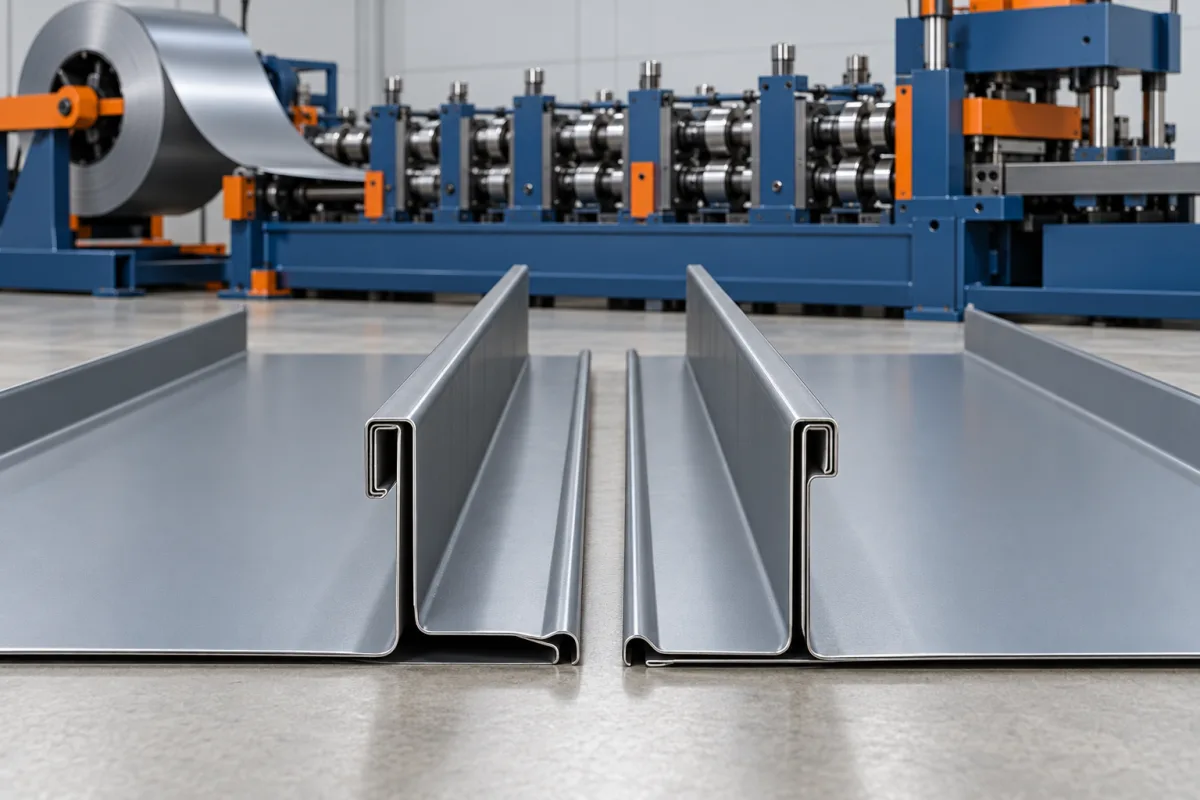
A 2 inch mechanical lock standing seam machine forms roof panels with a nominal 50.8 mm seam prepared for the selected mechanical closing process. The raised edges, clips and final seam shape must be specified together. The height identifies the profile family but does not establish its complete geometry or roof-system performance.
For buyers moving from a shallower seam or adding another product, the main task is to define what changes in tooling, cutoff support, material allowance and closing equipment. A taller edge is a new manufacturing interface, not simply a larger number in a panel program.
What should the two-inch profile package contain?
Provide the open male and female edge shapes, the completed seam and the specified clip relationship. Mark the height datum, returns, clearances and pan dimensions. Include any face ribs, striations or required edge relief.
Identify the closing method and compatible equipment. Two seams with the same nominal height can use different folds or component interfaces. A complete drawing package prevents a loose panel from being approved without knowing how its final joint will be made.
What changes compared with a lower mechanical seam?
The formed edges require their own material development and tool path. Their height also affects cutoff and handling support. The clip and closing equipment may differ, so the product matrix should address more than the main roll set.
Do not infer project suitability from increased height alone. The selected roof system has its own materials, attachments, support and performance requirements. The machine's role is to reproduce the approved manufacturing geometry.
How should the material envelope be established?
List grade or alloy, temper where relevant, base-metal thickness and coating for each proposed panel. Evaluate these combinations through the complete forming and closing route. A broad thickness range without material identities is not a useful approval basis.
Inspect the open edges and completed folds for coating condition. Also assess the pan using agreed support and viewing conditions. Keep coil identification with trial samples so later material substitutions can be evaluated rather than assumed equivalent.
How does the forming line prepare the seam?
Guided coil passes through progressive stages that form the pan and develop the raised mechanical-lock edges. Any specified notches, slots or other features require a defined operation. The cutoff then separates panels while preserving the prepared returns.
Supported takeoff protects the higher edges during transfer. Inspect them near the cut ends and after stacking. A profile can leave the last forming stage correctly but become unsuitable for seaming if downstream contact bends a return.
How should clips and closing equipment be coordinated?
Use the actual clip or its approved reference during assembly trials. Check the open-edge fit and the completed seam with the intended closing equipment. The test should follow the specified sequence, including any starting and finishing requirements.
List responsibility for the closing equipment and any auxiliary tools. They may be outside the roll-former purchase but remain essential interfaces. A machine quotation should not imply that preparing a panel edge completes the installed roof seam.
What is involved in changing profiles or widths?
A pan-width adjustment may be supported within one approved seam family, while a move to another seam height can require different rolls and other parts. Ask for a schedule of guides, tooling, cutoff components and seaming references for each variant.
Measure changeover from the last accepted old panel to the first accepted new closed joint. Include inspection and startup material. That result reflects the real production consequence of offering several seam families from one machine.
How should long-panel logistics enter the decision?
Define the longest required pieces, production location and handling path. Factory manufacture, transport and portable jobsite forming create different constraints. The equipment arrangement must support the panel without damaging its raised edges or visible surface.
Use a representative order when discussing output. Long identical panels may reduce cut events but increase handling demands. Shorter mixed orders may be limited by cutting and sorting. Accepted panels after normal transfer are the useful production measure.
What should a two-inch seam trial prove?
- Confirm open-edge dimensions and pan geometry.
- Verify clip fit and required end preparation.
- Inspect cutoff condition and handling damage.
- Close representative joints with compatible equipment.
- Measure the completed seam and inspect coating.
- Demonstrate required material or profile changes.
- Record accepted output and unresolved deviations.
Keep loose and closed samples as separate references. They help determine whether a later issue originates in forming, handling, component substitution or the closing process.
Frequently asked questions
Does a two-inch seam automatically perform better?
Not as a standalone conclusion. Performance depends on the complete approved roof system and project conditions. Height is one geometric input, not a replacement for system design and verification.
Can a 1.5-inch line be converted?
Only after the equipment and both profiles are reviewed. The conversion may involve rolls, guides, cutoff support and compatible closing equipment. Request an explicit scope rather than assuming a simple adjustment.
Is 2 inches the same as 50 mm?
Two inches equals 50.8 mm. Follow the actual drawing and tolerance. Nominal metric and imperial descriptions should not be used to assume joint compatibility.
Why test the same material through seaming?
The final closing operation adds deformation and establishes the working joint. A loose-panel trial alone cannot show whether that material and coating remain acceptable after the seam is completed.
What should be provided for an enquiry?
Send the complete open and closed seam drawings, clip references, material matrix, widths, lengths and end details. State whether production is in a factory or at the jobsite and identify existing seaming equipment.
Compare complete two-inch panel systems
A sound equipment decision joins the higher formed edge to its clip, cutoff support, handling and closing method. With those interfaces defined, the trial can demonstrate a repeatable finished joint instead of only a tall loose profile.

Continue your research
- Standing Seam Roll Forming Machines
- Standing Seam Roll Forming Machine
- Snap Lock Standing Seam Machine
- 25mm Snap Lock Standing Seam Machine
- 38mm Snap Lock Standing Seam Machine
- 1 Inch Mechanical Lock Standing Seam Machine
- How Standing seam roll forming machine Works
- How To Choose a Standing seam roll forming machine
- Standing seam roll forming machine Price: What Affects the Cost?
Configuration & specification inputs
Match the configuration to your section drawing, material and production requirements.
| Parameter | Requirement / confirmation needed |
|---|---|
| Profile geometry | Nominal 50.8 mm mechanical-seam family with defined open returns, clip and completed joint. |
| Material | Specified grade or alloy, temper and coating for the selected higher-seam section. |
| Thickness & grade | Material-thickness matrix demonstrated through forming, handling and mechanical closing. |
| Process route | Controlled entry, raised-edge forming, specified features, supported cutoff and compatible seam closing. |
| Cutting | Order lengths and end preparation preserving the higher seam and closing access. |
| Output | Accepted finished panels under the stated length mix, changeover and handling scope. |
| Electrical supply | Utilities for the forming line and separately identified closing and handling equipment. |
| Acceptance | Open and closed seam dimensions, clips, cutoff condition, coating and first-good-joint recovery. |