
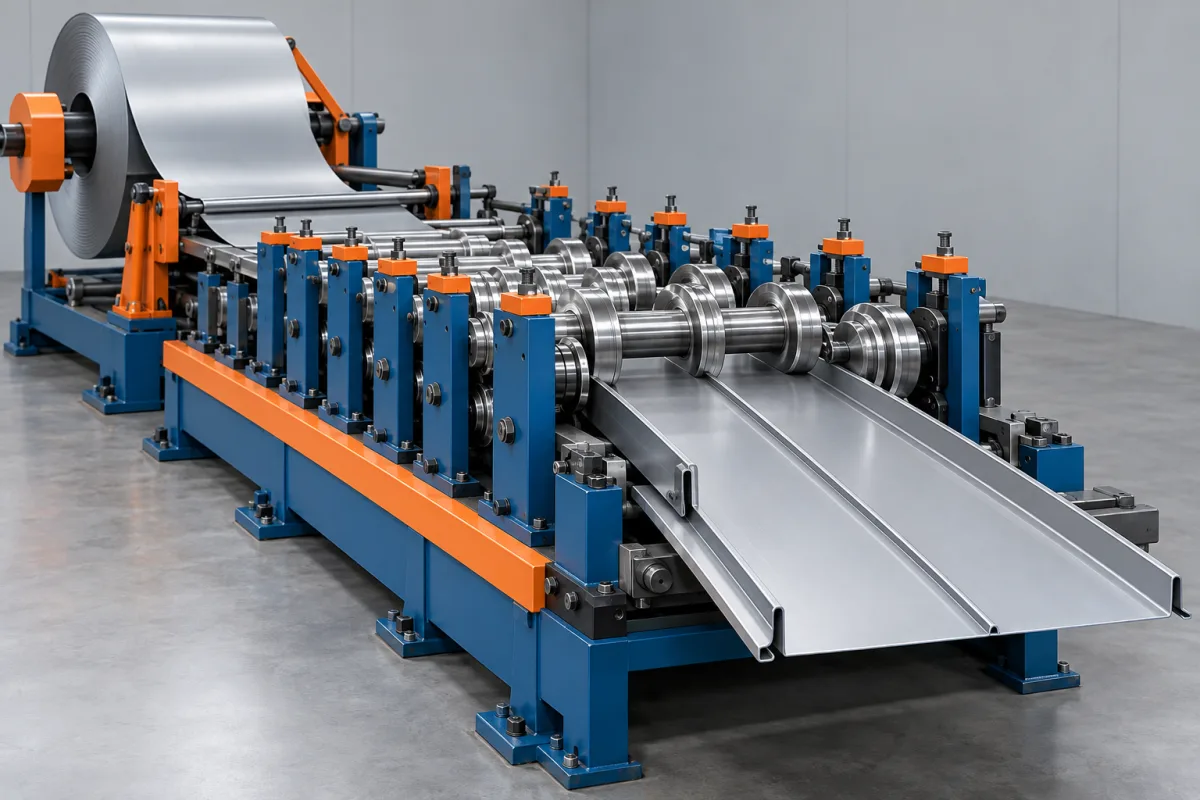
A standing seam roll forming machine makes the two raised edges and connecting pan of a metal roof panel. Those edges later form a specified joint with the adjacent panel and its attachment arrangement. Understanding the difference between forming the panel and closing the installed seam is essential when defining the equipment package.
The panel former and roof seamer perform different jobs
The panel former turns coil into the open or preformed section shown on the product drawing. A field seamer, where required by the selected system, closes the joint after panels are positioned. They are related equipment, but one should not be assumed to be included merely because the other is supplied.
A snap-lock design uses its specified engagement method instead of automatically following the same closing route as a mechanical seam. Some engineered profiles support more than one method, but that is a property of the exact design, not a general feature of all standing seam panels.
Begin with the complete seam assembly
Show both panel edges, the assembled joint and the intended attachment components. Identify whether the system uses separate clips or another defined fixing arrangement. The seam's nominal height does not describe all the surfaces that control fit and closure.
Provide the installation sequence used for approval. A sample may look correct while requiring inappropriate force or local alteration to assemble. Observing the specified assembly process helps reveal a mismatch that a photograph of a closed seam might conceal.
Coil entry establishes material and face orientation
The line receives the approved material in the correct orientation, with the required strip width and surface condition. Record grade or alloy, thickness convention and coating. If protective film or another layer is used, include it in the process definition rather than adding it after the forming trial.
For portable production, entry also depends on the chosen site layout and coil-handling arrangement. The material path, power supply and support of emerging panels must be planned under the equipment's operating requirements. Portability does not remove these production needs.
The pan connects the two forming paths
The central pan and its specified ribs or striations establish the relationship between the edges. Width control must therefore preserve both the panel's intended cover and the position of the seam features. A pan dimension alone is not a complete acceptance check.
Where width adjustment is offered, ask how the approved edge geometry is maintained and which configurations have been reviewed. Length changes, pan-width changes and seam-profile changes are separate capabilities. They should not be grouped under one vague statement that the machine is adjustable.
Successive stages create the functional returns
The tooling progressively develops shoulders, hooks and returns into the required edge shapes. These features need to work together after the strip leaves the tools and after the panel is cut. The material and sequence affect the result, so the final roll shape does not tell the whole story.
Inspect both edges on complete panels and retain their relationship to the drawing references. A good-looking male edge does not prove compatibility with the female edge or clip. The acceptance target is the complete specified joint.
Cutting and discharge preserve the seam ends
Length cutting must leave the functional edges in an acceptable condition. Compare the ends with the central section and check after normal handling. Local damage at an end can obstruct engagement even when the rest of the panel is correctly formed.
Long panels need a supported route away from the machine. Onsite production may reduce some transport constraints but introduces its own access and handling plan. The equipment demonstration should reflect the lengths and support arrangement actually intended.
Joint closure follows the selected roof system
For a mechanically closed seam, the correct seaming equipment and setup belong to the system's instructions. For a snap joint, use its defined engagement procedure and attachments. Do not substitute a similarly sized clip or seamer based only on nominal dimensions.
The production trial should retain the material identity and record how the sample assembled. Geometry, coating condition and any difficulty observed during closure all help assess manufacturing compatibility. Roof-system performance requires its separate design and evidence.
Curved and tapered panels add process questions
A straight-panel former should not automatically be described as making every curved or tapered roof component. Determine how the changing geometry is produced and which extra equipment, tooling or handling is required. The answer depends on the exact panel system and proposed route.
Show the intended geometry in the enquiry, including its relationship to the seam and attachment. A conceptual roof image is not enough to define the manufacturing task. Separate the ability to form an edge from the ability to supply the complete shaped panel.
Follow a trial from coil to closed sample
A useful demonstration includes representative material, lengths and any required width or profile transition. Measure the open section, inspect cut ends, assemble with the specified components and evaluate the resulting joint. Record the time boundary separately from the quality result.
- Confirm the profile, material and attachment references.
- Produce and inspect complete panels.
- Check the pan and both edge geometries.
- Assemble using the selected system's procedure.
- Record closure observations, dimensions and finish condition.
Frequently asked working-process questions
Does the roll former close the roof seam?
It generally produces the panel section. The installed closing operation depends on the roof system and may use a separate seamer or snap engagement. Define both operations explicitly.
Is every raised metal roof joint a mechanical seam?
No. Standing seam includes different joint arrangements. Identify the precise panel and closing method instead of inferring them from the visible seam height.
Can portable production eliminate all handling difficulties?
No. It changes where panels are produced but still needs coil loading, power, discharge support and safe movement of long panels. Plan those interfaces before the site demonstration.
Does a successfully closed sample establish a roof performance rating?
No. It demonstrates aspects of manufacturing compatibility. The complete roof assembly, installation and project conditions require their own applicable design and performance evidence.
Continue your research
- Standing Seam Roll Forming Machines
- Standing Seam Roll Forming Machine
- Snap Lock Standing Seam Machine
- 25mm Snap Lock Standing Seam Machine
- 38mm Snap Lock Standing Seam Machine
- 1 Inch Mechanical Lock Standing Seam Machine
- How To Choose a Standing seam roll forming machine
- Standing seam roll forming machine Price: What Affects the Cost?
- Materials and Thickness for Standing seam roll forming machine