
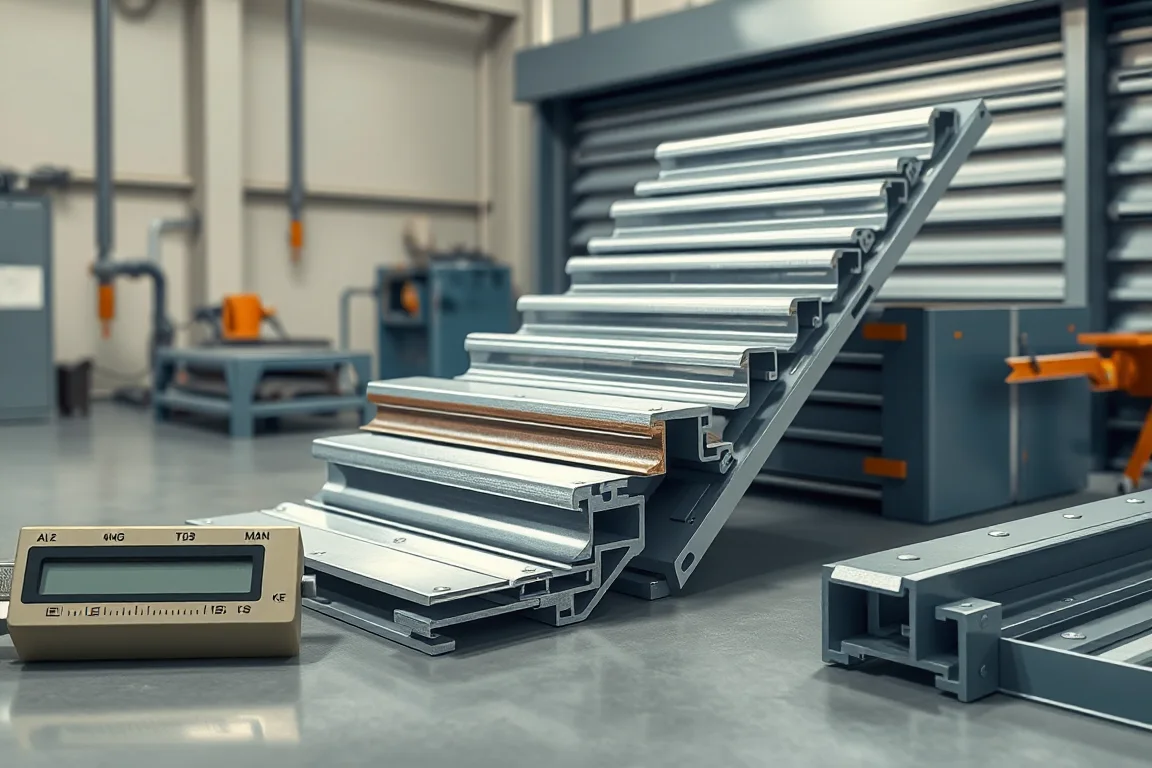
What material thickness means for roller shutter roll forming
Roller shutter roll forming machine material thickness is not a standalone number. It is one half of a material specification that also includes grade, strength range, and coating. The forming machine must bend the strip into a slat profile that interlocks with adjacent slats and coils into a curtain. The base-metal thickness sets the starting geometry. The material grade and coating influence how that strip behaves during bending, springback, and interlock closure.
Thickness is the base-metal dimension before coating. A coated steel strip may measure slightly thicker overall because of the paint or metallic coating, but the forming behaviour is governed mainly by the base metal. When a buyer specifies thickness, they should state the nominal value, the permitted variation, and the standard or method used to measure it. An ambiguous gauge number is not a substitute for a thickness and standard.
The operating range of a roll forming line is not the same as its capability for every material. A machine that forms one grade at a given thickness has not demonstrated the same capability for a harder or softer material at the same thickness. Harder strip requires more forming force and tends to spring back more. Softer strip may form more easily but can mark or distort under handling. The supported combinations should be confirmed as written pairings of grade, strength, thickness and coating, not as unrelated maximum values.
How the forming sequence interacts with material properties
In a typical roller shutter line, the strip passes through a series of forming stations that progressively bend the profile. The interlock edges are developed later in the sequence, because they need the slat face to be stable before the hook geometry is closed. If the material is thicker or stronger than the tooling was designed for, the interlock may not close to the intended shape. If it is thinner or softer, the interlock may close too easily and lose the clearance needed for articulation.
After forming and interlock development, the line may include optional operations such as insulation insertion, perforation or embossing. These steps change the material locally. Perforation, for example, interrupts the strip and can reduce slat stiffness. The effect depends on the pattern, the material and the slat geometry. It should be evaluated for its effect on stiffness and edge distortion, not treated as a cosmetic add-on.
The cutoff station is the next interface. The cutoff tool must support the formed profile so that the cut end is clean and the slat does not collapse. The cut length and end quality matter because the slats are later assembled into a curtain. A cutoff that works for one thickness or profile may not support another without changes. The machine's cutting capability should be confirmed for the specific profile and material combination.
Finally, the formed slats become a curtain. They must articulate and coil as an assembly, not just look correct as individual lengths. The hook geometry, guide clearance and end treatment are checked together. A slat that forms well on the line can still fail in the assembled curtain if the interlock clearance is wrong or if the material has different springback than expected.
Choosing material grade and thickness as a paired decision
The choice of grade and thickness is a paired decision. A thicker strip of a lower-strength grade may form with similar force to a thinner strip of a higher-strength grade, but the two will not behave identically in the interlock or in service. Thickness affects stiffness and weight. Grade affects strength, ductility and springback. Coating affects friction, surface finish and corrosion protection. These properties interact.
When selecting a material for a roller shutter application, start with the performance requirements: wind load, security level, expected cycles, and environmental exposure. These requirements lead to a target stiffness and strength. From there, the designer can evaluate combinations of grade and thickness that meet the target. The forming machine's supported range then becomes a constraint. If the preferred material is outside the machine's proven range, the buyer must either change the material or confirm that the machine can be adapted.
It is practical to state the grade, strength range, nominal base-metal thickness and permitted variation separately from coating or protective film. This separates the structural variables from the surface variables. Coating thickness and type can influence forming friction and tool wear, but they are not the primary determinant of interlock geometry.
Thickness variation and its effect on interlock and coiling
Thickness variation within a coil or between coils can cause inconsistent interlock closure. If the strip is at the high end of the permitted variation, the interlock may be tight. If it is at the low end, the interlock may be loose. Both conditions can affect curtain movement. The machine's forming stations and cutoff should be evaluated with representative samples from the intended coil supplier, not with idealised strip.
Coiling behaviour is also sensitive to thickness. A curtain coils around a drum or into a box. The slat's ability to bend depends on its section properties, which include thickness. A thicker slat is stiffer and may require more force to coil, or may need a larger coil diameter. The guide clearance must accommodate the slat without binding. These are assembly-level considerations, not just forming-line settings.
Surface finish and the exposed face also matter. If the roller shutter has a visible face, scratches or coating damage from forming or handling can be a rejection criterion. The material's coating and the tooling's surface condition should be compatible. A protective film may be used during forming, but it must be removable without leaving residue.
Insulated and foam-filled slats: different material demands
Foam-filled slats and sandwich garage-door panels require more than a standard single-skin forming line. Insulated constructions typically need additional processing to introduce and contain the insulation, and the slat geometry must accommodate the foam without compromising the interlock. The material thickness and grade may be different from a single-skin slat because the foam contributes stiffness. The forming line must be designed for the specific insulated profile.
Sectional garage door panels are a different construction. They are not roller shutter slats. They may need insulation and joining equipment that a roller shutter line does not include. A buyer looking at a roller shutter machine should not assume it can produce sectional garage door panels without significant additional equipment.
Quote scope and accepted-output cost
When evaluating cost, separate the scope of the quote from the accepted-output cost. A quote may cover the forming machine only, or it may include tooling, cutoff, decoiler, runout table, and controls. It may or may not include installation, training, or commissioning. The material thickness and grade affect the tooling design and the machine's structural requirements, so a quote for a thin, soft material may not be comparable to one for a thicker, stronger material.
Accepted-output cost is the cost per acceptable slat or per shift, taking into account scrap, downtime, and rework. A machine that runs faster but produces more interlock defects may have a higher accepted-output cost. To compare alternatives, define the accepted output per shift with the actual profile and material. The buyer should specify the material combination and the acceptance criteria, then ask for a quoted scope that matches.
Do not treat a list of unrelated maximum values as a capability statement. Instead, ask for written combinations that are supported. The quote should state which material grades, thicknesses and coatings the machine is intended to form, and what acceptance tests will be used.
Comparing alternative approaches to material and thickness flexibility
There are several approaches to handling a range of materials and thicknesses. One is to specify a machine with a narrow, well-defined operating envelope for a single material combination. This can be efficient for high-volume production of one product. Another is to specify a machine with adjustable forming stations and tooling that can accommodate a wider range, but this may require more setup time and can compromise the interlock quality at the extremes of the range.
A third approach is to use a machine with quick-change tooling or interchangeable forming sections. This can reduce changeover time when switching between materials or profiles. However, the tooling must still be designed for each combination, and the machine's structure must support the forces involved.
A fourth approach is to outsource forming and focus on assembly. This avoids capital investment but adds logistics and quality control challenges. The choice depends on production volume, product variety and the importance of controlling the forming process.
Troubleshooting material and thickness symptoms
Symptoms of a material-thickness mismatch include interlock that is too tight or too loose, slat distortion after forming, inconsistent cut lengths, and coating damage. These symptoms can have multiple causes. For example, a tight interlock may be due to strip thickness at the high end of the range, excessive forming force, or tool wear. Diagnostic evidence should be collected without adjusting moving machinery while it is running.
Useful evidence includes strip thickness measurements from the coil, forming force readings if available, and visual inspection of the interlock and cut ends. Compare formed slats from different parts of the coil. If the symptoms vary with thickness, the material variation is a likely contributor. If they are consistent, the tooling or setup may be the cause. Assemble multiple slats with the intended guide and end locks, then check movement and clearances. Inspect the interlock coating and cut ends for damage.
Do not attempt to adjust forming stations or cutoff while the machine is in motion. Any intervention should follow the machine manufacturer's procedures and safety instructions.
Practical checklist for specifying material and thickness
- State the material grade, strength range, nominal base-metal thickness and permitted variation.
- Separate coating or protective film from the base metal specification.
- Define the profile: slat interlock, curved or flat face, end-lock detail and guide clearance.
- Confirm the forming sequence and whether optional operations such as insulation or perforation are needed.
- Provide representative samples from the intended coil supplier.
- Ask for written supported combinations, not unrelated maximum values.
- Define accepted output per shift with the actual profile and material.
- Agree on acceptance tests: assemble slats with intended guide and end locks, check movement and clearances, inspect interlock coating and cut ends.
- Verify power requirements: voltage, frequency, phase and installed power schedule.
FAQ
Can a roller shutter roll forming machine run any material thickness?
No. Each machine and tooling set is designed for a specific range of thicknesses and material grades. Forming forces, springback and interlock geometry change with thickness and strength. A machine that forms one combination may not form another without tooling changes or machine modifications. The buyer should ask for written supported combinations.
How does material thickness affect the interlock?
Thickness affects the gap and closure of the interlock. If the strip is thicker than the tooling expects, the interlock may be too tight or may distort. If it is thinner, the interlock may be loose, affecting curtain articulation. The hook geometry and guide clearance should be checked as an assembly with representative material.
What is the difference between base-metal thickness and coated thickness?
Base-metal thickness is the thickness of the steel or aluminium before coating. Coated thickness includes the paint or metallic coating. Forming behaviour is governed mainly by the base metal, so specifications should state base-metal thickness and its measurement standard.
Can I use a standard roller shutter line for insulated slats?
Foam-filled slats and sandwich panels require additional processing to introduce and contain insulation. A standard single-skin line may not have the equipment for insulation or the joining processes. The machine should be specified for the insulated profile from the start.
How do I evaluate a quote for a roller shutter roll forming machine?
Compare the quoted scope: what equipment, tooling, and services are included. Then define accepted output per shift with your actual material and profile. Ask for written supported material combinations and acceptance tests. This makes quotes comparable on a like-for-like basis.
What should I do if the formed slats show interlock defects?
Collect evidence: strip thickness measurements, forming force readings if available, and visual inspection of the interlock and cut ends. Assemble slats with the intended guide and end locks to check movement and clearances. Do not adjust moving machinery. Consult the machine manufacturer's troubleshooting procedures.
Continue your research
- Roller Shutter Door Roll Forming Machines
- Roller Shutter Slat Roll Forming Machine
- Rolling Shutter Guide Rail Roll Forming Machine
- Flat Roller Shutter Slat Roll Forming Machine
- Curved Roller Shutter Slat Roll Forming Machine
- Perforated Roller Shutter Slat Machine
- How Roller shutter roll forming machine Works
- How To Choose a Roller shutter roll forming machine
- Roller shutter roll forming machine Price: What Affects the Cost?