
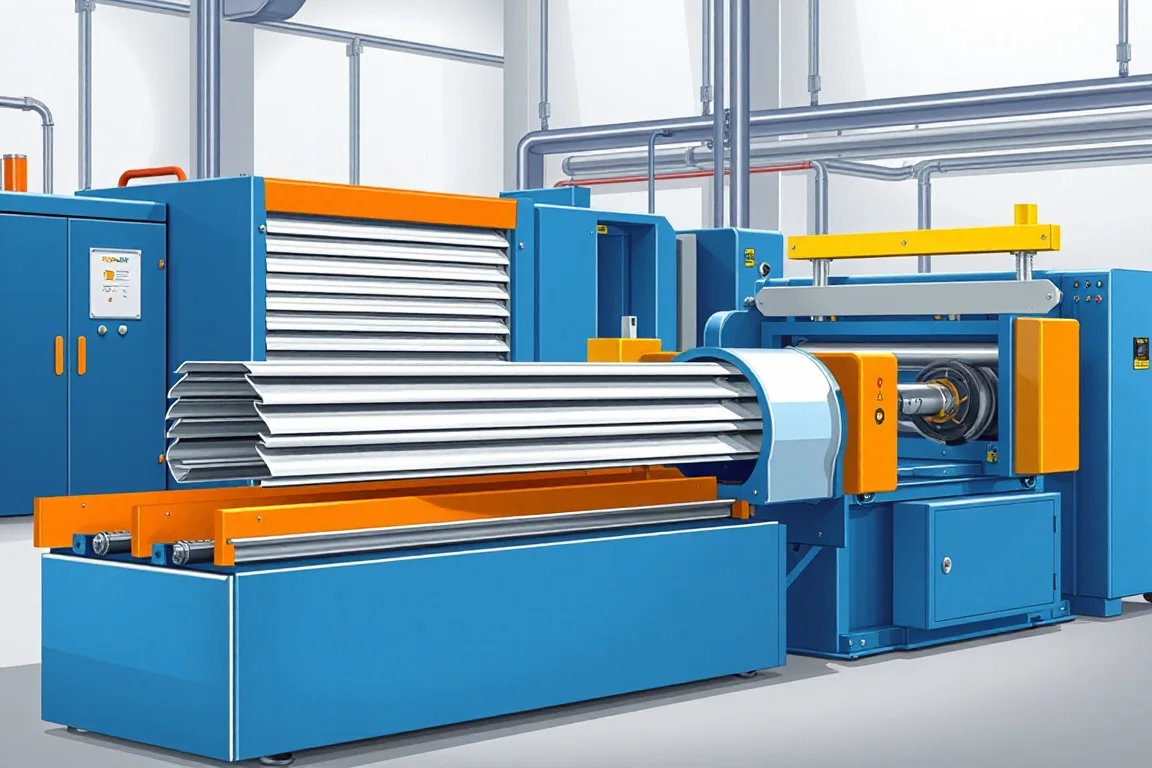
A roller shutter slat roll forming machine produces the repeated interlocking members that make up a rolling curtain. The slat's face, curvature and two connecting edges must work together so the curtain can assemble and articulate through the specified door system. The lock geometry is therefore as important as the visible profile.
Start with the intended slat family and finished curtain construction. Single-skin, foam-filled, perforated and other specialized products can require different equipment. A basic slat former should not be mistaken for a complete shutter factory containing guides, bottom bars, shafts, end fittings and assembly equipment.
Which slat construction is required?
Identify whether the product is flat-faced, curved, single-skin or a defined multi-wall or insulated construction. Each has its own section and joining or filling requirements. The curtain's commercial application does not by itself establish which manufacturing route is appropriate.
Provide the actual profile drawing rather than relying on a nominal slat height. Two slats of similar height can have incompatible hooks, different assembled pitch or a different relationship with end fittings and guides.
What should the interlock drawing show?
Include both mating edges in their loose and assembled conditions. Identify the surfaces that engage and the movement required between neighboring slats. The section should also show face curvature, any ribs and the relationship between overall profile height and effective curtain pitch.
- Face geometry and visible-side orientation.
- Upper and lower hook or lock details.
- Assembled pitch and articulation references.
- Material, thickness and finish.
- Required perforations and end features.
- End fittings, guides and bottom-member interfaces.
Use production-intent mating samples during review. A convenient slat from another system should not silently become the tooling target.
How does the line make a slat?
The line guides the strip, develops its face and functional edges progressively, performs required features and cuts the ordered length. Collection must protect the hooks because even local damage can interfere with curtain assembly.
- Confirm material, finish and released slat configuration.
- Present the strip with the correct surface orientation.
- Develop face curvature or ribs and the mating edges.
- Complete required perforations or end features in the proposed sequence.
- Cut with support matched to the finished slat.
- Inspect and identify accepted lengths for curtain assembly.
Ask how the proposed sequence controls the hook surfaces and avoids damaging them during cutoff. The final interlock is the outcome of material, pass development and handling, not merely the outline of the last roll set.
What changes for foam-filled slats?
A specified foam-filled construction needs additional material preparation, dispensing, profile closure and process control beyond single-skin forming. The equipment scope should identify those operations and the responsibilities for the selected filling system.
Define the completed slat section and inspection requirements, including the relationship between the formed skins or walls and the filling. A hollow profile sample does not demonstrate a filled product. Use the intended material and process during representative trials.
Keep thermal, acoustic or other curtain performance claims tied to the complete product's relevant evidence. Adding filling does not automatically establish a particular rating for the finished door.
How should material and finish be reviewed?
Specify grade or alloy, thickness, strip width and finish for each slat family. Aluminum, coated steel and stainless steel need their own review; equal nominal thickness does not mean identical springback or hook behavior.
Inspect the visible face and bends after forming, cutting and assembly. A finish can remain intact on a loose slat but be marked when neighboring locks engage or the curtain is handled. Trial the actual material and surface treatment rather than an easier substitute.
Retain coil identity with accepted slats and curtain samples. This supports investigation if later batches become tight, loose or visibly different at the interlock.
How should perforations and end features be specified?
Provide the pattern, positions and relationship to the locks and cut ends. Ventilation or vision features can occupy different parts of the slat and require different tools. They should follow the product design rather than a generic repeated-hole setting.
End fittings may need holes, notches or another preparation. Include the actual fitting and its attachment method in the scope. A cut slat is not assembly-ready when those operations remain outstanding.
Inspect features after forming and normal handling. Check local distortion, burrs and position, especially where a feature lies near an interlock or guide-contact area.
What should a curtain-assembly trial demonstrate?
Assemble several production-intent slats with the specified end fittings and bottom interface. Check effective pitch, engagement and articulation according to the chosen system. Record unusual resistance, loose joints or the need for local reshaping.
Use the intended guide and rolling arrangement where it is part of the acceptance plan. The relevant system components determine the test conditions; do not invent a universal roll diameter or clearance from the slat category alone.
A controlled assembly trial checks manufacturing compatibility. Door safety, wind, fire or other performance requirements need the applicable complete-system design and verification beyond the profile-forming demonstration.
What does changing slat profiles involve?
Separate length changes from changes in face curvature, hook geometry or construction. A line can often control different lengths within its envelope, while another interlock or filled profile may require tools and additional equipment.
Request a matrix covering rolls, guides, feature tools, cutoff parts and any filling or closure settings. Demonstrate a commercially relevant transition and a return to the original product. Include curtain fit and first-good-slat inspection in the recovery time.
If the same route makes an end or bottom slat, specify that product separately. Its connection and seal details may differ from the repeated curtain member.
How should cutoff and collection protect the locks?
Inspect slat ends for crushing, flare and burrs after normal discharge. Compare the end geometry with the middle of the same piece. A small local hook deformation can obstruct assembly even when most of the length is correct.
Define how slats are stacked, nested or fed into curtain assembly. Protect the visible face and avoid mixing lengths or colors. End fittings and prepared features should remain identifiable through the handling route.
Test both short and long commercial lengths. They create different cutting and support demands, and a convenient demonstration length can conceal either limitation.
How should practical output be measured?
Use accepted slats or completed curtains according to the delivery boundary. Perforation, filling, end fitting, cutting and assembly can each influence the result. A single-skin unpunched speed does not describe the rate of a filled or prepared curtain product.
For planning only, a curtain specified to contain 70 repeated slats requires 70 accepted members of the correct length, plus its designated top, bottom and end components. The actual count follows the system's pitch and curtain design, not a universal formula based on overall slat height.
Compare quotations with equivalent component and assembly scope. Identify guides, shafts, bottom bars and other door parts separately so a slat line is not mistaken for a complete installation package.
What should acceptance include?
- Face and interlock geometry in the actual material.
- Finished length, end condition and required features.
- Filling and closure checks where applicable.
- Assembly and articulation of representative slats.
- Fit with intended end fittings and guides where included.
- Required profile changes and recovered production.
- Surface condition and accepted output after normal handling.
Retain matched slats, hardware and setup references. They provide a clearer benchmark than a single loose profile whose mating parts are no longer available.
Frequently asked questions
Can slats with the same height interlock?
Not necessarily. Hook geometry and assembled pitch can differ. Use the intended profile family and mating samples rather than assuming compatibility from a nominal height.
Does a single-skin line make foam-filled slats?
Not without the required construction and filling equipment. Define the completed product and process separately. A hollow demonstration profile is not evidence of a finished insulated slat.
Are end fittings included automatically?
No. Their manufacture, preparation and attachment need explicit scope. Include the fitting drawings and the intended curtain-assembly route in the enquiry.
Why test several slats together?
The curtain depends on repeated engagement and articulation. One isolated section cannot show cumulative pitch or the behavior of mating hooks through the intended movement.
Can perforation be added to any slat?
It requires review of the product design, tool access and pattern relationship to the interlocks. Specify the actual features and trial the complete product rather than assuming a universal option.
What should be sent for a quotation?
Provide slat and interlock drawings, materials, finishes, lengths, features and mating components. Identify filling and curtain-assembly requirements. This defines the complete production task and its boundaries.

Continue your research
- Roller Shutter Door Roll Forming Machines
- Rolling Shutter Guide Rail Roll Forming Machine
- Garage Door Panel Roll Forming Machine
- Flat Roller Shutter Slat Roll Forming Machine
- Curved Roller Shutter Slat Roll Forming Machine
- Perforated Roller Shutter Slat Machine
- How Roller shutter roll forming machine Works
- How To Choose a Roller shutter roll forming machine
- Roller shutter roll forming machine Price: What Affects the Cost?
Configuration & specification inputs
Match the configuration to your section drawing, material and production requirements.
| Parameter | Requirement / confirmation needed |
|---|---|
| Profile geometry | Slat face, complementary interlocks and effective curtain pitch |
| Material | Specified metal and finish tested through forming and curtain assembly |
| Thickness & grade | Approve actual material and slat-construction combinations |
| Process route | Face and hook forming, required features, optional filling/closure, cutoff and curtain preparation |
| Cutting | Protect functional hooks and end-fitting areas during cutoff |
| Output | Accepted slats or complete curtains with included filling and end work |
| Electrical supply | Confirm utilities for forming, features, filling where required and handling |
| Acceptance | Measure hooks and pitch, assemble representative slats and inspect articulation and final surface condition |