
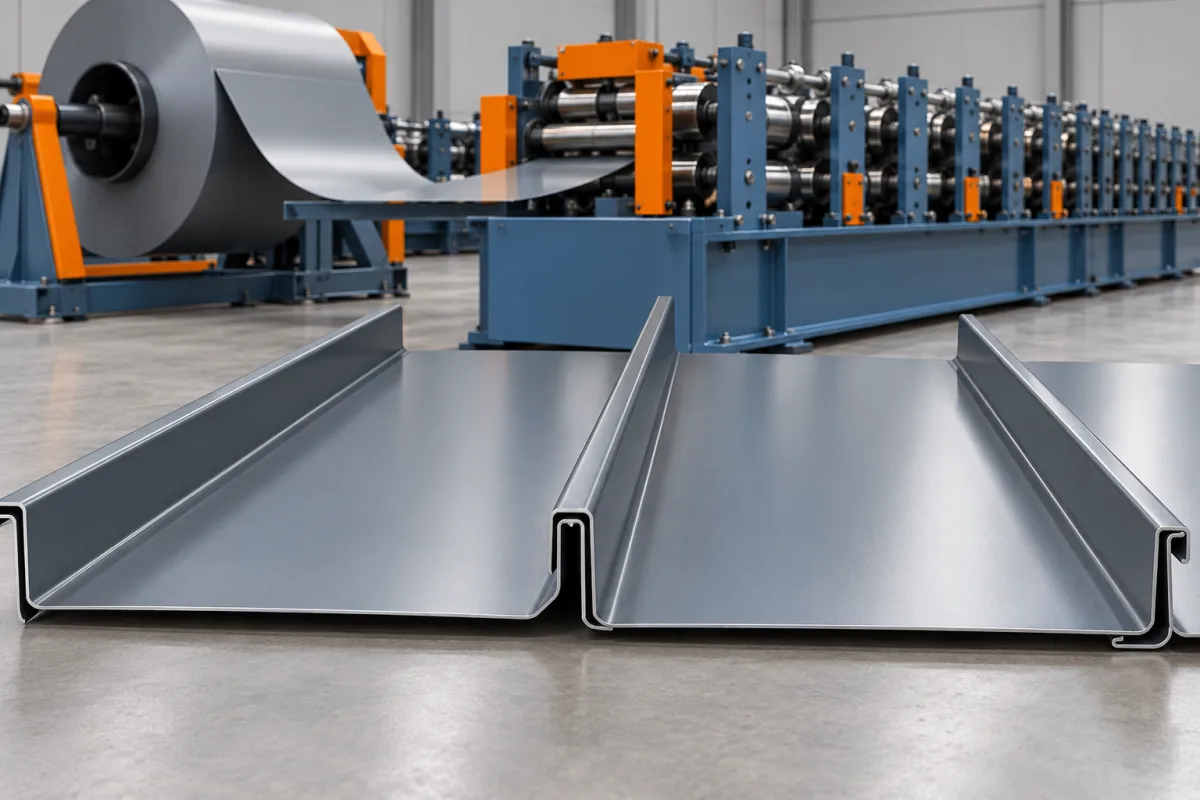
A standing seam roll forming machine produces roof panels with raised longitudinal edges that connect to form the roof seam. The central pan, the two edge profiles and the attachment arrangement work together. Choosing the equipment therefore begins with a defined roof-panel system, not with a seam-height label or a photograph of a finished roof.
The machine forms the panel; the installed joint may then snap together or require a specified mechanical seaming operation. Clips, fixing provisions, closing tools and installation details are part of that larger system. An effective equipment brief connects those interfaces to material, width, length, production location and the expected order mix.
What does the roll former make, and what happens afterward?
The former converts strip into a repeatable panel cross-section and cuts the required length. Depending on the configuration, it may also create specified pan features, notches or other details. Those operations should be listed individually instead of assumed from the broad standing-seam description.
Roof assembly is a separate stage. The formed edges connect with adjoining panels and the chosen attachment arrangement. For mechanically seamed systems, an appropriate closing operation completes the seam after positioning. A good-looking unassembled panel is not enough to demonstrate compatibility with the clips or closing tools used on the project.
Which standing seam family is required?
Snap-together profiles
The complementary edges are designed to engage through the system's specified assembly method. The opening, hook and mating surfaces must work together with the attachment detail. A snap-together designation does not establish a universal geometry or a common set of clips for every product.
Mechanically seamed profiles
The formed edges are prepared for a defined closing operation. The correct seamer, setup and material are part of demonstrating the final joint. A nominal rib height alone does not identify the edge development or closing configuration needed for a particular system.
Purpose-designed combination profiles
Some specifically engineered profiles support more than one closing arrangement. That is a property of the defined profile and its approved system, not a general ability of every standing-seam panel. Any proposed alternative assembly method needs the corresponding design and equipment review.
Which dimensions define the panel and seam?
The section drawing needs both edges, not merely the broad outline. Identify the male and female geometry or other joint arrangement used by the selected system. Show the clip contact, return details, nominal seam height, pan features and the dimensions used to establish effective cover.
- Panel width: distinguish input strip width, formed width and useful coverage.
- Seam: define bends, returns and the completed joint rather than only its height.
- Attachment: include clips or fixing flanges and their relevant interfaces.
- Pan: specify a flat face or the required ribs or striations.
- Ends: identify lengths, notches and any secondary preparation.
- Material: pair each configuration with the specified grade or alloy, thickness and coating.
Keep installation movement provisions and performance requirements tied to the roof-system design. They are not established simply by making a panel that measures correctly at the machine exit.
How does the forming process work?
- Present the coil: establish safe loading, the correct visible-face orientation and the agreed material identity.
- Guide the strip: control entry into the forming path and integrate any specified preparation or feature operation.
- Develop the pan and edges: form the cross-section progressively while maintaining access to the required bends.
- Produce the cut length: use a cutting arrangement compatible with the profile and required end condition.
- Support the panel: move long lengths through discharge and inspection without distorting the formed edges.
- Demonstrate the joint: assemble the actual attachment components and complete the required closing method.
The proposed layout should identify which operations are integrated and which are separate. Tapering, curving and special end preparation are additional requirements; they should not be treated as automatic features of a straight-panel former.
Factory production or portable forming?
A factory arrangement can be planned around stable utilities, controlled material storage and a dedicated takeoff area. Its project review also needs to consider how finished panels are packed and transported. The longest manufactured length is not useful if the intended delivery and site-handling route cannot accommodate it.
Portable forming moves part of the production route to the job location. Review power, coil delivery, safe machine positioning, weather exposure and support for the emerging panels. Producing near the installation area can change logistics, but it does not eliminate material handling or the need to inspect the output.
Compare both routes using actual jobs. Frequent short orders may favor a different arrangement from repeated long runs, while access and transport conditions can dominate another project. The decision concerns the complete flow from coil to usable panel, not just whether the machine can be moved.
What changes when panel width or profile changes?
Width adjustment within a defined profile family is different from changing the seam itself. Ask which dimensions the proposed machine adjusts and which require replacement rolls, guides, cutting components or other tooling. The quotation should list the equipment needed for every requested profile.
Also separate a pan-pattern change from a joint change. Adding or changing ribs in the broad face can involve a different requirement from producing another seam edge. Agree the variant matrix and demonstrate the important transitions through to accepted output.
For changeover timing, begin with an accepted panel in the first configuration and finish with an accepted panel in the next. Include tooling work, programs, guide settings, inspection and setup scrap. Measuring only mechanical movement can understate the work required to recover production.
How do material and coating affect the result?
Seam returns and broad pans make the actual material specification important. Identify grade or alloy, thickness convention, coating and any protective layer. A result obtained with one material does not demonstrate every other material at the same nominal thickness.
Use production-intent material for forming and assembly trials. Inspect coating condition at bends and contact surfaces, then check the joint after its intended closing operation. This reveals issues that may not be visible on an open profile sitting alone on a bench.
Agree how pan appearance will be assessed, including support and viewing conditions. Keep appearance observations separate from seam measurements. A surface issue, damaged cut end and mismatched clip require different investigations even if all are noticed during the same inspection.
Why must clips and seamers be part of the trial?
The joint includes more than the roll-formed metal. Use the specified clips or other attachments and a representative support arrangement. For a mechanically closed seam, use the intended closing equipment and its approved procedure. Record the resulting seam geometry and the material used.
If an assembly problem appears, retain samples before and after closing. This helps separate a forming deviation from a clip mismatch, tool setup or support issue. Do not substitute an unrelated clip because its nominal height looks close, and do not treat a closed seam's appearance as proof of the complete roof system's performance.
How should usable output and project cost be assessed?
Accepted output includes the required cutting, handling and inspection. Coil changes, width or profile changes and discharge of long panels can reduce practical delivery compared with an uninterrupted strip-speed demonstration. Record the actual length mix and all included downtime when comparing trials.
Keep forming output separate from roof-installation progress. A former can deliver panels faster than a particular site can move or install them, or site constraints may prevent continuous production. Those are coordination questions, not evidence that a panel's nominal machine speed describes an entire roofing operation.
Compare tools for the requested profiles, coil handling, length control, cutting, supports, power provisions and portability equipment where required. List seamers, end-processing equipment and additional profile options separately. A basic former and a complete production-and-closing package are not equivalent quotations.
What should acceptance demonstrate?
- Confirm the drawing revision, material and intended attachment components.
- Produce representative lengths and measure the pan and both seam edges.
- Inspect cut-end condition and the panels after normal discharge.
- Assemble several panels using the specified clips or fixing arrangement.
- Complete any required mechanical closing operation and inspect the resulting joint.
- Review coating and appearance under the agreed conditions.
- Demonstrate required configuration changes and record recovered accepted output.
Document deviations and responsibilities before the trial is signed off. Roof-system suitability, including project-specific slope and loading requirements, remains linked to the defined system and its engineering evidence rather than a general machine category.
Frequently asked questions
Is a standing seam roll former also a roof seamer?
They perform different jobs. The roll former makes the panel cross-section; a roof seamer completes the specified joint on a mechanically seamed system. A package can include both, but the scope and compatibility of each should be stated explicitly.
Can a snap-lock profile simply be mechanically seamed?
Not as a general rule. Some purpose-designed systems allow alternative closing methods, but that must be established for the exact profile and associated tooling. Do not improvise a closing method on an unrelated snap-lock section.
Does a taller seam make any roof application suitable?
No. Seam height is only one geometric feature. Project suitability depends on the complete panel, attachment, installation details and relevant system evidence. Obtain the actual product-system requirements instead of assigning performance from height alone.
Can the line make curved or tapered panels?
Only where the proposed configuration and additional processes cover them. Curvature and changing width introduce requirements beyond producing a straight constant section. Include their drawings and equipment needs in a separate review.
Can one clip fit every panel of the same nominal height?
No. Contact surfaces, engagement and attachment provisions can differ. Use the clip specified for the selected panel system and provide it during the tooling trial. A similar height is not a compatibility check.
What should a buyer prepare first?
Provide the profile and joint drawings, material combinations, panel lengths, attachment references and required closing method. Add the production location and representative order mix. These inputs establish a clear basis for comparing equipment and operating arrangements.
Specify the panel, the joint and the production route together
A standing-seam project is easier to compare when the formed section, mating components and closing method are defined as one coordinated product. Use that definition to choose the line and acceptance trial. The dedicated snap-lock, mechanical-lock and portable-former pages below develop the narrower decisions within this equipment family.

Continue your research
- Standing Seam Roll Forming Machines
- Snap Lock Standing Seam Machine
- Mechanical Lock Standing Seam Machine
- 25mm Snap Lock Standing Seam Machine
- 38mm Snap Lock Standing Seam Machine
- 1 Inch Mechanical Lock Standing Seam Machine
- How Standing seam roll forming machine Works
- How To Choose a Standing seam roll forming machine
- Standing seam roll forming machine Price: What Affects the Cost?
Configuration & specification inputs
Match the configuration to your section drawing, material and production requirements.
| Parameter | Requirement / confirmation needed |
|---|---|
| Profile geometry | Panel pan, both seam edges, returns, effective cover and the specified completed joint. |
| Material | Production-intent grade or alloy, coating and protective layers, paired with each required profile. |
| Thickness & grade | Defined material and thickness combinations demonstrated through forming and joint assembly. |
| Process route | Coil entry, pan and edge forming, specified features, length cutting, supported takeoff and joint demonstration. |
| Cutting | Required lengths and end condition, with separate scope for notching, tapering or other special work. |
| Output | Accepted panels for the agreed order and inspection schedule; distinguish machine output from roof installation progress. |
| Electrical supply | Factory or jobsite supply and auxiliaries appropriate to the selected production arrangement. |
| Acceptance | Section and ends, specified clips or fixings, required seam closing, coating condition and recovered output after changes. |