
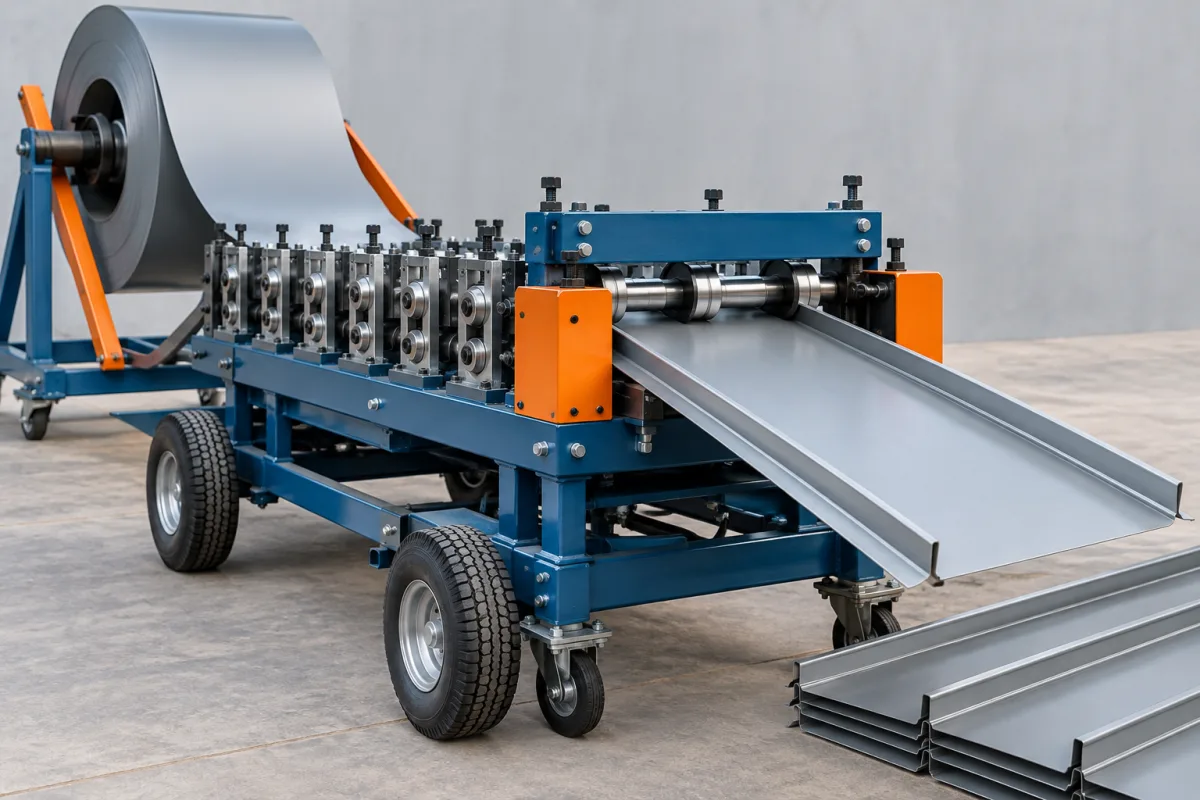
A portable standing seam roll former produces specified roof-panel profiles at a location where the machine, coil supply and finished-panel handling can be arranged for the job. Its value is not simply that the machine moves. It changes the production and delivery route: coils and equipment travel to the work area, and panels are made to the required lengths near the next operation.
A useful selection therefore combines the panel specification with a realistic site-production plan. Tooling compatibility, utilities, access, coil handling, takeoff support and inspection all matter. Portability does not remove these requirements; it makes them part of each deployment.
What does portable production change?
Factory production normally sends finished panels through packing, transport and site unloading. Portable production relocates the forming operation and changes those interfaces. It can reduce reliance on transporting certain finished lengths, but the incoming coil, machine, support equipment and tools still need a planned delivery and operating arrangement.
Compare the two routes against actual projects. A site with useful access and sufficient production space creates a different case from a constrained urban location. The required panel lengths, order variability and ability to protect material on site may be more important than the former's advertised maximum speed.
Which operating arrangement is appropriate?
Ground-level jobsite production
Define the machine position, coil loading area and supported takeoff path. The plan must account for moving finished panels to their next location. Producing on site does not imply that panels can safely emerge into any convenient open space.
Workshop use of a movable machine
A portable former may also operate in a workshop when the installed configuration and conditions permit it. Review how it fits the local material flow and utilities. Mobility is useful only if it does not compromise stable setup, safe access or finished-panel handling.
Special deployment arrangements
Elevated positions or other unusual setups require the equipment supplier's permitted arrangement and a competent site plan. Do not infer lifting, support or operating methods from photographs of another machine. The total equipment and coil load, access and working conditions must be assessed.
How should the required profiles be selected?
Choose the roof systems served by the expected jobs before choosing the number of available profiles. Define the seam, attachments, pan shape, material and width for each. Snap-together and mechanically seamed products may require different roll sets and closing arrangements even when their overall appearance is similar.
Make a profile-and-tool list showing what travels with the machine and what is optional. Include cutting components, guides, pan-forming accessories and any necessary closing tools. A long menu of potential profiles has limited value if the required tooling is not part of the package.
Where a job needs curved, tapered or specially notched panels, review those operations explicitly. They should not be assumed to follow from the ability to form a straight constant section on site.
What information is needed before the machine arrives?
- Product schedule: drawing revisions, lengths, quantities, profiles and material combinations.
- Access: delivery route and the permitted location of the complete operating arrangement.
- Coil handling: coil dimensions, mass, loading method and appropriate equipment.
- Utilities: the supply required by the actual machine and auxiliary equipment.
- Takeoff: support and movement of the shortest and longest panels.
- Protection: arrangements for material, tools and finished panels in the expected conditions.
- Inspection: responsible personnel, measuring equipment and attachment samples.
Use these inputs to create a deployment checklist. A machine that fits on a trailer is not necessarily ready to operate at every location that the trailer can reach.
How does an on-site production run proceed?
- Confirm the approved operating location, support arrangement and utilities.
- Identify the coil and install the required profile tools using the maker's procedures.
- Set up entry, width, length control and the supported discharge path.
- Produce first-off panels and check geometry, cut ends and surface condition.
- Trial the joint with the intended attachments and closing method where required.
- Release the order to production, identify finished lengths and record accepted output.
- Protect and handle panels according to the defined next operation.
This is a production-planning sequence, not a substitute for the machine's operating or site-safety procedures. Loading, tool changes and physical interventions require the appropriate equipment instructions and competent personnel.
How should power and auxiliary requirements be compared?
Match the power arrangement to the specific equipment package and intended locations. The main former, decoiling arrangement, controls and other auxiliaries may have requirements that need to be considered together. Do not select a supply solely from the fact that a machine is described as portable.
For electrical equipment, confirm the necessary voltage, frequency, phase and other manufacturer requirements with the responsible professionals. Where another power arrangement is proposed, evaluate its operating restrictions, maintenance and site suitability. Keep those requirements in the deployment plan rather than relying on last-minute improvisation.
Why is long-panel handling central to the purchase?
A long panel needs support as it leaves the former and as it moves toward storage or installation. Plan that route using the actual lengths and profiles. A panel with damaged seam edges is not useful output even if its length was produced accurately.
Include the interface between the forming crew and the team receiving panels. Agree identification, order sequence and where inspection occurs. Producing panels faster than they can be received can create congestion or damage rather than improving the project.
Transport considerations are not eliminated entirely. The machine and coils still move, and some finished panels may also need relocation. Evaluate the whole logistics route instead of replacing one unexamined transport assumption with another.
What does a practical changeover involve?
Width adjustment, tool replacement and material change can require different work. Identify the components, setup references and inspection needed for each transition in the expected job mix. Portable operation makes organized tools, protected reference samples and clear setup records particularly useful.
Time the change from the last accepted panel of one order through the first accepted panel of the next. Include first-off measurements and joint checks. A quick roll-set exchange is only one part of recovering usable production.
Demonstrate a return to a previously approved setup if repeated visits or mixed jobs are expected. The ability to reproduce an accepted profile matters more than simply recording where a machine adjustment was positioned last time.
How are productivity and project cost assessed?
Compare accepted output over a realistic deployment, including setup and the relevant handling. Distinguish transport time, site setup, steady production, profile changes and pack-down rather than combining them into an unexplained daily total. This makes the operational advantage or limitation of portable forming visible.
The equipment comparison should include the required profiles, coil-handling arrangement, cutting components, supports, transport provisions and auxiliary tools. Add training, maintenance access and the inspection equipment needed to release product at the work location.
Evaluate these items against the alternative route of purchasing or factory-forming finished panels. Material utilization, rework, delivery constraints and the actual order pattern belong in that comparison. A machine's maximum line speed alone cannot establish the better business choice.
What should a portable-former acceptance trial include?
- Demonstrate the supplied configuration with the agreed material and profiles.
- Check the deployment-related equipment and clearly identify anything excluded.
- Produce representative short and long lengths using the planned support arrangement.
- Inspect seams, pan geometry, cut ends and visible finish after handling.
- Assemble panels with the intended attachments and closing tools.
- Perform an agreed profile or width change and recover accepted output.
- Review setup records, operating documentation and maintenance responsibilities.
The trial should show the production route the buyer expects to use. A short demonstration in a fully supported factory environment may leave important site interfaces untested unless those differences are explicitly addressed.
Frequently asked questions
Does portable mean the machine can operate anywhere?
No. The site still needs the permitted operating arrangement, appropriate access, utilities, coil handling and panel support. Confirm the equipment maker's requirements and the site plan before deployment rather than assuming mobility establishes suitability.
Can a portable former also be used in a workshop?
Potentially, where the configuration and conditions are appropriate. Review material flow, support and utilities just as for any production route. The machine's transportability does not replace a suitable installed operating arrangement.
Will on-site forming eliminate all panel joints?
No blanket claim is appropriate. Panel lengths and joint arrangements follow the roof-system and project requirements. Portable production changes manufacturing logistics; it does not independently determine every detail of the installed roof.
Are all profile tools included with the base machine?
That depends on the quotation. List the exact profiles, cutting parts and accessories supplied, together with optional additions. A machine's potential profile range is different from the tool sets actually purchased and transported.
Does the portable former include a mechanical roof seamer?
Not automatically. A panel former creates the section, while a seamer completes the specified joint on mechanically seamed systems. Confirm the closing tools and their compatibility separately where those systems are required.
What is the most useful basis for comparing two packages?
Use the same representative jobs, panel drawings, material combinations and deployment conditions. Compare complete handling, tooling and inspection scope, then measure accepted output over that defined route. This is more informative than comparing isolated speed or mobility claims.
Plan the journey from coil delivery to accepted panel
The strongest portable-forming specification follows both the product and the equipment through the job. It connects profile choice with access, loading, utilities, takeoff, inspection and the next operation. That complete route is the basis for deciding whether mobile production fits the business and which package is needed to make it work.

Continue your research
- Standing Seam Roll Forming Machines
- Standing Seam Roll Forming Machine
- Snap Lock Standing Seam Machine
- 25mm Snap Lock Standing Seam Machine
- 38mm Snap Lock Standing Seam Machine
- 1 Inch Mechanical Lock Standing Seam Machine
- How Standing seam roll forming machine Works
- How To Choose a Standing seam roll forming machine
- Standing seam roll forming machine Price: What Affects the Cost?
Configuration & specification inputs
Match the configuration to your section drawing, material and production requirements.
| Parameter | Requirement / confirmation needed |
|---|---|
| Profile geometry | A portable former adds site access, power supply, coil loading and long-panel support to the selection problem. Check transport arrangements and setup requirements before assuming on-site production is more economical than delivered panels. |
| Material | Coated steel, aluminum or other specified roofing metal after forming trials |
| Thickness & grade | Buyer to specify base-metal thickness and grade; operating range requires supplier verification. |
| Process route | Coil payoff → edge/face forming → seam development → cutoff → assembly/seaming check |
| Cutting | Confirm profile-supported cutoff, cut lengths, end quality and any secondary operations. |
| Output | Define accepted output per shift with the actual profile and material. |
| Electrical supply | Buyer to state voltage / frequency / phase. Installed power requires a confirmed equipment schedule. |
| Acceptance | Producing close to the installation can change transport requirements for finished panels, but it also moves coil handling and production tasks to the site. Compare the entire workflow, including weather protection, material movement and storage, for the intended project sequence. |