
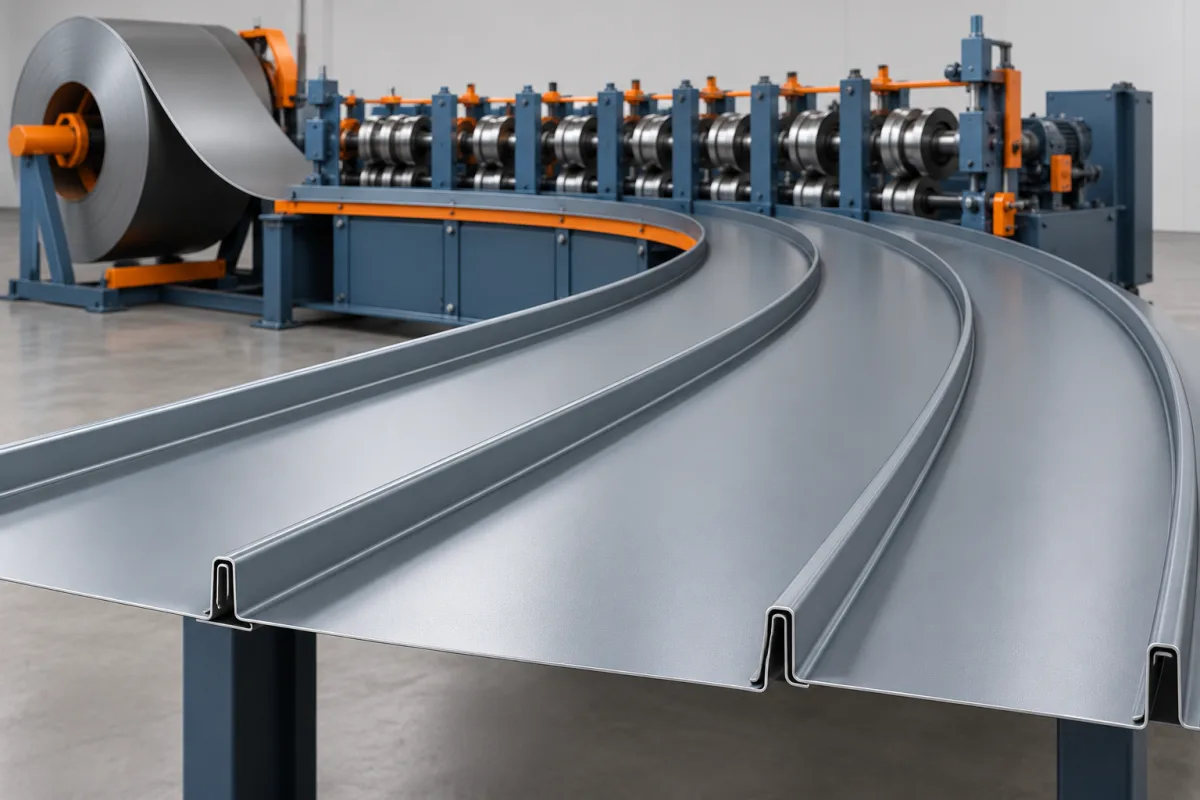
A curved standing seam roof panel machine produces or processes panels to a defined longitudinal curvature while retaining the seam geometry needed for assembly. The complete route normally needs to address both profile formation and controlled curving. A straight standing-seam former alone should not be treated as proof that the required curved roof panel can be manufactured.
The enquiry must describe the actual curve: its direction, radius or changing geometry, panel length and the point on the section used as the reference. Convex and concave products can have different equipment constraints. The word curved is therefore a starting description rather than a complete specification.
What curve information should be provided?
Supply a drawing showing the panel's intended longitudinal shape and how it relates to the roof layout. State whether the curve is constant or variable and whether straight portions are required at either end. Identify the reference surface used for dimensions.
- Convex or concave direction as defined by the exposed face.
- Required radius or controlled shape coordinates.
- Panel length and any straight end portions.
- Seam profile, pan width and attachment system.
- Material grade or alloy, thickness and coating.
- Any taper or additional geometric requirement.
Do not rely on a perspective rendering to establish a radius. A dimensioned profile or agreed geometric schedule is needed to compare equipment capabilities and inspect the finished panel.
How does curving differ from profile roll forming?
Profile forming creates the transverse pan and seam section. Longitudinal curving changes the path of that section along the panel. The curving process must preserve the functional edges and acceptable appearance while producing the required shape.
These functions may be arranged together or as separate machines, depending on the proposal. Identify the interface and support between them. A well-formed straight panel can still become unsuitable if the curving stage distorts its seam.
Why must the seam be compatible with the curver?
Curving equipment contacts and guides a particular section. Seam height alone does not define those contact points or the allowable geometry. Provide the complete edge drawing and confirm compatibility with the proposed curving process.
Where the roof uses mechanical closing, the resulting curved edges must also remain compatible with the intended clips and closing equipment. The final trial should connect profile forming, curving and assembly rather than approving each stage with unrelated samples.
How do material and coating affect the project?
List the exact grade or alloy and temper, base-metal thickness and coating. The achievable curve and surface result depend on the section and material combination. A radius demonstrated in one material is not an automatic rating for every other combination.
Inspect the pan and seam after curving for unacceptable deformation or finish damage. Use agreed supports during assessment so the panel is not forced into the target shape by the inspection fixture. Retain material identification with the approved curved sample.
Can both convex and concave panels be made?
That depends on the equipment, section and specified geometry. The two directions may need different attachments or working arrangements. Ask for an explicit capability matrix instead of assuming that reversing a setting produces the opposite curve.
Also distinguish a parallel-width curved panel from a tapered curved panel. Combining taper and curvature introduces another geometric requirement and may fall outside a setup that handles either condition separately. Trial the actual combination if it is part of the order.
What should be expected at panel ends?
The process may have defined limitations around the first and last portions of a piece. State the required straight or curved end condition and identify any separate finishing operation. The purchase scope should explain how the complete ordered shape is achieved.
Check end geometry as well as the middle radius. A panel with the correct central curve may still fail to meet an eave or ridge interface if its end condition was never included in the production brief.
How should curved panels be handled and measured?
Define supports, lifting arrangements and package shape appropriate to the finished geometry. Panels should not be flattened or locally forced into a stack that changes their accepted curve. Protect seam edges throughout transfer.
Use an agreed measurement method such as a controlled template or documented geometric references suitable for the project. Record the support condition. A radius value without a method and datum is difficult to reproduce during later production checks.
What does a complete curved-panel trial include?
- Verify the straight profile and material identity.
- Produce the required curvature and end conditions.
- Measure the shape without forcing it into position.
- Inspect pan appearance and seam geometry.
- Assemble representative adjacent panels with intended attachments.
- Complete any specified seam-closing operation.
- Check the panel again after normal handling and packing.
Report accepted curved pieces rather than applying a straight-former speed to the whole route. Curving, inspection and shape-preserving handling can determine practical output.
Frequently asked questions
Can any standing-seam panel be curved?
No. The profile, material and curving equipment must be reviewed together. Confirm the actual required geometry and trial the chosen combination rather than relying on the general panel family.
Does a smaller radius always need a thicker panel?
No universal rule should be assumed. Curving behavior depends on the complete section, material and process. Use an engineering review and representative trial for the required shape.
Can the machine make both curve directions?
Only if the proposal explicitly covers them. Convex and concave production can require different arrangements, and their approved ranges may differ.
Is a curved panel automatically suitable for a curved roof?
The manufactured shape must still fit the specified roof system, supports and attachments. The machine trial establishes the agreed product, not all project-specific design requirements.
What should be supplied for quotation?
Send the seam drawing, curve geometry, panel lengths, material matrix and end conditions. Add any taper, existing closing equipment and the planned handling or transport arrangement.
Approve the finished curve and joint together
A useful curved-panel proposal connects transverse profile, longitudinal shape and assembly. With clear measurement and handling references, the trial can demonstrate the roof component required rather than only a curved metal sample.

Continue your research
- Standing Seam Roll Forming Machines
- Standing Seam Roll Forming Machine
- Snap Lock Standing Seam Machine
- 25mm Snap Lock Standing Seam Machine
- 38mm Snap Lock Standing Seam Machine
- 1 Inch Mechanical Lock Standing Seam Machine
- How Standing seam roll forming machine Works
- How To Choose a Standing seam roll forming machine
- Standing seam roll forming machine Price: What Affects the Cost?
Configuration & specification inputs
Match the configuration to your section drawing, material and production requirements.
| Parameter | Requirement / confirmation needed |
|---|---|
| Profile geometry | Approved standing seam plus dimensioned longitudinal curvature, direction and end conditions. |
| Material | Specified grade or alloy and temper, coating and surface requirements for the actual curved section. |
| Thickness & grade | Material-thickness combinations trialed with the required curve and seam geometry. |
| Process route | Profile forming, compatible controlled curving, attachment and closing checks, shape-supported handling. |
| Cutting | Panel lengths and end conditions coordinated with the required curved and straight portions. |
| Output | Accepted curved pieces after shape, seam and handling checks rather than isolated straight-former speed. |
| Electrical supply | Utilities for forming, curving and compatible auxiliary equipment in the selected layout. |
| Acceptance | Unforced curve measurement, ends, seam fit, coating and retained shape after normal packing. |