
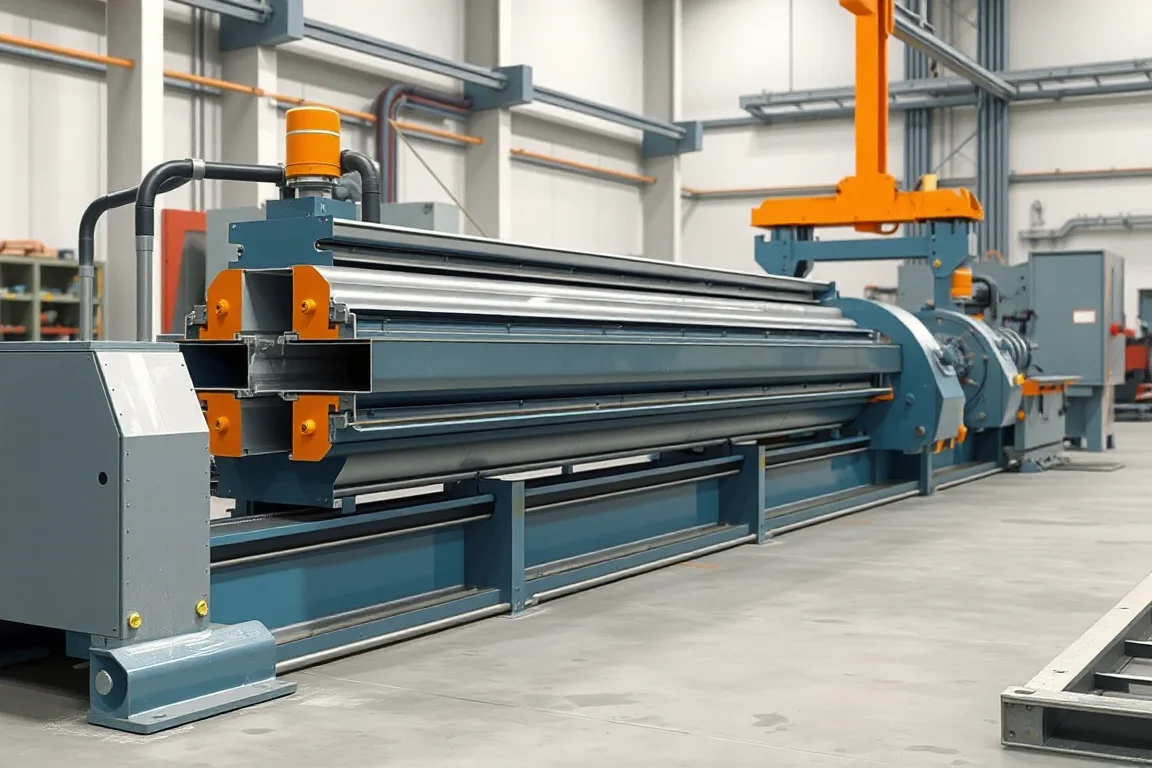
A greenhouse purlin roll forming machine is a production line that converts metal coil into defined longitudinal sections used within greenhouse structures. These sections serve distinct functions: gutter drainage, film-lock retention, crop support or structural bracing. Each function imposes different demands on profile geometry, material grade, surface protection and connection details. This article explains how to assess the fit between a proposed machine, the intended component and the wider greenhouse build. It distinguishes forming from assembly and certification, and it highlights where alternative production routes may be more appropriate.
Clarifying the purlin role in a greenhouse system
In greenhouse construction, a purlin usually spans between rafters or arches to support cladding, film or crop loads. However, the term is often applied broadly to several distinct components. A drainage gutter collects condensate and directs it away from the growing area. A film-lock channel grips flexible covering using a spring wire or similar retainer. A crop support channel carries trellis wire or hydroponic gutters. A structural purlin resists bending and transfers wind or snow loads. Because these functions differ, the profile drawing, material thickness and connection method must be defined per component.
A roll forming machine designed for one of these roles is unlikely to produce all of them without significant changes. The selection requirements for a greenhouse purlin roll forming machine list profile elements such as gutter drainage shape, film-lock channel, support section and connection holes. That list describes possible features of a single or multi-function part, not a guaranteed machine capability. The buyer must supply a complete profile drawing and state which features are mandatory. The machine must then be configured to form that geometry and punch holes where required.
Component interfaces: what the purlin must connect to
A formed purlin becomes useful only when it interfaces correctly with the rest of the greenhouse. The film-lock channel must accept the specified retaining profile, whether that is a wire, a plastic strip or a clamping extrusion. If the channel is too wide, the film may release under wind; if too narrow, insertion becomes difficult and may damage the film. The drainage gutter must join end-to-end with a seal or overlap that prevents leakage. Its outlet or downpipe connection must match the plumbing hardware. Structural purlins need bolt holes or slots that align with rafter brackets and base plates.
Connection holes are typically punched or drilled before forming, during the coil preparation stage. The hole pattern must match the greenhouse drawing exactly, including hole diameter, spacing and edge distance. Misaligned holes can force on-site rework, which may compromise the protective coating and introduce corrosion risk. A roll forming machine with integrated punching can improve consistency, but only if the punch tooling is designed for the specific hole pattern and material thickness. The buyer should provide a detailed drawing showing all hole positions relative to the profile datum.
Material selection for humid and chemical environments
Greenhouses are humid environments. Condensation forms on cool surfaces, and liquid water may collect in gutters or drip onto purlins. Fertigation chemicals, cleaning agents and disinfectants can become airborne or splash onto structural components. These conditions accelerate corrosion in unprotected steel. The material specification should therefore state the base metal grade and the protective coating or finish. Common choices include hot-dip galvanized steel, zinc-aluminium coated steel, pre-painted steel or stainless steel. Each has different corrosion resistance, formability and cost.
The selection requirements note that material must be specified protected metal sections, and that plastic growing channels use a different process. This is an important boundary. Many hydroponic nutrient film technique channels are extruded from PVC or polypropylene. A metal roll forming line cannot produce those plastic extrusions. If a greenhouse design combines metal gutters with plastic growing channels, they are separate supply items. Similarly, if the growing environment includes aggressive nutrient solutions or frequent cleaning with strong chemicals, the metal purlin may need a coating system suited to that exposure. The buyer should state the expected chemical contact and cleaning regime so that the material finish can be assessed accordingly.
Production routes: forming, secondary operations and assembly
The core production route for a metal purlin is coil preparation, connection punching, section forming and cutoff. Coil preparation may include uncoiling, levelling and sometimes edge trimming. Punching creates holes or slots for fasteners. Forming progressively bends the strip through a series of rolls until the desired cross-section is achieved. Cutoff separates the finished part, ideally with a die that supports the profile to prevent distortion. After cutoff, the part may require secondary operations such as bending, curving, end milling or welding. These operations are often outside the scope of a standard roll forming machine.
Assembly is a separate stage. A purlin may be assembled with brackets, end caps, seals or film-lock retainers. Those items are typically purchased components, not produced by the roll forming machine. Certification of the greenhouse structure is also separate. Structural calculations, load ratings and building approvals depend on the complete system, not just the purlin profile. The roll forming machine's role is to produce the section consistently; it does not certify the greenhouse. Buyers should keep these boundaries clear when specifying equipment and comparing quotations.
Cutoff, cut lengths and end quality
Greenhouse purlins often vary in length from one bay to another, or they may be produced in long standard lengths and cut on site. The cutoff system must be capable of cutting the formed profile cleanly without crushing or deforming the section. A profile-supported cutoff uses a die that matches the cross-section, which helps maintain end squareness and dimensional stability. The buyer should confirm the range of cut lengths required, the tolerance on length and the acceptable end condition. If the design calls for angled or notched ends, those features may require secondary operations or a more complex cutoff tool.
Long members present handling challenges. A purlin that is several metres long may need run-out tables, stacking equipment or packaging that prevents twisting and surface damage. The production target should be defined in terms of accepted output per shift with the actual profile and material, not a theoretical maximum. Changeover between different profiles or hole patterns adds setup time and scrap. The buyer should request a changeover procedure and consider whether multiple profiles will be produced on the same line.
Inspection and acceptance checks
Inspection should begin with the first-off piece. The formed section must be measured against the drawing for dimensions such as overall height, width, flange lengths, bend radii and hole positions. Gauges should be agreed in advance. After first-off approval, a representative sample from steady production should be inspected to confirm that the process remains stable. Straightness, twist and camber are important because they affect fit-up on site. The cut ends should be examined for burrs, deformation or coating damage.
Functional checks are equally important. The film-lock channel should be tested with the actual retaining hardware. The drainage gutter should be checked with its intended joint seal or connector. Connection holes should be trial-fitted with the specified bolts or brackets. If the purlin is part of a growing system, evaluate its suitability for the actual nutrient and cleaning environment. This may involve reviewing coating compatibility or considering a material change. The acceptance criteria should be written into the purchase order so that both parties understand what constitutes a conforming part.
Alternative production approaches and when they apply
Roll forming is not the only way to make greenhouse components. Press braking, tube rolling, extrusion and pultrusion are alternatives. Press braking is suitable for short runs or complex shapes that are difficult to form continuously, but it is slower and less consistent for long lengths. Tube rolling produces closed sections, which may be used for structural purlins but not for open gutters or film-lock channels. Extrusion is the standard route for plastic growing channels and some aluminium profiles. Pultrusion creates fibre-reinforced polymer sections, which can offer corrosion resistance but differ in stiffness and connection methods.
The choice depends on the component function, material, production volume and connection requirements. A metal gutter with an integrated film-lock channel is a good candidate for roll forming because it combines multiple features in one continuous section. A simple structural angle or channel might also be roll formed, but if volumes are low, press braking or buying standard sections may be more economical. The buyer should compare the total cost of ownership, including tooling, setup, secondary operations and logistics, rather than focusing only on the forming machine price.
Matching the machine to the drawing and material
Roll forming machines are built around a specific profile and material. The number of forming stations, roll material, shaft diameter and drive power all depend on the section complexity and strip thickness. A machine that forms a thin, simple channel may not be able to form a thick, complex gutter with multiple bends. The selection requirements state that thickness and grade are buyer-specified and that operating range requires supplier verification. The buyer should provide the full range of materials and thicknesses to be formed, and the supplier should confirm the machine's capability in writing.
The profile drawing should include all critical dimensions, tolerances and material conditions. If the drawing is incomplete, the supplier may make assumptions that lead to a machine that cannot produce an acceptable part. Similarly, if the buyer intends to use a different material or thickness later, that should be stated upfront because it may affect roll design, power and tooling. A trial run with the actual material and profile is the most reliable way to verify performance. Demonstration with an easier substitute material does not prove capability.
Electrical supply and installed power
The electrical supply must be specified by the buyer: voltage, frequency and phase. Installed power depends on the equipment schedule, including the main drive, punching unit, cutoff, hydraulic power unit and any auxiliary conveyors or stackers. The buyer should request a complete equipment schedule that lists the power requirements of each component, so that the site electrical infrastructure can be planned. Voltage fluctuations or phase imbalances can affect forming consistency and control system reliability. If the machine is to be installed in a remote location, the buyer may need to consider a transformer or voltage stabiliser.
Quotation scope: separating forming from secondary operations
A quotation for a greenhouse purlin roll forming machine should clearly state what is included and what is excluded. Typical inclusions are the uncoiler, forming stations, punching unit, cutoff, control system and safety guards. Exclusions may include coil handling equipment, run-out tables, secondary bending or curving machines, packaging, installation and training. The buyer should compare quotations on a like-for-like basis. A lower price may omit essential items that are needed to produce a finished part. The quotation should also specify the profile and material for which the machine is warranted, and the acceptance criteria.
It is helpful to separate structural profiles, gutters and film-lock components in the quotation if they are to be produced on the same line. Each may require different tooling or changeover procedures. Additional bending, punching and assembly may be outside the forming scope. The buyer should list every operation needed to convert coil into a finished, installable purlin, and then confirm which of those operations the machine will perform.
FAQ: practical questions about greenhouse purlin roll forming
Can one machine produce gutters, film-lock channels and structural purlins?
It can, but only if the machine is designed for each profile and the changeover between them is managed. The roll tooling, punching patterns and cutoff dies are profile-specific. A machine set up for a simple structural channel will not automatically form a complex gutter with a film-lock return. The buyer should provide all required profile drawings and discuss changeover time and tooling costs with the supplier.
How do I specify the correct material for a humid greenhouse?
Start by defining the expected environment: humidity levels, condensation, chemical exposure from fertilisers and cleaners, and whether the purlin will be in contact with soil or growing media. Then select a base metal and coating system that suits that exposure. Hot-dip galvanized steel is common, but the coating thickness and quality matter. Pre-painted steel may be suitable if the paint is compatible with the chemicals used. Stainless steel offers high corrosion resistance but is more expensive and harder to form. The material specification should be written into the purchase order and verified with test certificates from the coil supplier.
What should I check on the first-off sample?
Check all dimensions against the drawing: overall height and width, flange lengths, bend angles, hole positions and diameters. Verify straightness and twist by placing the part on a flat surface or using a gauge. Inspect the cut ends for burrs or deformation. Test-fit the film-lock retainer or gutter joint to confirm function. If any feature is out of tolerance, the machine setup should be adjusted before full production begins. Record the settings for future runs.
Are plastic growing channels made on the same machine?
No. Plastic growing channels are typically extruded, not roll formed. Extrusion involves melting plastic and pushing it through a die; roll forming shapes metal coil at room temperature. A metal roll forming machine cannot produce plastic extrusions. If your greenhouse uses both metal gutters and plastic growing channels, they are separate production routes and should be quoted separately.
How do I handle long purlins after cutoff?
Long members need a planned handling system to prevent damage and ensure safety. Run-out tables, roller conveyors or stacking cradles can support the part as it leaves the machine. Consider how the parts will be bundled, lifted and transported to the greenhouse site. Avoid dragging long sections across each other, which can scratch coatings. If the purlins will be curved or bent after forming, plan that operation as a separate step with appropriate tooling.
What is outside the scope of a roll forming machine?
Assembly of brackets, seals and retainers; structural certification and load calculations; installation on site; and any secondary machining, bending or welding are typically outside the machine scope. The roll forming machine produces the section. The buyer is responsible for ensuring that the complete greenhouse system meets building codes and performance requirements. Clarify these boundaries in the purchase contract to avoid misunderstandings.
Checklist for specifying a greenhouse purlin roll forming machine
- Provide a complete profile drawing with all critical dimensions and tolerances.
- State the material grade, coating and thickness range for each profile.
- Define the hole pattern, including diameter, spacing and edge distances.
- Specify cut lengths, length tolerance and acceptable end condition.
- Confirm the electrical supply: voltage, frequency and phase.
- Agree on the production target in accepted parts per shift, using actual material.
- List all secondary operations needed to make a finished part.
- Plan for coil handling, run-out and packaging of long members.
- Define changeover procedures if multiple profiles will be produced.
- Agree on first-off and steady-production inspection criteria and gauges.
- Clarify what is included and excluded in the quotation.
- Arrange a trial run with the actual material and profile before acceptance.

Continue your research
- Greenhouse Profile Roll Forming Machines
- Greenhouse Gutter Roll Forming Machine
- Greenhouse Channel Roll Forming Machine
- Greenhouse Film Locking Channel Machine
- Greenhouse Crop Support Channel Machine
- Greenhouse Steel Column Roll Forming Machine
- How Greenhouse roll forming machine Works
- How To Choose a Greenhouse roll forming machine
- Greenhouse roll forming machine Price: What Affects the Cost?
Configuration & specification inputs
Match the configuration to your section drawing, material and production requirements.
| Parameter | Requirement / confirmation needed |
|---|---|
| Profile geometry | A greenhouse purlin must match the greenhouse frame and cladding connections. Include humid-environment corrosion requirements in the material and finishing specification. |
| Material | Specified protected metal sections; plastic growing channels use a different process |
| Thickness & grade | Buyer to specify base-metal thickness and grade; operating range requires supplier verification. |
| Process route | Coil preparation → connection punching → section forming → cutoff → greenhouse-interface checks |
| Cutting | Confirm profile-supported cutoff, cut lengths, end quality and any secondary operations. |
| Output | Define accepted output per shift with the actual profile and material. |
| Electrical supply | Buyer to state voltage / frequency / phase. Installed power requires a confirmed equipment schedule. |
| Acceptance | Check the formed purlin with its intended brackets and fasteners. Inspect straightness and ends after cutting. Keep structural calculations and greenhouse layout separate from the machine's section-production capability. |