
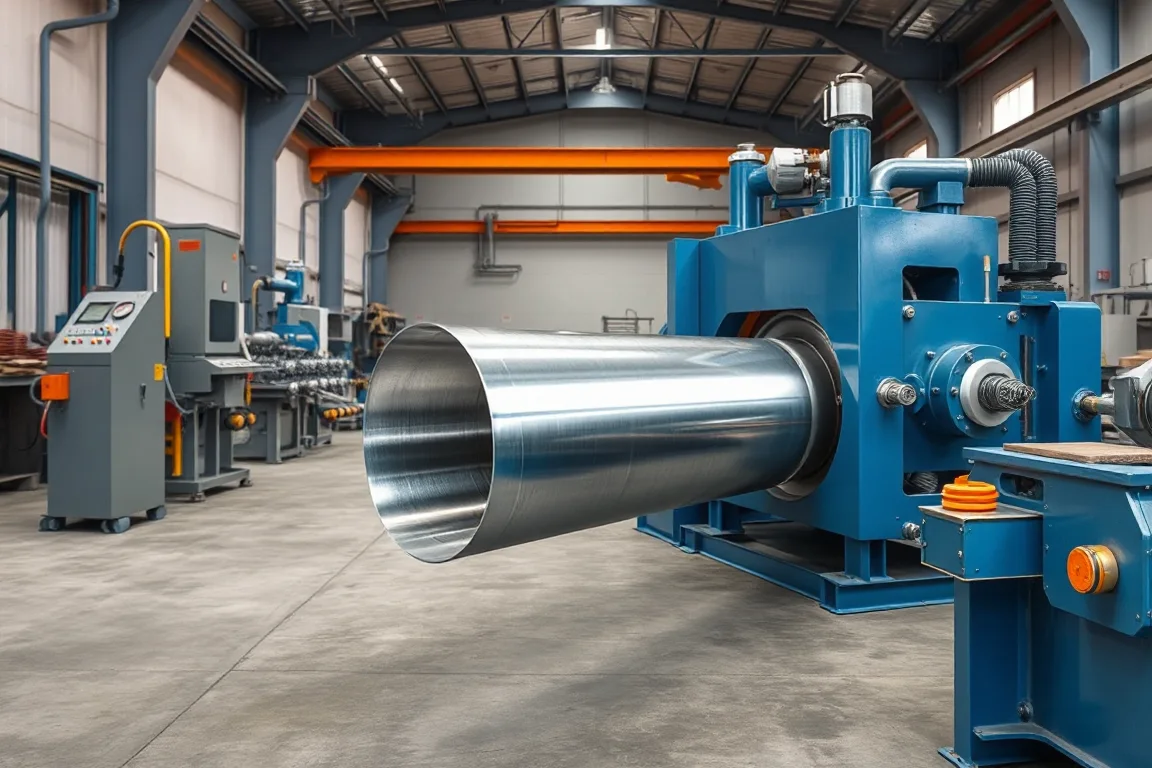
The term greenhouse steel column roll forming machine covers more than one production problem. A greenhouse structure uses columns, gutters, film-lock channels, crop support sections and connection hardware. These are different functional parts, often made from different materials and by different processes. The category name alone does not identify the manufacturing process. This article explains what a roll forming line can produce for greenhouse columns, how those parts connect to the rest of the structure, where the forming boundary ends, and how to evaluate a production route without assuming the profile is defined by the machine.
What a greenhouse steel column actually is
A greenhouse steel column may be an open section or a tube. Open sections are formed from coil by progressive rolls; tubes are commonly made by roll forming a round or rectangular section and then welding or locking the seam. The structural design and the connection details determine which form is appropriate. A column that carries roof load, resists wind and transfers load to the foundation has different requirements from a light longitudinal member that only positions film or crop support.
Before choosing a machine, establish the column's structural role, its connection method, its corrosion environment and its installation sequence. The column drawing typically includes a section shape, a base connection, a top connection to a truss or arch, and possibly holes or slots for cross-bracing. Those details are engineering inputs. They are not machine settings that can be guessed from the category name.
Component interfaces around the column
Greenhouse columns rarely work alone. A column may connect to a foundation plate, a gutter, a roof arch, a purlin, a diagonal brace and a film-lock channel. Each interface has its own fit requirement. A connection hole in the column must align with the mating part on site or in the assembly shop. A slot may be needed for field adjustment. A gutter attached to the column must allow drainage to flow and joints to seal. A film-lock channel, if it is integrated into the same section, must accept the retaining hardware that holds the film.
Because these interfaces are functionally different, inspection cannot be limited to the section outline. The finished member should be checked against the greenhouse drawing for connection positions, hole diameters and slot lengths. Drainage features should be checked for continuity and joint geometry. Film-retaining features should be checked for compatibility with the specific retaining element, not just for shape.
Why roll forming is used for greenhouse columns
Roll forming is a continuous bending operation that progressively transforms metal coil into a consistent cross-section. For greenhouse columns, it offers repeatable section geometry along long lengths, which suits columns that are cut to length on site or in a fabrication shop. It also allows punching, slotting and marking to be integrated into the same line, so connection features are positioned by the machine rather than by a separate operation.
The process is appropriate when the column section is constant along its length and when the material is a protected metal coil that can be formed without cracking. It is not a universal substitute for tube making, press braking, or extrusion. A tube column may be more structurally efficient for a given load, but making tubes requires a different line configuration and often a welding or locking step. A plastic growing channel, such as a hydroponic NFT channel, is an extrusion and is not produced on a metal roll forming line.
Production route for a formed steel column
The typical route begins with coil preparation. Coil is loaded, its end is prepared, and it is fed into the line. Coil preparation may include straightening and, if the material is supplied with a protective coating, care to avoid surface damage. The next stage is connection punching, where holes and slots are created according to the drawing. Then the section is formed by a series of roll stations. After forming, the profile is cut to length. Finally, the part is checked against greenhouse-interface requirements.
This route assumes that all connection features can be punched before forming. In some profiles, punching after forming is preferred because the flat pattern distorts less or because hole position must be referenced to the formed shape. In other cases, secondary operations such as bending, notching or end forming are needed. Those operations are outside the roll forming line and should be listed separately in any quotation.
Distinguishing structural columns from gutters and film-lock components
A greenhouse uses several unrelated profile functions: drainage, crop support, structural members and film retention. The manufacturing process should be chosen for each individual component. A gutter drainage shape requires a section that collects and directs water, and its joints must be reviewed for leakage and thermal movement. A film-lock channel must be compatible with its retaining element, which may be a wire, a spring or a plastic profile. A support section for crops may need smooth edges and a shape that does not damage plants or workers.
A structural column, by contrast, is selected for load capacity, stiffness and connection strength. Combining a structural column with a gutter or film-lock feature is possible, but it creates a more complex roll formed section and a more demanding inspection plan. The quotation should separate structural profiles, gutters and film-lock components so that the scope of each line and its secondary operations is clear.
Material and corrosion considerations
Greenhouse environments combine humidity, condensation and, in some cases, fertilizers, cleaning agents and disinfectants. These conditions influence the choice of base metal and protective coating. A generic galvanized description may not be sufficient if the column is exposed to nutrient solutions or aggressive cleaning chemicals. The buyer should specify the expected environment, the cleaning regime and any contact with growing media or water.
Roll forming can affect corrosion protection at cut edges, punched holes and formed corners. If the coil is pre-coated, the coating may be damaged during forming or punching. If the coating is applied after forming, the line must be compatible with that sequence. The chosen corrosion-protection process affects the production route and the inspection plan, so it should be agreed before the line is specified.
Cutoff and end quality
Cutoff requirements depend on the profile and the material. The cutoff operation must produce a cut end that meets the drawing and does not deform the section. For some columns, a simple square cut is sufficient. For others, the end may need to be shaped to fit a base plate or a top connection. The cut length must be consistent, especially when columns are assembled in a jig.
Secondary operations such as end milling, drilling or welding may be needed after cutoff. These operations should be identified in the equipment scope so that the finished part is not assumed to come off the forming line complete. If the greenhouse design requires curved or tapered columns, those are separate processes and should not be included in the roll forming line description without specific engineering review.
Assembly boundaries: forming versus fabrication
Roll forming produces a shaped member. It does not produce a finished greenhouse. Assembly includes connecting columns to base plates, attaching gutters, installing film-lock hardware and joining members with bolts or other fasteners. These operations are part of fabrication and site work. The forming line's boundary ends at the cut, inspected member, unless additional operations are explicitly included.
Certification and in-service performance are separate from production. Structural capacity, fire performance, and compliance with building codes are engineering and certification matters. They depend on the design, the material, the connections and the installation, not only on the forming machine. A production line does not certify a greenhouse column for a given load.
Application-specific inspection
Inspection should be based on the function of the specific profile. For a structural column, check the section dimensions that affect connection fit and load transfer. For a gutter, check drainage continuity and joint geometry. For a film-lock channel, check that the retaining hardware fits and holds as intended. For any profile with punched holes, check hole position relative to the formed reference surfaces.
Run the agreed material and profile, not an easier demonstration substitute. Inspect first-off pieces and a representative steady-production sample with the agreed gauges. Record changeover steps, setup scrap, punching and unloading time. Compare the written equipment scope with all secondary operations needed for a finished part. For growing systems, evaluate suitability for the actual nutrient and cleaning environment.
Comparison of production alternatives
- Roll forming from coil: suited to constant-section columns and integrated punching; produces long lengths with repeatable geometry; requires coil handling and careful setup.
- Tube making: often more structurally efficient for a given material; requires a tube mill and welding or locking; connection holes may be drilled after forming.
- Press braking: flexible for short runs and varied sections; slower for long columns and less consistent on long lengths.
- Extrusion: used for plastic growing channels and some aluminum profiles; not a metal roll forming process and not a substitute for a steel gutter line.
The choice depends on the column design, the production volume, the material and the required connection features. A roll forming line is a strong candidate when the section is constant and the volume justifies tooling, but it is not the only route.
Practical checklist before approving a production line
- Confirm the column drawing, including section, material, thickness and all connection features.
- Identify which features are formed, punched, cut or added in secondary operations.
- Agree the material grade and protective coating, and how forming affects them.
- Define cut lengths, end quality and any shaping required.
- Specify the electrical supply: voltage, frequency and phase.
- Define accepted output per shift with the actual profile and material.
- Plan handling for long members and variable cut lengths.
- Include secondary curving, joining or assembly operations in the quotation scope.
- Agree inspection gauges and first-off approval criteria.
- Separate structural columns, gutters and film-lock components in the quotation.
FAQ
Can one roll forming machine make structural columns, gutters and film-lock channels?
It can make more than one profile if the line is designed for changeover, but each profile has different forming stations, punching requirements and inspection criteria. Structural columns, gutters and film-lock channels are functionally different, so they may need separate tooling sets and possibly separate lines. The quotation should list each profile and its tooling separately.
Does a greenhouse steel column roll forming machine also make plastic growing channels?
No. Plastic growing channels, such as hydroponic NFT channels, are typically extrusions. They are made by a different process and from different materials. A metal roll forming line is not a substitute for a plastic extrusion system.
How do I specify the material and thickness for a greenhouse column?
The buyer should specify the base-metal thickness and grade based on the structural design and the corrosion environment. The operating range of the machine requires supplier verification, because the forming stations, punch tooling and cutoff must be compatible with the specified material. A generic description such as galvanized is not enough if the column will contact nutrients or cleaning chemicals.
What should be inspected on a formed column before assembly?
Inspect the section dimensions that affect connection fit, the position and size of punched holes and slots, the cut length and end quality, and any drainage or film-retaining features if they are part of the section. Check these against the greenhouse drawing. First-off and steady-production samples should be measured with agreed gauges.
Are certification and load capacity part of the machine scope?
No. Certification, load capacity and in-service performance are engineering and certification matters that depend on the design, material, connections and installation. The roll forming machine produces the shaped member. It does not certify the column for a structural load or a building code.
What secondary operations are commonly needed after roll forming?
Secondary operations may include end shaping, additional drilling, bending, notching, welding of base plates or brackets, and surface treatment. These operations are often outside the roll forming line and should be identified in the equipment scope so that the finished part is not assumed to come off the line complete.

Continue your research
- Greenhouse Profile Roll Forming Machines
- Greenhouse Gutter Roll Forming Machine
- Greenhouse Channel Roll Forming Machine
- Greenhouse Film Locking Channel Machine
- Greenhouse Crop Support Channel Machine
- Greenhouse Purlin Roll Forming Machine
- How Greenhouse roll forming machine Works
- How To Choose a Greenhouse roll forming machine
- Greenhouse roll forming machine Price: What Affects the Cost?
Configuration & specification inputs
Match the configuration to your section drawing, material and production requirements.
| Parameter | Requirement / confirmation needed |
|---|---|
| Profile geometry | A greenhouse steel column may be an open section or a tube. Establish the structural design and connections first; the category name alone does not identify the manufacturing process. |
| Material | Specified protected metal sections; plastic growing channels use a different process |
| Thickness & grade | Buyer to specify base-metal thickness and grade; operating range requires supplier verification. |
| Process route | Coil preparation → connection punching → section forming → cutoff → greenhouse-interface checks |
| Cutting | Confirm profile-supported cutoff, cut lengths, end quality and any secondary operations. |
| Output | Define accepted output per shift with the actual profile and material. |
| Electrical supply | Buyer to state voltage / frequency / phase. Installed power requires a confirmed equipment schedule. |
| Acceptance | Measure the functional connection references on the finished member. Review how the chosen corrosion-protection process affects the route. The structure's capacity and installation requirements remain part of its engineering design. |