
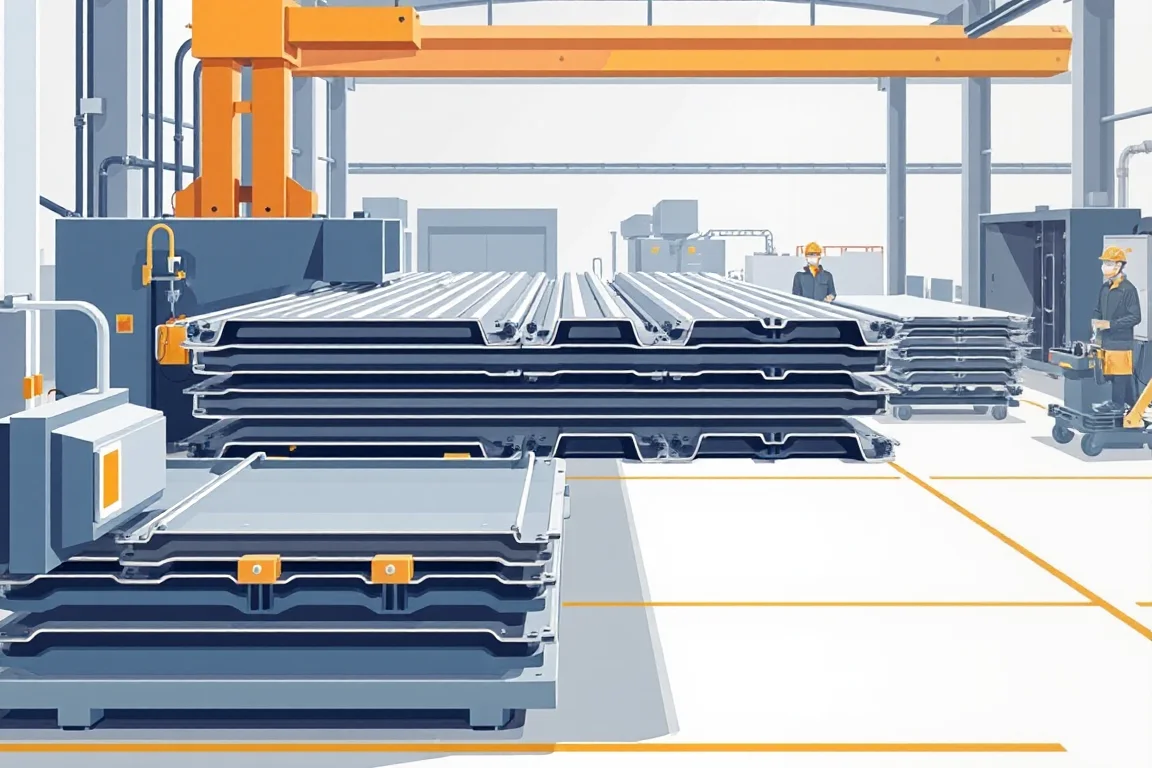
Floor deck productivity should be measured as accepted coverage delivered in usable bundles. The strip speed through the forming stands does not include every feature operation, cut, profile change or stack-removal delay. A useful production study keeps the deck geometry and complete handling route attached to the output figure.
Choose the output boundary and unit
State whether the count ends at the cutoff or after inspection and stacking. Accepted square metres are useful commercially, while linear metres and pieces help explain machine work. Use effective cover to convert length into nominal deck area.
Do not count rejected or handling-damaged sheets as accepted output. Keep gross production separate so a speed increase cannot hide a decline in saleable yield.
Build a representative deck-order basket
Include the actual profiles, materials, lengths and required features. Short pieces create frequent cuts; long sheets require more extensive support and bundle handling. One convenient demonstration length does not describe the full order mix.
Where several profiles share a line, include meaningful changes or study them separately. Record what the clock includes: preparation, first-off approval, forming, cutting, inspection and stack removal. Equal boundaries are necessary for comparing proposals.
Functional features are part of the work content
A deck with specified embossments or other operations should be studied with those features active and accepted. A plain-section speed can omit an important part of the actual route.
Verify feature condition and location alongside output. A high rate that produces sheets outside the approved feature geometry is not an improvement in finished deck capacity. Preserve the exact drawing and material combination in the report.
Calculate coverage from accepted sheets
Assume a hypothetical trial releases 90 accepted sheets at 6 metres long and 0.75 metre effective cover. Nominal coverage is 90 × 6 × 0.75 = 405 square metres. Over a 135-minute measured route, average output is 3 square metres per minute, or 180 square metres per hour.
These inputs illustrate the calculation, not a machine rating. They also do not establish the net area of a particular floor after openings and project cutting. Keep production coverage separate from the building takeoff.
Cut frequency changes the length-to-piece relationship
For equal linear metres, shorter sheets require more individual cuts and collection events. The impact depends on the selected cutting route. Ask for demonstrated output at required lengths rather than multiplying a nominal strip speed by shift time.
Inspect ribs and side laps near the ends while evaluating cutting productivity. A faster cycle that increases local deformation can reduce accepted output. Time and quality must be measured on the same trial.
Long sheets make stacking a production constraint
Observe whether the former waits for sheets to be supported, nested or removed in bundles. The layout and handling capacity can determine the sustained rate. More available forming speed may simply create a queue at discharge.
Evaluate improvements under the intended safe operating and protective arrangements. A brief demonstration using extra manual assistance may not represent the routine staffing plan. Record those resources so the capacity estimate is reproducible.
Measure changes through an accepted complete sheet
A profile transition can involve roll tools, guides, feature tools and cutting components. End the operational changeover when the first sheet passes its required geometry, feature and lap checks, not when the main tooling movement finishes.
For an illustrative week with five changes, saving 30 minutes per complete recovery releases 150 minutes. Whether that produces financial value depends on demand and downstream capacity. Do not treat all released time as guaranteed sales.
Keep loss categories specific to deck production
Separate rejected starts, feature deviations, lap mismatch, cut-end damage and stacking losses. Their causes and remedies differ. A single scrap percentage may conceal a late handling problem that consumes otherwise good sheets.
- Setup and first-off approval time.
- Coil preparation and loading interruptions.
- Feature and cutting work for the required product.
- Stack-removal and bundle-handling waits.
- Quality losses by the stage where detected.
Plan capacity around completed orders
Track the labor and auxiliary equipment used during each measured trial. A result achieved with extra temporary handling staff may be valid for that demonstration but unsuitable for a routine one-crew plan. Likewise, a study that begins with coils already staged should not be compared directly with one that includes retrieval and loading unless the difference is stated.
Use the same discipline when evaluating an improvement. If a new stacker reduces waits, keep the deck profile, lengths and acceptance criteria comparable before crediting the full output change to the equipment. A simultaneous switch to easier orders can exaggerate the apparent gain. The useful question is whether the intervention delivers more accepted coverage for the same kind of work under the intended resources, not whether one favorable shift sets a new record.
Use measured rates for meaningful product groups and add the required changes. Include accessory or secondary work if the business sells a complete floor package. A main-sheet output figure alone may not predict delivery.
Consider a schedule with one long standard run followed by several short mixed-profile orders. Their average output will differ even on the same line. Keep separate planning rates or a visible order model rather than declaring the less favorable day a machine-performance failure.
Frequently asked floor-deck output questions
Can maximum strip speed predict accepted area per shift?
Only as a theoretical movement-based estimate. Real output includes cuts, changes, handling, inspection and yield. Validate it with representative deck orders.
Why use effective cover instead of sheet width?
Effective cover represents the installed nominal width after the side-lap relationship. Overall width and flat strip width describe different quantities.
Should a stacking demonstration use the actual profile?
Yes. Nesting and handling can depend on ribs and laps. A different sheet may not reveal the relevant damage or removal constraint.
What is the best first improvement?
Address the largest recurring measured loss in the actual order mix. It may be setup, cutting or bundle removal rather than forming speed. Verify the change on comparable work.
Continue your research
- Floor Deck Roll Forming Machines
- Floor Deck Roll Forming Machine
- Roof Deck Roll Forming Machine
- B Deck Roll Forming Machine
- N Deck Roll Forming Machine
- H Deck Roll Forming Machine
- How Floor deck roll forming machine Works
- How To Choose a Floor deck roll forming machine
- Floor deck roll forming machine Price: What Affects the Cost?