
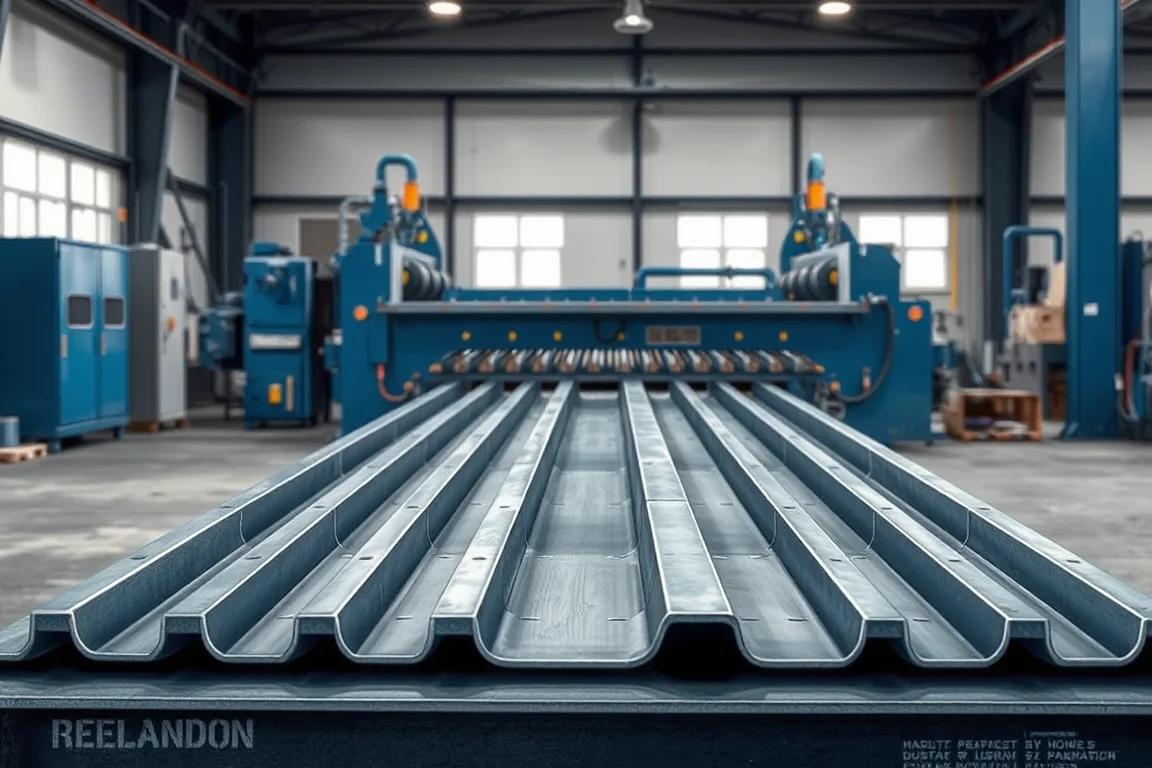
A roof deck roll forming machine produces the profiled steel substrate specified for a roof assembly. Its output is different from a finished weathering roof sheet: the deck belongs to a defined structural and roofing arrangement that can include insulation, membranes, cover boards or other layers above it.
Selecting the equipment starts with the roof-deck profile and its side-joint system, then adds material, length, optional features and handling requirements. A familiar commercial deck designation is useful for identifying a family, but the complete drawing is what gives the forming line a reliable production target.
How is roof deck different from exposed roofing?
An exposed roofing panel is selected as part of the weathering surface and its joints. Roof deck serves the role defined beneath or within the selected roof assembly. The fact that both can contain repeated ribs does not make their profiles, attachments or applications interchangeable.
The manufacturing brief should state whether the product is a conventional open deck or another defined construction. If acoustic, cellular or other specialized variants are intended, describe their additional components and operations separately. A basic former does not automatically produce every product sold under the wider roof-deck category.
Which profile dimensions govern the production target?
Include rib depth and pitch, top and bottom widths, side-wall geometry, bend radii and both terminal edges. The side-lap construction must match the intended adjoining sheet. Specify effective cover separately from overall width and developed strip width.
- Controlled cross-section and functional measurement references.
- Side-lap or interlocking-edge arrangement.
- Material grade, thickness and coating combinations.
- Required venting, perforations or other features.
- Length range, end condition and any special order details.
- Stacking, identification and delivery format.
Do not substitute one supplier's profile drawing for another merely because their names are similar. A difference at a terminal edge or rib can affect both tooling and the compatibility of the delivered product.
What equipment stages belong in the line?
The basic route needs controlled coil presentation, progressive forming, length production and supported collection. Feature-making may be integrated where the deck requires it. The complete layout should show how raw coils, strip, finished sheets and stacks move through the factory.
- Identify and load the specified coil.
- Guide the strip consistently into the forming sequence.
- Develop repeating ribs and the terminal side-joint geometry.
- Produce required features using the agreed method.
- Cut the ordered lengths with profile-appropriate support.
- Inspect, label and stack accepted deck sheets.
Ask how the proposed sequence protects the side joint during cutoff and takeoff. The terminal edge is a functional interface, not scrap margin that can be allowed to deform during collection.
How should steel grade and thickness be specified?
Define the actual grade, base-metal thickness, width and coating combinations for each profile. A nominal gauge can be interpreted differently across markets, so the controlled material specification should be unambiguous. The machine trial should use the agreed material rather than only the easiest available coil.
Changing strength or thickness can influence the forming result and cutting duty. Review those changes with the profile geometry instead of treating each maximum value independently. Retain coil identity with the accepted samples and finished bundles.
Inspect coating condition where the strip bends and contacts the tools. If material requirements differ between roof-deck variants, keep their records and labels distinct so similar-looking sheets are not mixed after production.
How do side-lap choices affect tooling and checks?
A nested lap and an interlocking-edge arrangement present different forming targets. The drawing should show the terminal edges individually and in their assembled relationship. The line must reproduce that geometry along normal production lengths, not only in a short demonstration sample.
Assemble several sheets using the specified joint method and check cover, alignment and engagement. Inspect near the ends as well as at mid-length. If a sheet needs local bending to fit, record the deviation instead of treating the completed assembly as an unqualified pass.
The production fit check is separate from the project's side-lap attachment design. Fastener or joining method, spacing and structural requirements must follow the selected roof system; they are not established by the roll former alone.
What changes for vented or acoustic deck?
Required openings need controlled size, position and pattern. Specify whether they belong to the main sheet, another component or a separate operation. Feature-making equipment must be evaluated with the actual pattern because its duty can differ substantially from producing a plain deck.
Acoustic or cellular products may involve additional layers, inserts or joining operations according to their design. Identify those items in the manufacturing boundary. A perforated sheet by itself should not be presented as a complete acoustic roof-deck assembly without its defined construction.
Inspect features after forming and handling, and retain the drawing revision used for approval. A changed perforation pattern or added feature is a product change that deserves review rather than an informal operator adjustment.
How should profile flexibility be compared?
List every roof-deck section the business expects to make and its material combinations. Ask which transitions require different roll tools, guides, feature dies and cutoff components. A change in rib depth or side-joint design can be more significant than a change in length.
Dedicated, changeable-tool and multi-path arrangements have different scheduling implications. Compare them against the expected order mix and floor space. More forming paths do not necessarily mean simultaneous production if coil feed, drive or discharge is shared.
Demonstrate a relevant profile change through to accepted stacked sheets. Include setup scrap and inspection, then recover the original configuration. Repeatability is a practical part of flexibility.
Why do long sheets need a handling plan?
Roof-deck orders can include lengths that require substantial support and removal space. Draw the path from cutoff through inspection to the completed stack. Check that the terminal edges and ribs remain protected when the sheet is moved or nested.
Define stack orientation, quantity and identification before choosing a takeoff system. A production trial should include the longest required handling case and a short-length order with frequent cuts. Those expose different constraints that a single convenient sample length can hide.
Measure straightness under agreed support conditions. An unsupported long sheet can appear distorted in a way that does not represent its permanent condition, while handling damage can create a real defect after forming has finished.
How should roof-deck output be reported?
Use accepted sheets, nominal cover area and completed stacks for a defined order. Include coil changes, cutting, feature operations and stack removal. Keep rejected or damaged pieces separate rather than counting all strip that passed through the line as saleable deck.
For a planning example, 150 accepted sheets at 6 metres long and 0.9 metre effective cover represent 810 square metres of nominal coverage. This is a quantity calculation, not a machine rate or a roof takeoff. Project openings, overlaps and installation waste remain separate considerations.
A quoted strip speed becomes useful only when paired with the actual profile, material, lengths and included operations. Compare like-for-like trial orders rather than isolated headline values.
What should the investment scope include?
Include the coil-handling package, profile tools, optional feature operations, cutoff, takeoff and stacking. Identify inspection equipment, controls, training and commissioning. Specialized deck constructions should list their additional joining or component-handling equipment separately.
Clarify the future-product assumptions. A line designed around one plain roof-deck profile is a different investment from a system expected to alternate several depths, side joints and perforation patterns. The quotation should make that difference visible.
What should acceptance verify?
- Rib geometry, terminal edges and effective cover.
- Specified features and their finished positions.
- Length, end condition, straightness and coating observations.
- Assembly of several adjacent sheets.
- Representative long and short order handling.
- Required profile changes and recovered production.
- Stack condition, labels and accepted-output records.
Retain the approved samples and process settings. They provide the reference needed to investigate a later change in side-lap fit or section geometry without relying on memory.
Frequently asked questions
Can roof deck be used as exposed roofing?
Use it only within the roof assembly for which the product is designed. Ribbed appearance does not make deck equivalent to a weathering panel. The equipment specification follows the selected product, not a general assumption about its use.
Does one deck name define an exact profile?
Not reliably across all suppliers and markets. Obtain the controlled cross-section, side joint and material specification. Similar names can conceal differences that matter to tooling and installation compatibility.
Can perforations be added to a plain line?
They require a review of the feature tools, sequence, controls and intended product design. Specify the actual pattern and output requirement. Do not assume every opening can be added without affecting the production route.
Does a forming trial establish roof capacity?
No. It verifies manufacture of the specified component. Structural and other roof-system requirements depend on the applicable design, materials, connections and evidence for the complete assembly.
Why test both short and long lengths?
Short products emphasize cutting and collection cycles, while long sheets emphasize support and handling. Both can constrain useful output in different ways. A representative trial should reflect the real order range.
What is needed for a useful quotation?
Provide profile and side-joint drawings, material combinations, optional features, length mix and stack requirements. Identify any acoustic or cellular variants separately. This keeps the proposal aligned with the intended roof-deck catalogue.

Continue your research
- Floor Deck Roll Forming Machines
- Floor Deck Roll Forming Machine
- Composite Deck Roll Forming Machine
- B Deck Roll Forming Machine
- N Deck Roll Forming Machine
- H Deck Roll Forming Machine
- How Floor deck roll forming machine Works
- How To Choose a Floor deck roll forming machine
- Floor deck roll forming machine Price: What Affects the Cost?
Configuration & specification inputs
Match the configuration to your section drawing, material and production requirements.
| Parameter | Requirement / confirmation needed |
|---|---|
| Profile geometry | Roof-deck rib geometry, terminal joints and effective cover |
| Material | Drawing-specified grade, base-metal thickness and coating combinations |
| Thickness & grade | Use unambiguous thickness specifications rather than gauge names alone |
| Process route | Identified coil, progressive deck forming, required features, supported cutoff and stacking |
| Cutting | Inspect terminal-edge condition at both short and long ordered lengths |
| Output | Accepted roof-deck sheets and labelled stacks for the stated order mix |
| Electrical supply | Confirm supply for forming, feature-making, cutoff and selected takeoff systems |
| Acceptance | Check ribs and side-lap fit, features, long-sheet support and recovered profile changes |