
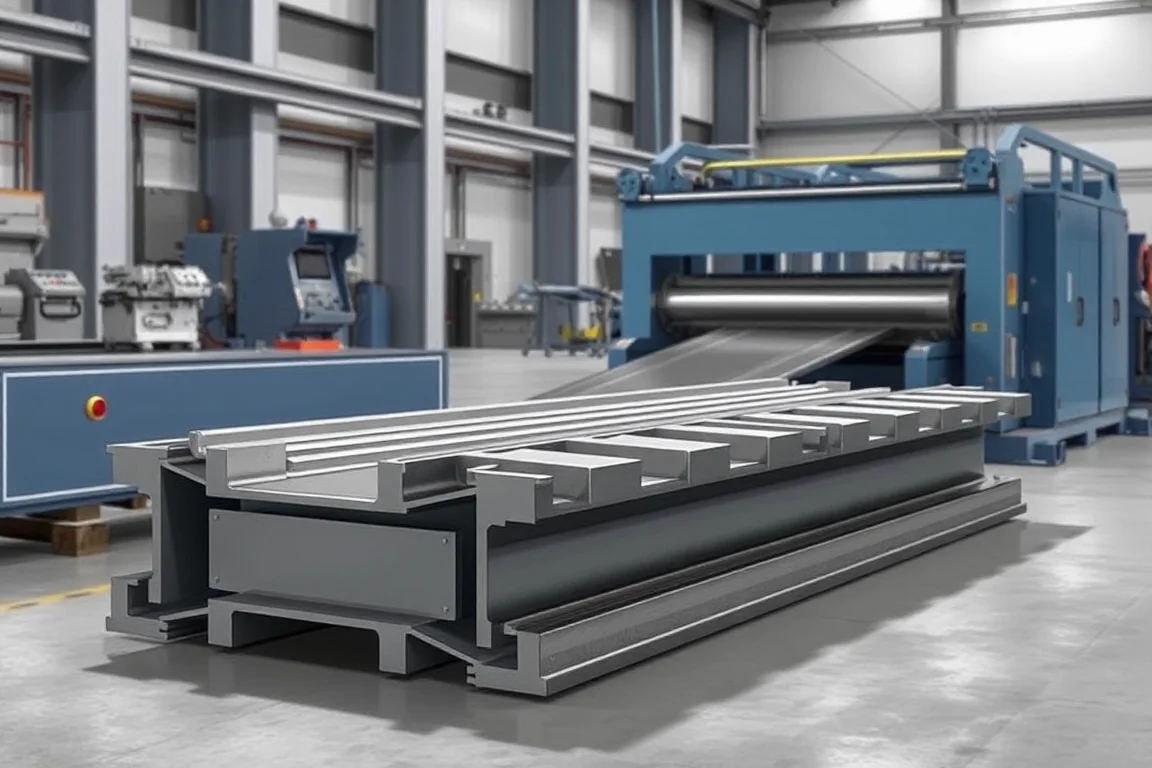
A composite deck roll forming machine produces steel deck intended to work within a defined composite slab design. The profile includes the ribs, side edges and specified bond-related features associated with that product. Those details distinguish the manufacturing task from making a visually similar plain corrugated sheet.
The project should therefore begin with a qualified product design and a clear manufacturing specification. Tooling selection, embossing, material control and inspection must reproduce that design consistently. Changing a feature because another deck uses it is not a substitute for reviewing the complete slab and deck system.
What makes the deck a composite product?
The intended interaction between the steel deck and the concrete is part of the slab design. Many composite-deck profiles use controlled embossments alongside their section geometry. The required behavior is not established simply by placing concrete on any ribbed sheet.
The production line's role is to manufacture the specified deck. Concrete properties, reinforcement, supports, connections, construction conditions and design verification remain part of the wider floor project. Keep those responsibilities clear while making the machine acceptance detailed enough to control the product features that matter.
Which features must be frozen before tooling approval?
Provide a controlled cross-section and feature drawing. Include rib pitch and depth, pan geometry, side-wall shape, bend radii and terminal edges. Show the embossment pattern in relation to those surfaces, with the dimensions and measurement method used for acceptance.
- Cross-section and effective cover.
- Side-lap or interlocking-edge details.
- Embossment shape, location, repeat pattern and required geometry.
- Material grade, thickness and surface condition.
- Finished lengths and end requirements.
- Product identification and applicable drawing revision.
A physical reference sample is useful, but it should correspond to the same controlled design. If sample and drawing differ, resolve the difference before machining the tools rather than leaving operators to choose which version looks more convincing.
How does embossing interact with roll forming?
The proposed route must create the required embossments while developing the deck section. Their final condition depends on the material and the operations that follow them. Ask the supplier to explain where embossing occurs and how the specified geometry is maintained through subsequent passes.
Inspect embossments on completed sheets, not only on flat strip or an intermediate sample. Check the defined dimensions and their position relative to ribs and ends. Features that look prominent can still differ from the approved pattern, so visual impression alone is not an adequate control method.
Tool wear and changes in setup should be managed against that reference. An informal adjustment that makes an embossment easier to produce can change the product. Keep tooling changes tied to the responsible engineering review and the applicable acceptance criteria.
What does the complete production sequence include?
- Material verification: identify the approved coil and its relationship to the production order.
- Coil presentation: load and guide the strip within the specified equipment envelope.
- Feature and profile development: create ribs, terminal edges and embossments in the proposed controlled sequence.
- Length production: cut the ordered sheets without unacceptable distortion of the profile or ends.
- Inspection: verify the section, features, material record and sheet condition.
- Stacking and identification: preserve the product geometry and link bundles to their production records.
Ask which operations are included and which remain outside the line. A complete former package may still rely on separate material testing, accessory production or product qualification work.
How should the material envelope be controlled?
Specify grade, base-metal thickness, strip width, coating and any relevant surface requirements as combinations. The material affects both the main section and the formation of local features. A successful run on one thickness should not be treated as proof for every material in a broad catalogue.
Use the trial matrix to cover the required product range and retain coil identification with measured samples. If embossment geometry or side-joint fit later changes, the team needs to compare the material, tooling condition and setup against the accepted reference.
Avoid substituting a convenient trial material without documenting the difference. The acceptance record should state what was actually demonstrated and which combinations still need review.
Why are side joints still important on composite deck?
Attention to embossments should not obscure the terminal edges. Adjacent sheets must form the specified deck arrangement, with the intended cover and connection geometry. Measure and assemble production-length sheets after normal cutting and handling.
Check the beginning, middle and end of the side joint. Local end flare or a damaged edge can create assembly difficulty even when the repeating central profile is correct. Record any need for unplanned forcing rather than treating a finally completed joint as evidence of a clean fit.
The site attachment procedure remains part of the floor design. A manufacturing assembly check confirms compatible geometry; it does not select fasteners, spacing or structural connection details for a building.
Can one line make several composite-deck families?
A configured multi-profile line may cover several products, but the required tools and changes need to be explicit. Rib depth, pitch, terminal edges and embossment design can all change independently. A machine that adjusts one dimension does not automatically support an unrelated deck family.
Request a configuration matrix covering roll tools, embossing tools, guides, cutoff parts and inspection references. Demonstrate a meaningful change and return to the original product. Include the first accepted sheet and feature measurements in the timing.
Keep each product's drawing and setup distinct. Reusing an embossment pattern across profiles simply to reduce tooling cost should occur only where the relevant product design supports it, not as an undocumented shop-floor compromise.
What should quality control measure beyond overall dimensions?
Use a hierarchy of checks: material identity, cross-section, functional edges, embossments, length and finished condition. The measurement method should be practical enough to repeat in production while still addressing the drawing's critical features.
Define where measurements are taken and how samples are supported. Deep or locally formed features can be difficult to assess consistently if operators use different reference surfaces. Establish the method during commissioning rather than after conflicting inspection results appear.
When a deviation occurs, preserve a sample and record the coil, settings and tool condition. This supports a controlled correction. It is more informative than adjusting the line until the next sheet appears closer to a photograph.
How should stacking protect product identity and geometry?
Specify the nesting direction, stack size and handling method for each deck family. The stack should protect terminal edges and allow normal separation without unacceptable damage. Inspect representative sheets after ordinary bundle movement.
Labels should distinguish profile, thickness, length, order and the relevant production reference. Similar-looking plain and composite products must not be mixed. Clear identification is a practical safeguard when several deck types pass through the same factory or warehouse.
What is a meaningful output comparison?
Measure accepted sheets and nominal cover area during a stated order, including feature production, inspection and stack removal. Report startup scrap and rejected pieces separately. A high strip speed does not demonstrate productive composite-deck manufacture if the required embossments are inconsistent.
For planning arithmetic only, 120 accepted sheets at 5 metres long and 0.8 metre effective cover contain 480 square metres of nominal coverage. Converting that quantity into production time requires the demonstrated operating cycle. It also does not establish a slab area or structural capacity for a project.
Compare quotations that include the same profile and embossment families, material range, handling and inspection scope. Separate machine supply from any product-design or qualification services so responsibilities and costs remain clear.
What should the acceptance record contain?
- The controlled deck and embossment drawings used for the trial.
- Actual material combinations and coil records.
- Section, terminal-edge and feature measurements on finished sheets.
- Length, cut-end and surface observations.
- Adjacent-sheet assembly results.
- Required changeover and setup-recovery evidence.
- Packed-bundle condition and accepted production quantities.
The result should be reproducible by the production team. Retained samples, gauges and setup references are useful only when they correspond to the same approved product definition.
Frequently asked questions
Does embossing automatically make a deck composite?
No. Composite behavior belongs to the defined deck-and-slab design and its required evidence. The embossments must match that product specification; adding arbitrary marks to plain deck is not a substitute for engineering review.
Can embossment depth be adjusted for easier production?
Only through the responsible controlled review of the product and tooling requirements. A feature change can affect the manufacturing target. Operators should not alter it merely to make a difficult material run more conveniently.
Can the line also make plain form deck?
That depends on the agreed tooling and process arrangement. Specify the plain profile and how embossing or other features are omitted or changed. Demonstrate both configurations instead of assuming one follows automatically from the other.
Why retain coil records?
They connect feature and section measurements to the actual material used. When a later batch differs, the team can investigate stock, tooling and setup together rather than treating every deviation as a machine fault.
Does machine acceptance replace slab testing or design?
No. It verifies manufacture of the specified deck. The slab's performance depends on the relevant complete design and qualification evidence. Assign those responsibilities separately in the project.
What is needed for an equipment enquiry?
Supply controlled section and embossment drawings, material combinations, side-joint details, lengths and expected orders. Add inspection and bundle-identification requirements. This provides a concrete basis for the complete composite-deck production route.

Continue your research
- Floor Deck Roll Forming Machines
- Floor Deck Roll Forming Machine
- Roof Deck Roll Forming Machine
- B Deck Roll Forming Machine
- N Deck Roll Forming Machine
- H Deck Roll Forming Machine
- How Floor deck roll forming machine Works
- How To Choose a Floor deck roll forming machine
- Floor deck roll forming machine Price: What Affects the Cost?
Configuration & specification inputs
Match the configuration to your section drawing, material and production requirements.
| Parameter | Requirement / confirmation needed |
|---|---|
| Profile geometry | Composite-deck section, side edges and specified bond-related embossment pattern |
| Material | Approved deck grade, coating and surface condition with retained coil records |
| Thickness & grade | Trial the actual grade, thickness and width combinations for the product family |
| Process route | Material verification, controlled profile and embossment development, cutoff, inspection and identification |
| Cutting | Preserve finished ribs, edges and required feature relationships at the ends |
| Output | Accepted feature-compliant sheets and nominal coverage, not strip speed alone |
| Electrical supply | Confirm complete forming, embossing, cutting and handling utility requirements |
| Acceptance | Measure completed embossments and section, assemble adjacent sheets and repeat required product changes |