
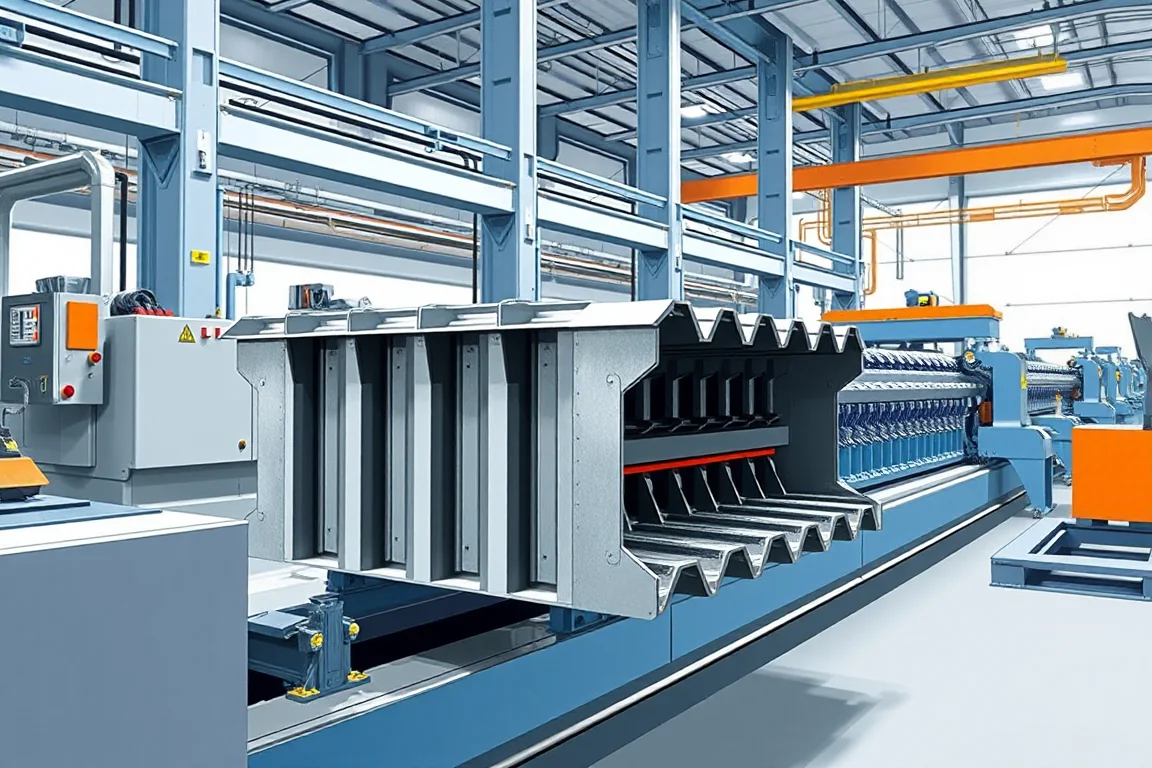
A 3 inch metal deck roll forming machine enquiry identifies a nominal 76.2 mm deck depth but not the complete product. The intended sheet may belong to a roof-deck family, a composite floor-deck family or another defined construction. The first task is to establish that role and the exact section before selecting tools.
This distinction prevents a common mistake: treating all deep ribbed steel sheets as interchangeable. Roof deck and composite floor deck can share a nominal depth while using different ribs, side laps and surface features. The line must make the approved product, not merely reach three inches in height.
Which three-inch deck is required?
Identify the controlled drawing, application and product revision. Show rib pitch, upper and lower widths, web angles, bend radii and terminal edges. Include embossments, perforations or liners where they belong to the finished construction.
Keep roof and floor variants separate in the catalogue and machine matrix. A shared depth may be useful for an initial discussion, but it does not establish shared forming tools or product qualification.
How do roof and composite-floor requirements differ?
The roof-deck drawing defines the steel support component for its specified roof system. A composite-floor product includes the geometry and features required by its deck-slab design. Those roles should not be inferred from the appearance of the ribs.
If the business plans both, ask for an explicit dual-product proposal with separate feature and acceptance requirements. Do not assume a generic embossing option converts one approved product into another.
What does the deeper geometry change?
The developed strip, forming progression and physical section envelope all need review. Deeper ribs can require different tool access and support from shallower products. The actual material combination is part of that assessment.
- Confirm the complete rib and lap section.
- Identify input width independently of cover.
- Review the largest material and profile combinations together.
- Define cutoff support and discharge contact points.
- Include the intended bundle shape and handling route.
These are engineering inputs, not reasons to assume a universal machine size from deck depth alone.
How should optional features be specified?
For a composite product, define the controlled deformation or embossment pattern. For vented or acoustical products, define the required openings and any liner assembly. Each feature needs its own equipment and inspection scope.
Ask where features are created in relation to forming and cutting. Inspect their delivered condition after the complete route. A demonstration of the plain ribbed section does not establish a featured or assembled variant.
What material matrix is needed?
Pair grade, base-metal thickness, coating and strip width with each three-inch section. Select trial cases that represent normal demand and the demanding combinations. Keep coil identity and incoming-material requirements with the results.
Do not borrow another deck manufacturer's capacities or approvals. The machine trial verifies production of the specified component, while its structural application and qualification require their own evidence.
How should cut ends and side laps be checked?
Measure terminal edges and ribs near the cut ends and in the interior. Check squareness, local flare or crushing and the permitted edge condition. Use the intended joining arrangement to assemble several sheets and verify effective cover.
The deeper section must remain supported through transfer. Inspect the lap after normal stacking because package contact can create a fit problem that was absent at the machine exit.
Can several three-inch profiles share equipment?
Possibly, with the right tooling and feature arrangement, but depth alone is not the deciding factor. Compare rib pattern, material development, laps, embossments and cutoff requirements. Ask for a common-parts and change-parts matrix.
Demonstrate a complete transition to an accepted new sheet. Include feature programs, cutting parts, inspection and startup scrap. This shows whether shared equipment fits the actual order frequency and product mix. Clearly identify finished bundles by the actual roof or floor product, not only by depth, because visually similar sheets may belong to different controlled specifications.
What should a production acceptance order contain?
- The exact roof or floor product and material.
- Representative short and long lengths.
- All required surface or opening features.
- Joined-lap and cover checks.
- Cut-end and package-condition inspection.
- A meaningful product or material change where required.
- Accepted output with included operations clearly stated.
Compare complete accepted orders rather than maximum strip speed. Feature cycles, cutoff and stack removal can determine the useful output of a deep-deck route.
Frequently asked questions
Does three-inch deck always mean N deck?
No. N is a familiar roof-deck family, but nominal three-inch depth can appear in other products. Confirm the actual section and intended use.
Can the same sheet serve roof and composite floor work?
Only where the relevant product design and qualification explicitly support those uses. A similar depth or rib appearance is not enough to establish interchangeability.
Is 3 inches exactly 75 mm?
No. Three inches equals 76.2 mm. Follow the controlled drawing and tolerance rather than substituting a rounded nominal dimension.
Are liners or cellular assembly included?
Only if the equipment proposal includes them. Define the finished construction and identify every forming, joining and handling operation needed to make it.
What should be supplied for quotation?
Send the complete section, application, material matrix, side laps, features and lengths. Include other planned variants and the expected order schedule for changeover evaluation.
Identify the product behind the depth
A three-inch deck project needs a clear roof or floor product definition before machinery is selected. Connecting that definition to features, material and handling produces a meaningful trial and avoids false equivalence between different deep-deck systems.

Continue your research
- Floor Deck Roll Forming Machines
- Floor Deck Roll Forming Machine
- Roof Deck Roll Forming Machine
- B Deck Roll Forming Machine
- N Deck Roll Forming Machine
- H Deck Roll Forming Machine
- How Floor deck roll forming machine Works
- How To Choose a Floor deck roll forming machine
- Floor deck roll forming machine Price: What Affects the Cost?
Configuration & specification inputs
Match the configuration to your section drawing, material and production requirements.
| Parameter | Requirement / confirmation needed |
|---|---|
| Profile geometry | Selected nominal 76.2 mm roof or floor deck with explicit product identity, ribs, laps and features. |
| Material | Application-specific steel grade and finish assigned to the controlled deck product. |
| Thickness & grade | Approved material-thickness and strip-width combinations for each three-inch variant. |
| Process route | Coil preparation, product-specific features, deep-rib and lap forming, cutting and supported packaging. |
| Cutting | Required deck lengths with controlled end distortion and retained side-lap fit. |
| Output | Accepted identified roof or floor deck orders including their distinct feature and handling scope. |
| Electrical supply | Utilities matched to the actual deep-deck profile and optional manufacturing operations. |
| Acceptance | Product identity, rib and feature geometry, joined cover, cut ends and package condition. |