
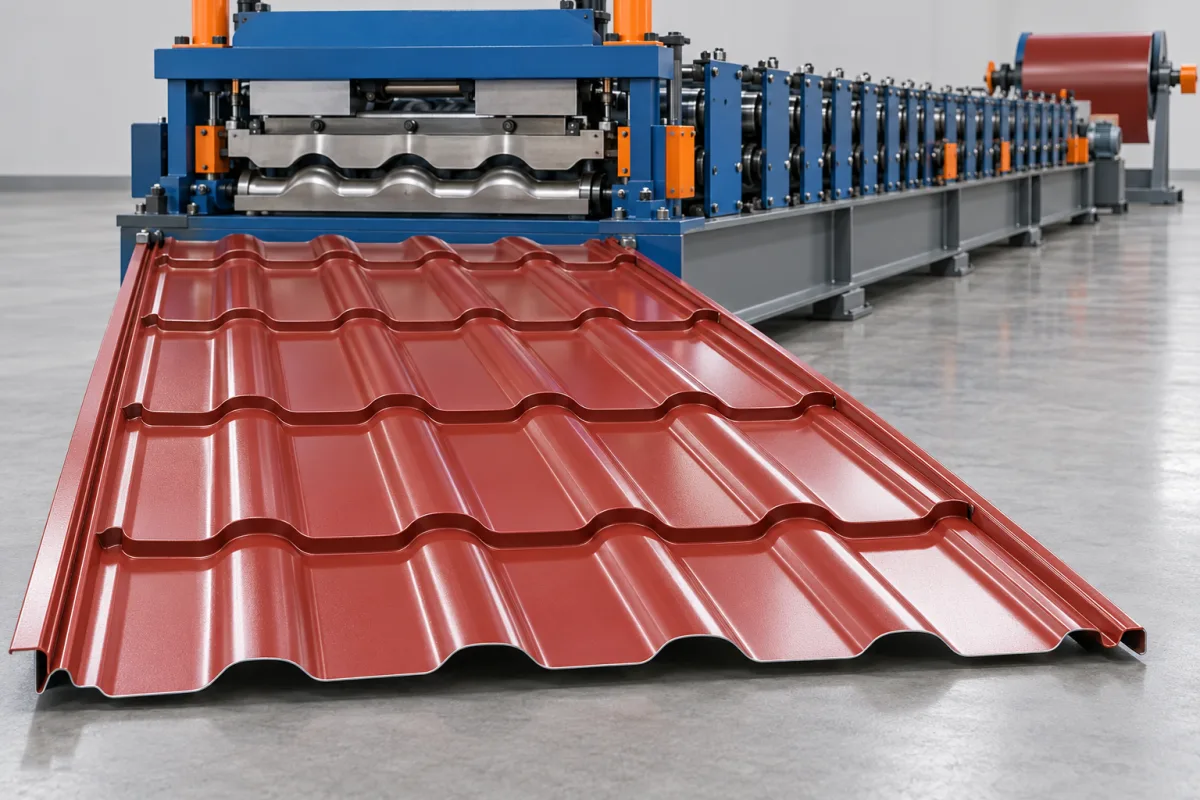
A glazed tile roof panel roll forming machine produces metal roofing with a tile-like stepped appearance. In this product category, glazed tile describes the visual style rather than a ceramic-glazing process. The line shapes coated metal into longitudinal contours and repeated transverse steps so the finished sheet resembles a series of tile courses.
This is a different manufacturing problem from a straight ribbed roof sheet. The production brief must define the step pitch, step shape, end treatment and relationship between the longitudinal profile and the transverse pressing operation. Those details determine both appearance and how adjoining sheets align.
What separates tile-effect sheet from ordinary roofing?
A conventional ribbed sheet maintains a substantially constant cross-section along its length. A tile-effect panel adds repeated features across that length, creating the visual course pattern. These transverse features require a coordinated operation beyond simply passing strip through longitudinal roll tools.
Also distinguish long tile-effect sheets from individual metal shingles. They can require different pressing, edge formation and handling routes. Specify the exact saleable unit, including its side and end joints, before requesting a machine configuration.
Which tile dimensions control the product?
Define longitudinal rib geometry, effective cover, transverse step pitch and the step depth and contour. Show the beginning and end of a finished sheet, not merely one repeating middle module. The first and last course can determine how a panel meets an eave, ridge or adjoining length.
- Identify the visible face and side-lap direction.
- Show the repeated tile module along the sheet.
- Define the allowed length schedule or module count.
- Specify end-lap and termination details where required.
- Include matched ridge and edge accessories separately.
A decorative rendering communicates style but cannot establish these manufacturing relationships. Use a controlled drawing and representative formed sample to agree the final tile effect.
How are forming, stepping and cutting coordinated?
The strip is presented from the coil, guided and formed into its longitudinal contour. A coordinated pressing or stepping operation creates the transverse tile pattern, and the cutting arrangement produces the required finished length. The actual sequence depends on the proposed equipment and product design.
Ask how the controller relates the step pattern to the cut position. A correct overall length is not enough if the end cut lands in the wrong part of a tile module. Trial records should include module pitch, cumulative alignment and both end conditions.
Why do material and coating need a dedicated trial?
The material experiences longitudinal forming and local transverse shaping. Grade, thickness, coating and protective-film behavior should therefore be reviewed against both operations. A coil that works well in a simple straight roof profile is not automatically approved for the tile step.
Inspect the step corners, rib bends and visible faces after the complete process. Look separately for surface marks, coating damage and unacceptable shape variation. Keep the trial material identification with approved samples so later coil changes can be assessed consistently.
Can customers order any panel length?
The answer depends on the product's module and end design. Some orders may follow a defined combination of repeated steps and end allowances rather than arbitrary cut lengths. Agree the order-entry rules and the finished-length convention before production starts.
Demonstrate the shortest and longest intended products. Short panels may contain few repeated modules and need careful transfer, while long panels require support that preserves the stepped shape. Both conditions should be represented in discharge and packaging design.
What changes when another tile design is added?
A different visual pattern can require changes to longitudinal rolls, transverse dies, cutoff parts or several systems together. Changing module pitch within an approved design is a different requirement from changing the shape of the tile step. The proposed controls and tools should distinguish those cases.
Request a product matrix showing the equipment changes and setup checks for each style. Measure changeover through an accepted finished sheet with correct module alignment. A tool exchange is not complete until the new pattern and cut registration have been verified.
How should tile-panel output be compared?
Use finished accepted panels or their agreed coverage from a defined order. The transverse forming cycle, length schedule and handling can determine the complete route's output. A continuous strip-speed number does not describe the frequency or effect of those coordinated operations.
State whether the trial includes coil changes, style changes and package preparation. Count damaged steps and coating rejects rather than treating every pressed panel as saleable. This makes comparisons relevant to the actual roofing business.
What should the acceptance assembly demonstrate?
Assemble panels side by side and, where the product uses an end lap, in the intended longitudinal relationship. Check that the visual tile courses align and that mating features sit as designed. Evaluate the assembly without forcing panels into an artificial position.
- Confirm longitudinal ribs and side-lap geometry.
- Measure tile-step pitch and repeated alignment.
- Check first and last course details.
- Inspect coating at the transverse shaped areas.
- Verify cut position and finished length.
- Repeat inspection after normal stacking and packing.
Keep the manufacturing result distinct from the roof assembly's design requirements. Accurate tile geometry does not by itself determine fastening, support spacing or project suitability.
Frequently asked questions
Does the machine apply a ceramic glaze?
No. In this context the name describes a tile-like metal roofing style. Any coating, finishing or separate surface-treatment operation must be specified explicitly in the production scope.
Can a normal trapezoidal former make tile steps?
It needs the appropriate coordinated transverse-shaping equipment and compatible product design. Longitudinal rolls alone do not create the repeated step pattern along the sheet.
Can the tile pitch change through software?
Only within the range and process supported by the proposed equipment. A change in step spacing is not the same as a change in die contour or longitudinal profile.
Why check the ends as well as the middle?
The cut position must correspond to the product's first and last module details. An attractive central pattern can still leave a panel that does not join or terminate correctly.
Are ridge tiles produced on the same route?
Not automatically. Ridge and accessory shapes may require separate dies or equipment. Include the complete accessory list in the project brief rather than assuming the main-panel line covers them.
Specify the pattern as a complete product
A useful tile-roofing proposal connects longitudinal shape, transverse step, module registration and finished-sheet handling. Define those relationships first so the final machine trial demonstrates a coherent roofing product rather than a decorative sample alone.

Continue your research
- Roofing Sheet Roll Forming Machines
- Corrugated Roof Sheet Roll Forming Machine
- Trapezoidal Roof Sheet Roll Forming Machine
- R Panel Roll Forming Machine
- PBR Panel Roll Forming Machine
- IBR 686 Roofing Sheet Machine
- How Roofing sheet roll forming machine Works
- How To Choose a Roofing sheet roll forming machine
- Roofing sheet roll forming machine Price: What Affects the Cost?
Configuration & specification inputs
Match the configuration to your section drawing, material and production requirements.
| Parameter | Requirement / confirmation needed |
|---|---|
| Profile geometry | Tile-effect metal sheet with approved ribs, side lap, transverse step pitch and end-module details. |
| Material | Production-intent coated metal reviewed through both longitudinal forming and transverse shaping. |
| Thickness & grade | Grade and base-metal thickness combinations demonstrated at the tile-step features. |
| Process route | Coil entry, longitudinal forming, coordinated transverse stepping, registered cutting and protected takeoff. |
| Cutting | Cut position matched to the first and last tile modules and the specified finished-length schedule. |
| Output | Accepted tile panels or coverage including the stepping cycle and stated handling conditions. |
| Electrical supply | Utilities for forming, transverse-shaping, cutting and auxiliary equipment in the proposed route. |
| Acceptance | Step pitch, course alignment, side and end fit, coating at shaped features and package condition. |