
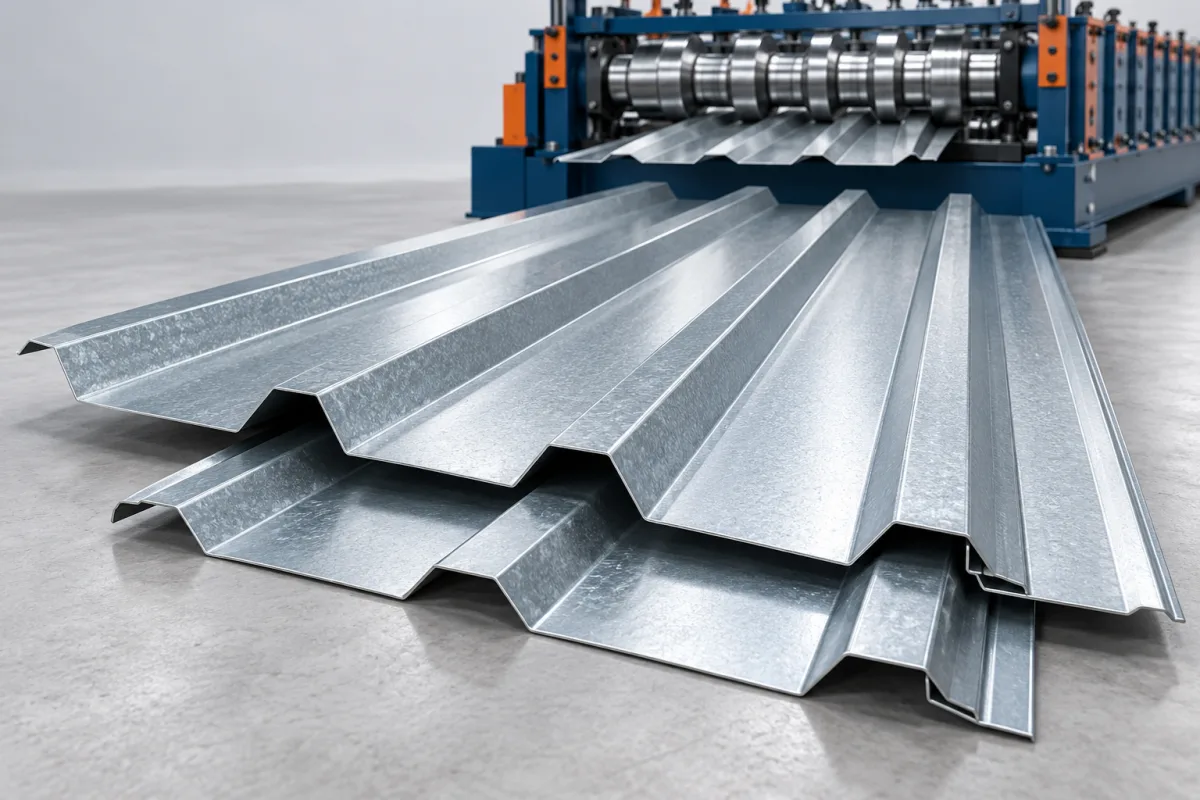
An 840 trapezoidal roofing sheet machine is intended for a trapezoidal panel sold under an 840 profile designation. In many specifications the number refers to nominal effective cover, but that meaning must be confirmed on the actual drawing. It does not uniquely identify rib count, pitch, height or the terminal lap.
The production decision begins with the roofing product that customers will install. Its central ribs, side laps and accessories need to work as a coordinated section. Choosing equipment by the 840 label alone risks receiving a panel that has the expected width but does not match the intended roof system.
What distinguishes a trapezoidal profile?
The section uses defined crests, inclined rib walls and valleys rather than a continuous rounded corrugation. The widths and angles of these features establish the cross-section. Some drawings add intermediate stiffening ribs, while others use wider uninterrupted flats.
These differences affect tooling and appearance. A change in rib height can also change the developed strip requirement and cutoff shape. Treat each intended profile as a drawing-controlled product instead of assuming all trapezoidal sheets fit one adjustable roll set.
How should the 840 designation be documented?
State whether 840 mm is effective cover, overall sheet width or another commercial dimension. If it is cover, show the assembled overlap used to obtain it. Keep input-coil width in a separate specification field.
Mark both terminal ribs clearly. The two edges often serve different roles in the lap and should not be judged as mirrored versions of one another. An assembled drawing is more informative than a cross-section cropped at the repeating center.
What information is needed to match an existing panel?
- An undamaged section sample with identifiable exposed face.
- Rib pitch, height, crest and valley dimensions.
- Both edge details and the intended overlap.
- Effective cover measured across several joined sheets.
- Matching closures and important trim interfaces.
- Material grade, thickness and coating information.
Where the sample and nominal drawing differ, agree which becomes the master. A weathered or distorted sample can explain the market requirement, but it should not silently redefine the tooling dimensions.
How does the line develop the trapezoidal ribs?
Controlled coil entry establishes the strip path. Successive forming stages progressively raise and shape the ribs while developing the edge laps. The completed panel then passes through the specified length-control and cutting arrangement before supported discharge.
Ask for the actual proposed route, including whether cutting occurs before or after forming. If the finished profile is cut, the support and blade arrangement need to suit the 840 cross-section. End distortion near a terminal rib is a product issue even if the central rib measurements are correct.
How do material changes affect the proposal?
Provide combinations of grade, base-metal thickness and coating rather than independent maximum values. A thicker, stronger material at the widest input strip may create a different forming case from the lightest product. The agreed operating envelope should identify those combinations explicitly.
For painted material, specify exposed-face orientation and appearance criteria. Inspect bends and tool-contact areas during the trial, then repeat the check after stacking. This separates forming damage from marks introduced downstream.
Should the business choose a dedicated or shared line?
A dedicated 840 route is straightforward when one section dominates demand. A shared arrangement may make sense when another profile has enough volume to justify additional tools but not a separate complete line. The comparison should use the real order schedule.
Ask what changes between profiles: input guides, roll tooling, cutoff parts, discharge supports and inspection references. Measure changeover through the first accepted panel. A second forming level or another tool set does not necessarily mean both products run simultaneously.
How can short and long order lengths be handled?
Short sheets increase the number of cuts and transfers for each metre processed. Long sheets increase the demands on discharge space, supports and package handling. Both should be included in the layout and production trial if they are part of normal business.
Define order identification and stack separation as well. A length controller can produce the correct pieces while poor sorting still creates delivery errors. Evaluate the finished order, not just a continuous run of identical demonstration sheets.
What is the right acceptance sequence?
- Verify the approved 840 drawing and material.
- Measure the relaxed cross-section on defined supports.
- Join panels and confirm lap engagement and cover.
- Check cut ends and the terminal ribs near them.
- Fit the specified closures and accessory references.
- Inspect finish before and after normal stacking.
- Record accepted quantity for the trial order.
Keep any building-performance approval separate from this manufacturing acceptance. The machine trial should demonstrate the agreed product geometry and production result, while the completed roof has its own design and installation requirements.
Frequently asked questions
Is every 840 profile identical?
No. The number alone does not fix rib count, height or edge details. Use a complete controlled cross-section and mating samples when comparing equipment or matching existing stock.
Can an 840 line make a 1000 panel?
Only if the proposed tooling and equipment cover the actual second section. Compare the profiles and request a written change-parts schedule rather than assuming width is the only difference.
Should input coil be ordered at 840 mm?
Not from the product name alone. Developed ribs and laps require their own strip width. Obtain the approved input specification before purchasing production coil.
Are roof flashings part of the line?
They need a separate equipment scope unless explicitly included. Many flashings use folding or other tools that are different from the main panel former.
How should machine output be expressed?
Use accepted sheets, lengths or defined covered area for a stated order mix. Include the agreed cutting, handling and changeover conditions so comparisons reflect usable production.
Make the nominal size a starting point
The 840 designation helps organize a product range, but the complete section determines the manufacturing route. Resolve ribs, laps, material and handling first, then compare equipment against that common reference.

Continue your research
- Roofing Sheet Roll Forming Machines
- Corrugated Roof Sheet Roll Forming Machine
- Trapezoidal Roof Sheet Roll Forming Machine
- R Panel Roll Forming Machine
- PBR Panel Roll Forming Machine
- IBR 686 Roofing Sheet Machine
- How Roofing sheet roll forming machine Works
- How To Choose a Roofing sheet roll forming machine
- Roofing sheet roll forming machine Price: What Affects the Cost?
Configuration & specification inputs
Match the configuration to your section drawing, material and production requirements.
| Parameter | Requirement / confirmation needed |
|---|---|
| Profile geometry | 840-designated trapezoidal section with drawing-confirmed cover, rib pattern and terminal laps. |
| Material | Approved coated-metal combinations with identified visible face and film requirements. |
| Thickness & grade | Thickness, grade and strip width assessed together for each target section. |
| Process route | Coil entry, staged trapezoidal forming, lap completion, cutting and supported order stacking. |
| Cutting | Matched cutoff that preserves terminal ribs at the required finished lengths. |
| Output | Accepted roofing orders with length mix, stack changes and rejects included in the trial basis. |
| Electrical supply | Site supply and auxiliary loads determined from the complete equipment package. |
| Acceptance | Relaxed section, assembled cover, closure compatibility, cut-end integrity and finish. |