
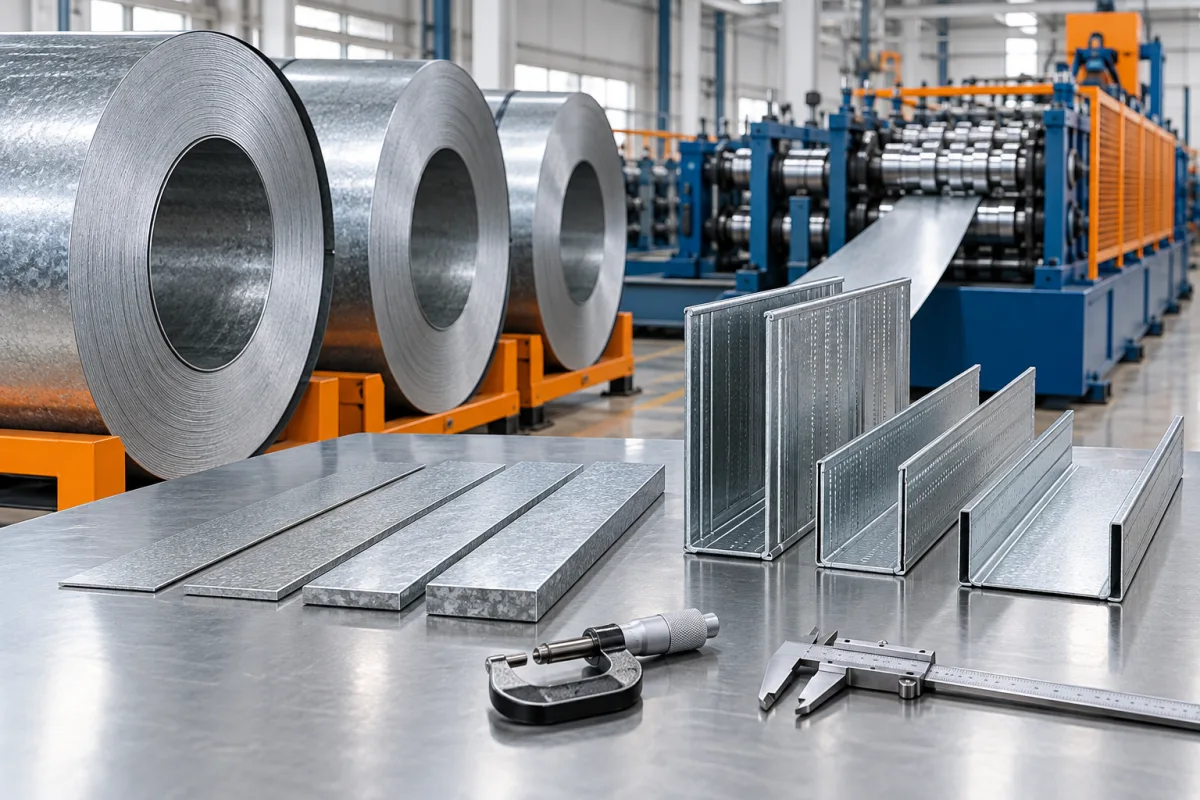
Stud and track material approval must connect the steel specification with the matched framing geometry. Thickness, grade, coating and strip width affect the production task, while the intended wall system determines the required product. A machine's ability to form a channel does not establish that the resulting member is suitable for every framing application.
Distinguish the intended framing application
Drywall sections and structural framing members should be specified through their own approved drawings and materials. Similar appearances do not establish interchangeability. The production brief must identify the product being made before defining its material range.
Keep component manufacture separate from complete-wall performance. Structural, fire and acoustic outcomes depend on the approved assembly and its conditions. A coil thickness or formed sample is not a substitute for that evidence.
Use grade and thickness together
Provide the specified grade and relevant material documentation with each nominal thickness. Different materials can respond differently through bending and feature-making. A thickness-only range does not fully describe what the equipment is expected to process.
Clarify the measurement convention for coated stock and the allowed variation. Base-metal thickness and total coated measurements should not be confused. Retain the incoming inspection method so purchasing and production use the same definition.
Specify studs and tracks as an approved pair
The receiving fit depends on the actual dimensions and material of both sections. Matching commercial size labels do not mean their geometries should be identical. Use the controlled drawings and assembly criteria.
When material changes, inspect the complete pair rather than approving each section independently. A subtle change in formed geometry can affect fit even if the members still look normal. Record the stud and track material identities used in the trial.
Calculate strip width from the whole section
The strip supplies the web, flanges, lips and bends. A stud and its matching track may therefore require different widths. Use the developed width associated with each approved profile rather than deriving it from nominal web size alone.
A flange or lip change should trigger a review of material development. The new section may not be obtainable from the previous coil width even if its trade size is unchanged. Keep width and drawing revision linked in the purchasing record.
Include feature operations in material trials
Service holes, slots or embossing specified for the member are part of the production route. Their condition and position should be checked after forming. A satisfactory plain-section trial does not demonstrate all the operations needed for the saleable product.
Do not add or enlarge openings as an informal response to manufacturing convenience. The approved framing design determines permissible features. Equipment capability and component-design approval answer different questions.
Retain coating and surface requirements
Specify the required coating and any relevant post-processing route. Inspect formed bends and cut or punched areas according to the product's acceptance criteria. The production team needs to know which observed conditions require review rather than relying on a generic coated-steel description.
Handling and storage should preserve material identity and condition under the operation's approved procedures. Mixing similar coils or losing their labels can make it difficult to verify which material entered a batch of framing components.
Review incoming condition before adjusting tools
When fit, twist or feature quality changes after a coil change, compare material records and relevant incoming criteria. Do not immediately compensate through undocumented settings. A controlled investigation should distinguish material variation, setup and handling.
Retain identified first-off samples and the setup reference. This gives the next shift or technical support team a baseline. An unlabelled sample showing a good fit cannot explain which coil or configuration produced it.
Construct a practical approval matrix
Consider a trial in which the stud passes its dimensional check but will not enter the track after a coil substitution. Inspect the two identified members together and compare the new material with the approved records. Do not immediately reduce the stud dimension to recover fit, because that can move it outside its own drawing. The responsible review should establish whether the issue follows the material, the setup, the track variant or an end defect. Once the cause is known, repeat the relevant checks on both products. This preserves the distinction between manufacturing a matching pair and merely forcing two samples together.
For every required stud and track family, list material, thickness convention, coating, developed width, feature pattern and mating requirement. Record trial evidence and limitations. The matrix prevents one successful combination from being treated as approval of an unrelated range.
- Member drawing and revision.
- Grade, thickness and coating identity.
- Input width and coil reference.
- Final dimensions and feature results.
- Mating stud/track assembly result.
- Cut ends, handling and bundle condition.
Handle substitutions with separate design and process decisions
Suppose a replacement coil has the same nominal thickness but a different grade. First determine whether it satisfies the approved member specification. Then determine whether the line and tooling have evidence for producing the required geometry and features from it. One favorable answer does not automatically supply the other.
Keep the release decision traceable to the order. If a later fit issue appears, the operation should identify the affected material interval and the evidence used for approval. This is more useful than attempting to reconstruct substitutions from supplier invoices after the event.
Frequently asked framing material questions
Can thicker steel replace the specified material automatically?
No. Thickness changes can affect fit, forming and the approved component design. Review the substitution rather than assuming more metal is always equivalent.
Do studs and tracks always use the same coil width?
No. Their complete cross-sections can have different developments. Use the approved width for each member.
Can a plain stud sample approve service-hole production?
It does not demonstrate the feature-making operation. Include the required holes and inspect their position and condition on the finished member.
What is the best retained material reference?
Identified stud and track samples with coil documentation, drawings, dimensions, feature checks and a recorded mating result. That combination preserves both material evidence and practical production compatibility.
Continue your research
- Stud & Track Roll Forming Machines
- Drywall Stud Roll Forming Machine
- Drywall Track Roll Forming Machine
- C89 Light Gauge Steel Framing Machine
- C140 Light Gauge Steel Framing Machine
- Top Hat Light Steel Framing Machine
- How Stud and track roll forming machine Works
- How To Choose a Stud and track roll forming machine
- Stud and track roll forming machine Price: What Affects the Cost?