
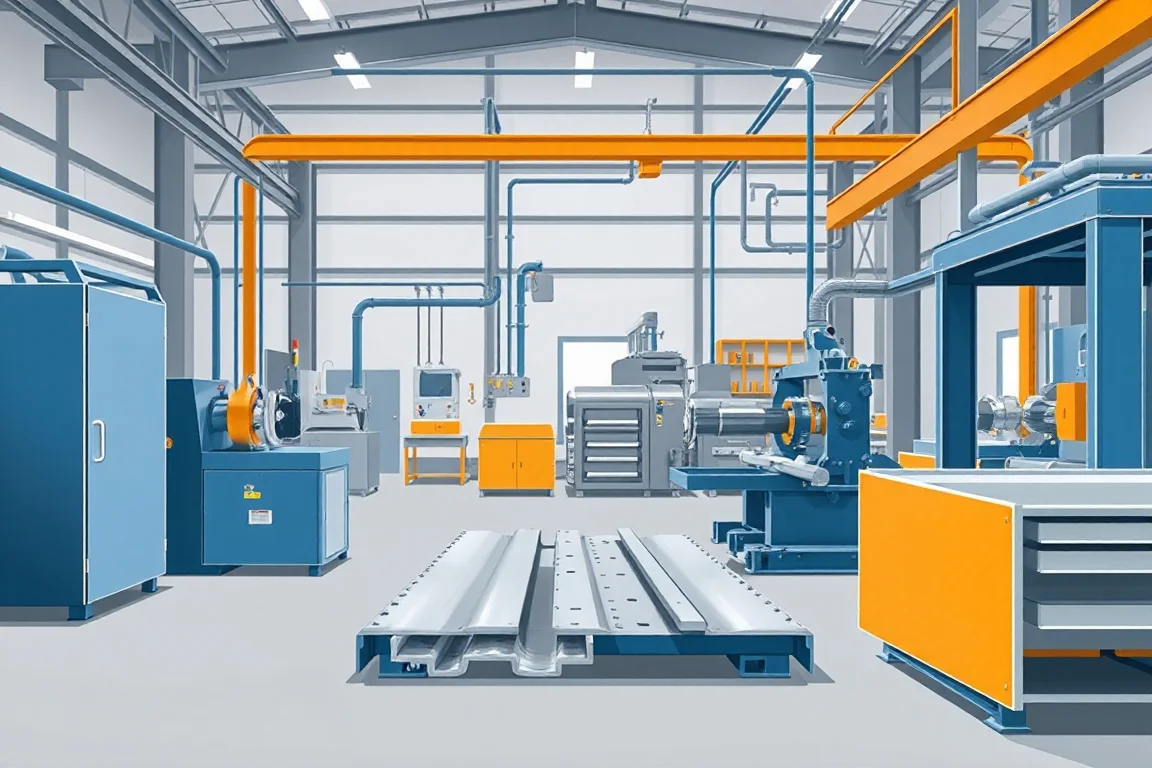
A door frame roll forming machine turns flat sheet or coil into a continuous metal frame profile. It does this by pulling material through a series of stations that progressively bend the cross-section, while punching or notching features for hardware and corner joints. The machine itself produces a formed section or a set of cut lengths. It does not, by itself, produce a finished door frame ready for installation. Understanding how the machine works means separating the inline sequence from the complete manufacturing route, because corner assembly, hardware fitting, and final inspection usually happen after the roll forming line or outside it.
What the machine actually does
At its core, a door frame roll forming machine performs a controlled deformation process. Flat strip enters the line, passes through a series of roll stations, and exits as a profile with a specific cross-section: a rebate for the door leaf, a jamb return, and features for hinges, a latch, or a strike. The machine may also punch holes, notches, or slots at defined positions along the strip. Finally, a cutoff station separates the continuous profile into measured lengths.
The machine does not create the corner joints that connect jambs to a head. Those joints are typically made later by welding, crimping, or mechanical fastening. Nor does the machine install hardware or seals. Those are assembly steps. The roll forming line's output is an intermediate product: a formed, cut, and possibly punched section that still needs to become a frame.
The inline sequence from coil to cut length
Most door frame roll forming lines follow a practical sequence: blank or coil preparation, feature punching, frame forming, cutoff, and then corner assembly. Each arrow in that sequence is a process boundary. The machine may integrate some of these steps, while others remain manual or happen in a different area of the plant.
Coil preparation involves loading a coil or blank, feeding it into the line, and often straightening it. Feature punching may occur before forming, after forming, or in a dedicated station within the line. Frame forming is the roll forming pass itself. Cutoff follows forming, usually using a die that matches the profile. Corner assembly is typically separate.
The important distinction is between the machine's physical sequence and the complete manufacturing route. A quotation for a roll forming machine may include the roll forming line only, while punching, corner assembly, and hardware fitting are quoted separately or handled manually. An operation omitted from the machine quotation still needs to happen somewhere.
Feeding and referencing: why the first station matters
Roll forming depends on consistent material positioning. The strip must enter the first forming station at a known location relative to the roll tooling. If the strip wanders laterally or twists, the finished profile will not match the intended cross-section. Feeding systems therefore use guides, edge references, or a combination of both to keep the strip aligned.
Referencing is not just about the entry point. After punching, the strip may need to be re-referenced before forming so that punched features align with the bends. After cutoff, a secondary operation may require the part to be located again. Each time the part is gripped or referenced, there is an opportunity for variation. A practical way to evaluate a proposed line is to walk through one actual drawing and mark every point where the part is gripped, referenced, punched, bent, cut, joined, or inspected.
Punching and notching: before or after forming
Door frames often require holes for hinges, a latch, a strike, or mounting screws. Some profiles also need notches to allow corners to close or to clear hardware. These features can be produced by punching or notching before the strip enters the forming stations, after forming, or in a separate operation.
Punching before forming is common because the strip is flat and easier to locate. However, forming can distort punched holes or alter their position slightly. Punching after forming can maintain feature position relative to the formed section, but the tooling must access the profile, which can be difficult with narrow returns or multiple bends. The choice affects tooling cost, line speed, and the ability to inspect features before the part is formed.
Notching for corner joints may also happen before or after forming. If corners are prepared by removing material to allow a bend or a weld, that notch must be positioned accurately. A notch placed before forming may shift during bending; a notch placed after forming may require a more complex die. The supplier should explain where notching occurs and how the interface between punching and forming is controlled.
Forming: how rolls create the frame profile
The forming section consists of pairs of rolls that progressively bend the strip. Each station performs a small amount of bending, and the sum of those bends produces the final cross-section. The number of stations depends on the complexity of the profile: a simple jamb return may need fewer stations than a profile with a rebate, a stop, and a hinge reinforcement.
Roll design must account for material thickness and grade. Thicker or stronger steel requires more forming force and may need more stations to avoid cracking or excessive springback. Springback is the tendency of metal to partially return to its original shape after bending. Roll designers compensate for springback by overbending slightly or by adjusting roll geometry.
Narrow returns and multiple bends create tool access challenges. If the profile has a tight return, the roll may not be able to reach the inside of the bend without interfering with another part of the section. This is a tooling design issue that should be evaluated with a section drawing before the machine is built.
Cutoff: separating the profile without distorting it
After forming, the continuous profile is cut to length. The cutoff station typically uses a die that matches the profile's cross-section so that the cut end is clean and the profile is not crushed. The cut length is determined by the frame size and the corner joint design.
Cutoff can be a flying cut, where the die moves with the material, or a stationary cut, where the line stops. The choice affects line speed and cut quality. A flying cut allows continuous production but requires a more complex mechanism. A stationary cut is simpler but may slow the line.
The cutoff also determines the end quality. A burr-free cut is important if the end will be visible or if it will be welded. The machine may include a deburring station or the deburring may be a secondary operation. The supplier should confirm the expected end quality and any secondary operations needed.
Corner assembly: the step after roll forming
Door frames are typically assembled from two jambs and a head. The corner joint must be strong enough to hold the frame square and to transfer loads from the door to the building structure. Common corner joints include welded corners, crimped corners, and mechanical fasteners.
Corner assembly is usually not part of the roll forming machine. It may be a separate workstation with a welding fixture, a crimping press, or a manual assembly table. The roll forming machine produces the formed sections; the corner assembly process joins them.
This separation matters because the roll forming machine's output is not a finished frame. The frame's squareness, strength, and hardware alignment depend on both the formed sections and the corner assembly method. A frame that is perfectly formed but poorly joined will not perform as intended.
What the machine does not do: certification and performance
A door frame roll forming machine does not certify a fire-rated assembly. Fire ratings depend on the complete tested and approved door system, including the frame, door leaf, hardware, seals, and installation. The roll forming machine produces a component; the rating is a property of the assembled system as tested.
Similarly, the machine does not guarantee that the finished frame will accept a specific door or hardware. The profile must be designed to match the door thickness, the hinge type, the latch, and the seals. These are design decisions that happen before the machine is built. The machine executes the design; it does not validate it.
How to evaluate a proposed line
When evaluating a door frame roll forming machine, start with a section drawing and an assembly drawing. Identify the input and output of each station. Distinguish the line's physical sequence from the complete manufacturing route. Confirm how a part is referenced again after cutting or a secondary operation.
Ask which operations are integrated into the line, which are manual, and which happen elsewhere. An operation omitted from the quotation still needs to happen somewhere. Determine who supplies the tooling for each operation and who is responsible for the interface between operations.
Consider the material. Specified sheet steel is the starting point; stainless steel or other alloys may require separate tooling validation. Thickness and grade affect forming forces, springback, and tool wear. The buyer should specify the base-metal thickness and grade, and the supplier should verify the operating range.
Review the cutting operation. Confirm that the cutoff is profile-supported, the cut lengths are achievable, and the end quality meets requirements. Identify any secondary operations, such as deburring or notching, that are needed after cutoff.
Finally, define accepted output. There is no verified model rating for output. The buyer should define accepted output per shift based on the actual profile and material, and the supplier should demonstrate that the line can meet it.
Comparison of alternatives
Roll forming is one way to make door frames. Other methods include press braking, folding, and extrusion. Each has trade-offs.
Press braking uses a press brake to bend flat sheet into a profile. It is flexible for low volumes and prototypes, but it is slower and less consistent for long runs. Each bend is a separate operation, and positioning errors can accumulate.
Folding uses a folding machine to create bends. It is common for light-gauge sheet metal and can produce simple profiles, but it may not handle complex cross-sections with narrow returns or multiple bends.
Extrusion is used for aluminum frames. It produces a continuous profile with a fixed cross-section, but it requires a die and is not suitable for steel frames that need punched features or welded corners.
Roll forming is efficient for long runs of a consistent profile. It can integrate punching and cutoff, and it produces a continuous section that can be cut to length. The trade-off is that the tooling is profile-specific and the line is less flexible for design changes. The choice depends on volume, profile complexity, material, and the complete manufacturing route.
Decision checklist
- Identify the input and output of each station in the proposed line.
- Distinguish the line's physical sequence from the complete manufacturing route.
- Confirm how a part is referenced again after cutting or a secondary operation.
- Confirm whether notching happens before or after forming and how corners are prepared.
- Verify that the profile can accept the door or glazing system, hardware, and seals.
- Request a section and an assembly drawing before selecting the manufacturing route.
- Identify who supplies tooling for each operation and who is responsible for the interface.
- Define accepted output per shift with the actual profile and material.
- State the required voltage, frequency, and phase; installed power requires a confirmed equipment schedule.
- Inspect rebates and seal lands, then test actual hardware and a representative corner joint.
- Measure the finished frame after assembly as well as the unjoined section.
Frequently asked questions
Can a door frame roll forming machine produce a finished frame ready for installation?
No. The machine produces formed, cut, and possibly punched sections. Corner assembly and hardware fitting are typically separate operations. The finished frame is the result of the complete manufacturing route, not just the roll forming line.
Does the machine punch hinge and latch features?
It may, depending on the line configuration. Punching can be integrated before or after forming, or it can be a separate operation. The choice affects tooling, line speed, and feature accuracy. The supplier should explain where punching occurs and how it is controlled.
How is the frame profile designed?
The profile is designed to accept the door leaf, hardware, and seals. It includes a rebate, jamb returns, and features for hinges, a latch, or a strike. The design must be validated with a section drawing and an assembly drawing before the machine is built.
What material can be formed?
Specified sheet steel is common. Stainless steel or other alloys may require separate tooling validation because they have different forming characteristics. The buyer should specify the base-metal thickness and grade, and the supplier should verify the operating range.
What determines the cut length?
The cut length is determined by the frame size and the corner joint design. The cutoff station is set to produce that length. The end quality depends on the cutoff die and any secondary operations, such as deburring.
Is a fire-rated door frame produced differently?
A fire-rated assembly is certified as a complete system, including the frame, door leaf, hardware, seals, and installation. The roll forming machine produces a component, but it does not certify the assembly. The rating depends on the tested and approved system.
Where the machine ends and the process begins
The roll forming machine is one part of a larger manufacturing process. Its purpose is to convert flat steel into a consistent profile with the required features and cut lengths. The complete process includes material selection, tooling design, corner assembly, hardware fitting, and inspection. Understanding how the machine works means understanding its role in that process and the interfaces between the machine and the steps before and after it.
Continue your research
- Door & Window Profile Roll Forming Machines
- Steel Door Frame Roll Forming Machine
- Window Frame Roll Forming Machine
- Hollow Metal Door Frame Roll Forming Machine
- Garage Door Track Roll Forming Machine
- Door Reinforcement Channel Roll Forming Machine
- How To Choose a Door frame roll forming machine
- Door frame roll forming machine Price: What Affects the Cost?
- Materials and Thickness for Door frame roll forming machine