
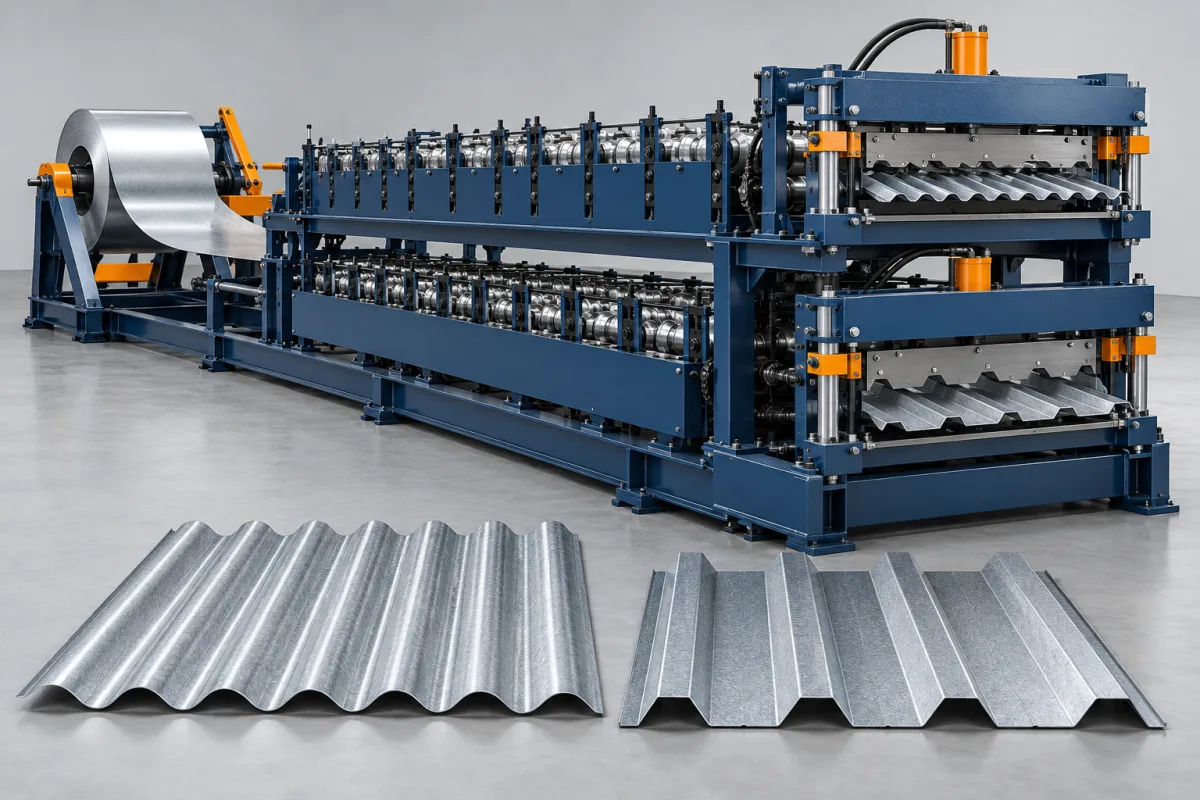
A double layer roofing roll forming machine places two specified forming paths within a shared equipment arrangement. It is commonly considered when a business wants to produce two roofing profiles while limiting the space occupied by separate lines. The useful question is how the two paths share feeding, drive, cutting and discharge, not merely whether one is positioned above the other.
The proposed arrangement must be assessed against the actual pair of products. Corrugated and trapezoidal sheets, for example, require their own approved drawings and tools. A compact layout can offer an operating advantage, but it does not automatically mean both profiles can be produced simultaneously or that switching between them has no setup work.
What does double layer describe?
It describes the physical arrangement of forming paths rather than a universal operating method. The supplier should show which units are shared and which belong to each profile. Coil feeding, drive, cutoff and takeoff can be organized differently between proposed machines.
Ask what happens during a normal transition from one product to the other. Identify material movement, entry changes, control selection, cutting support and first-off inspection. A diagram showing two levels does not answer those operational questions.
Which two products belong in the configuration?
Different roof-sheet sections
Provide a complete drawing for each profile, including its terminal laps and cover width. Do not assume that the tools for a second product can be defined from its name or from a photograph of the first.
Related profiles with different materials
List the material combinations required on each path. A line suitable for one coated strip and section does not automatically cover another strength, thickness and width combination on the second level.
Products with different order and handling patterns
One profile may be sold in long repeat runs and another in short mixed batches. Include those differences when reviewing transition time, takeoff and stacking. The compact former is only part of the combined production route.
What should the profile matrix contain?
- Separate section drawings and revision references for both paths.
- Input material, thickness convention, strip width and coating for each product.
- Finished width and effective cover with the intended lap arrangement.
- Required lengths and cut-end quality.
- Surface protection and package requirements.
- The frequency and sequence of switching between products.
Use that matrix to compare quotations. A proposal for two simple profiles with shared handling cannot be treated as equivalent to one covering broader material ranges or more demanding discharge conditions.
How does the operating sequence work?
- Select the required product: identify the drawing, material and order program.
- Prepare the active path: establish entry guidance, controls and any profile-specific components.
- Form the sheet: develop the selected section through its own tooling.
- Cut and receive: use the specified cutoff and takeoff arrangement for that path.
- Inspect: verify the section, laps, length and finish after normal handling.
- Change products: complete the defined transition and approve the next first-off sheet.
The supplier should demonstrate the exact sequence for the proposed equipment. Do not infer simultaneous operation or a particular drive arrangement from the double-layer label. Those capabilities must be explicitly part of the supplied design.
Which functions are shared, and why does that matter?
Ask for a layout and equipment schedule identifying the decoiling arrangement, drives, controls, cutting units, discharge and stack handling. Shared units influence scheduling and what must happen when the active profile changes.
For example, a production plan requiring both products at once needs a different assessment from one that alternates complete batches. If equipment is shared, a demand for one profile may occupy the resources needed by the other. Resolve that scheduling relationship before comparing headline output figures.
Also consider service access and routine inspection. A compact layout should still provide the maker-required access for maintenance and safe operation. Reduced floor footprint is not the only layout criterion.
How should changeover time be measured?
Begin with the last accepted sheet from the first profile and finish with the first accepted sheet from the second. Include all required material handling, threading or entry work, control changes, cutting support and inspection. Record the setup material consumed during the transition.
Repeat the switch in the reverse direction where both sequences matter to production. A demonstration of one easy change does not necessarily represent the full operating pattern.
Keep length changes within one profile separate from switching paths. These are different tasks, and combining them into a single unexplained changeover claim makes proposals harder to compare.
What does a compact layout need around it?
Draw incoming coil movement and the discharge route for each path. Check the shortest and longest intended products, receiving heights, inspection access and stack removal. A compact machine body can still need a substantial clear material-flow area.
Verify how finished sheets are supported as they leave the active level. Damage introduced at a transition or receiving point counts against usable output even when the forming tools make an accurate section.
Include the space and equipment needed for material storage, profile-specific parts and maintenance access. Compare the complete working layout with two separate lines, rather than comparing only their bare frames.
Double layer or two dedicated lines?
A shared arrangement can be attractive when the required products alternate and the available space favors a compact configuration. Two dedicated lines can offer different scheduling possibilities where independent production is valuable, but they also require their own equipment, space and handling arrangements.
Use representative orders for both products. Record quantities, lengths, material changes, deadlines and how often the sequence switches. Evaluate accepted output and required staffing over that schedule instead of assuming one layout is universally cheaper or faster.
Consider future changes as well. A new third profile or a substantially different material envelope may not fit the original two-path arrangement without additional tools or equipment. Ask how expansion would actually be handled.
How should material, coating and output be evaluated?
Trial each path with its agreed material combinations. Inspect section dimensions, laps, cut ends and appearance after normal discharge. A successful run on one level does not validate the other profile or its handling route.
Measure accepted output over the actual mixed schedule. Include the defined changeovers, coil changes and stack handling. Adding the two separate maximum running speeds is not a meaningful combined production rate if the proposed equipment does not operate that way.
For coverage reporting, use each profile's own effective cover and accepted length. Different sections can produce different saleable area from the same reported strip length, so keep the calculations distinct before combining order totals.
What should quotation and acceptance scope include?
The quotation should identify the full tools and auxiliary equipment for both products, the shared functions and the demonstrated operating mode. Include commissioning, training and inspection requirements, as well as any excluded handling or optional features.
- Verify both profile drawings and their material matrices.
- Run representative lengths on each path.
- Inspect laps, geometry, cut ends and finish for both products.
- Demonstrate receiving and stacking from each operating level.
- Perform the required transitions in the relevant directions.
- Record first-good-sheet recovery, accepted output and shared-resource limits.
- Review access, setup references and the supplied documentation.
Acceptance should match the operating route the buyer intends to use, not merely prove that both sets of rolls can form a short sample independently.
Frequently asked questions
Does double layer mean two profiles run simultaneously?
Not automatically. The answer depends on the specific drive, feed, cutting and discharge arrangement. Ask the supplier to state and demonstrate the supplied operating mode rather than inferring it from the number of paths.
Can any two roofing profiles be paired?
The actual profiles and material combinations need an engineering review. Space, tools, cutting and handling all matter. Provide both drawings instead of assuming every pair fits the same compact arrangement.
Is changeover only a control selection?
It can involve more than controls, including material entry, supports or other profile-specific work. Measure the full transition through to accepted output using the proposed equipment's actual procedure.
Will it need half the floor space of two lines?
Do not assume a fixed saving. Compare complete operating layouts, including loading, discharge, stacking and access. The machine frame is only one part of the space required for production.
Can the second path be added later?
That depends on the original equipment design and the requested product. Obtain a specific expansion proposal covering tools, controls, structure and handling. A general double-layer description is not a retrofit guarantee.
What should be prepared before asking for a price?
Provide both profile drawings, material ranges, lengths and the expected mixed order schedule. Add layout constraints and package requirements. These inputs establish whether a shared arrangement actually fits the production need.
Compare complete two-product workflows
The value of a double-layer line lies in how it serves the chosen pair of products within the available layout and order pattern. Define shared resources, transitions and receiving arrangements explicitly. Then compare accepted production against the alternatives instead of treating two levels as a performance claim by themselves.

Continue your research
- Roofing Sheet Roll Forming Machines
- Corrugated Roof Sheet Roll Forming Machine
- Trapezoidal Roof Sheet Roll Forming Machine
- R Panel Roll Forming Machine
- PBR Panel Roll Forming Machine
- IBR 686 Roofing Sheet Machine
- How Roofing sheet roll forming machine Works
- How To Choose a Roofing sheet roll forming machine
- Roofing sheet roll forming machine Price: What Affects the Cost?
Configuration & specification inputs
Match the configuration to your section drawing, material and production requirements.
| Parameter | Requirement / confirmation needed |
|---|---|
| Profile geometry | A double-layer machine places two forming paths in one installation. Ask whether production alternates between layers, how feeding changes, and which components are shared. Do not budget for simultaneous two-profile output unless that operating mode is explicitly demonstrated. |
| Material | Galvanized or coated steel; aluminum only after a separate tooling review |
| Thickness & grade | Buyer to specify base-metal thickness and grade; operating range requires supplier verification. |
| Process route | Coil payoff → entry guiding → progressive forming → profile-matched cutoff → supported stacking |
| Cutting | Confirm profile-supported cutoff, cut lengths, end quality and any secondary operations. |
| Output | Define accepted output per shift with the actual profile and material. |
| Electrical supply | Buyer to state voltage / frequency / phase. Installed power requires a confirmed equipment schedule. |
| Acceptance | Two independent lines and a double-layer installation should be evaluated against required simultaneous production, staffing, maintenance access and order priorities. Ask how one path is isolated for service and whether doing so affects the other. Consider scheduling consequences as well as machine purchase price. |