
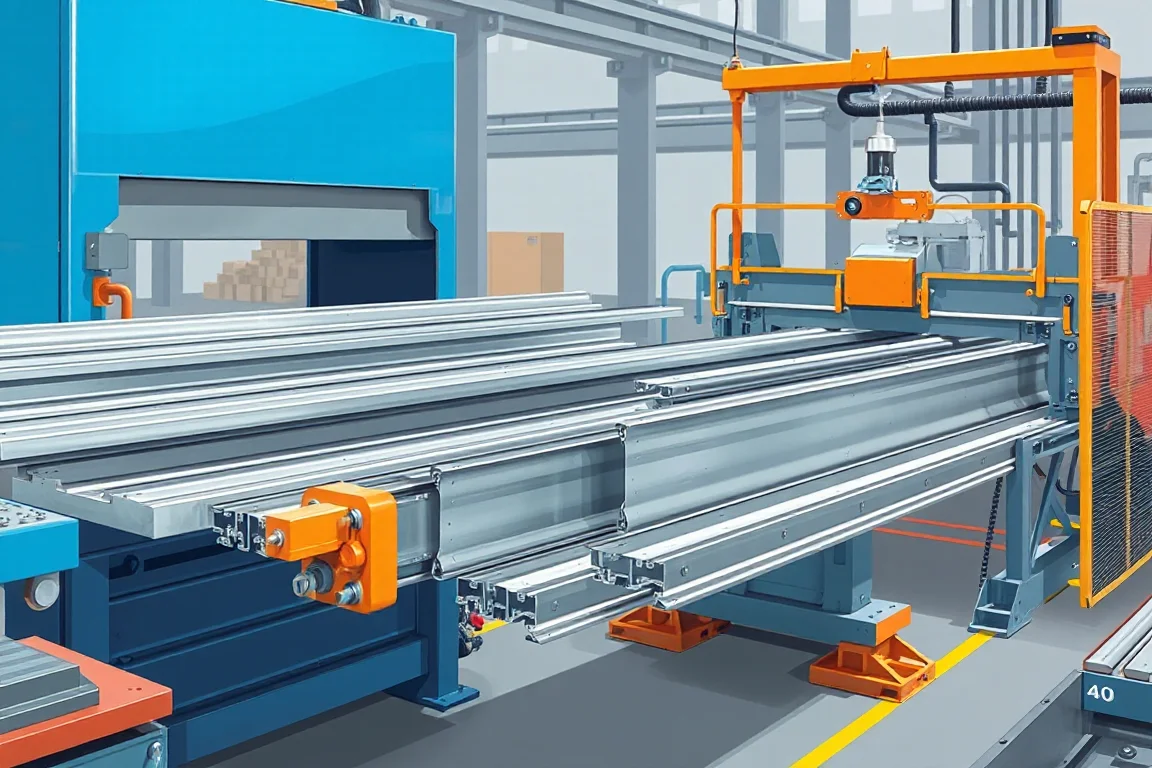
Production speed and output are two different things. Speed is how fast a machine can turn coil into a continuous formed section; output is how many finished, inspected, and accepted parts leave the line in a working period. For solar mounting components such as rails and posts, output depends on profile complexity, material, punching and cutoff operations, coil changes, and how many parts meet the mounting system's acceptance criteria. This guide explains how to reason about speed and output without relying on unverified ratings.
What production speed actually means
On a roll forming line, production speed is usually described as the linear speed of the strip through the forming stations, measured in metres per minute. That number is a consequence of several interacting factors: the number of forming stations required for the profile, the ductility and thickness of the base metal, the amount of work done at each pass, and the ability of the drive and control system to maintain stable strip tracking. A simple symmetrical section may be formed at higher linear speed than a complex, deep, or asymmetrical section because each pass does less work and strip stability is easier to maintain.
Speed is not a single fixed value. A line can run at a higher speed during steady forming and then slow or stop for punching, cutoff, coil changes, and setup. When a supplier quotes a speed, clarify whether it refers to steady running speed, average speed over a shift, or the maximum speed at which acceptable parts are produced.
Why linear speed is not the same as output
Output is the number of accepted parts completed in a defined period. Linear speed alone does not tell you output because it ignores cut length, punching frequency, reject rate, and downtime. For example, if a long rail requires a cut every few metres, the number of finished rails per hour is the running length divided by cut length, adjusted for rejected material and stoppages. If the same line also produces short brackets, the mix of lengths and punching patterns changes the effective output.
The practical formula for planning is: accepted length = steady running speed × actual running minutes × good-output fraction. This is arithmetic for planning, not a machine rating. The good-output fraction accounts for material that is rejected or reworked because of dimensional, surface, or interface nonconformance. Actual running minutes exclude coil changes, setup, punch tooling changes, and unplanned stops.
Where the bottleneck usually occurs
On a solar roll forming line, the sequence commonly runs from leveling, through connection punching, channel forming, cutoff, and then mounting-interface inspection. Forming speed is often not the limiting step. Punching can be the bottleneck when a profile requires multiple holes or slots with precise position relative to the finished section. If the punch press cannot cycle as fast as the forming line, output is controlled by punching. Cutoff can also limit output if the cut length is short and the cutoff cycle is longer than the time needed to form that length.
Use this sequence to find the true constraint:
- Measure the time each operation adds per part, not just the forming speed.
- Separate steady-state cycle time from changeover and coil-change time.
- Identify whether punching, cutoff, or handling is slower than forming.
- Confirm that inspection or interface checking does not consume more time than expected.
Profile and material effects on practical speed
Profile geometry determines how many forming stations are needed and how much deformation occurs at each station. A deep channel or a rail with return flanges and stiffening features requires more passes and more careful roll design than a simple open section. More passes generally mean more strip contact and more opportunities for marking or distortion if the line is pushed beyond a stable speed.
Material also matters. Coated structural steel has a coating that can be damaged by excessive forming speed or improper roll pressure. The base-metal grade and thickness affect springback, which in turn affects the amount of overbend built into the rolls. A line that runs well with one thickness may not run at the same speed with a thicker or stronger material because the forming loads and springback change. Aluminum extrusion is a separate process and is not formed on a roll forming line.
Calculation inputs you should define before estimating output
To move from a vague speed number to a useful output estimate, define these inputs with the equipment supplier and your production team:
- Actual running minutes per shift, excluding planned and unplanned stops.
- Steady running speed for the specific profile and material, confirmed by trial or reference.
- Good-output fraction based on dimensional and interface acceptance.
- Representative cut lengths and hole patterns for the product mix.
- Coil change frequency and time, including handling and threading.
- Setup time when changing profiles or tooling.
- Punching and cutoff cycle times per part.
- Inspection and unloading time that takes the line out of production.
Do not treat a single speed figure as a universal rating. A machine that produces one profile at a given speed may produce a different profile at a lower speed because the forming work, punching pattern, and cutoff cycle change.
Changeover, coil changes, and setup time
Changeover is often underestimated. If the line produces more than one profile or cut length, setup time between runs reduces available running minutes. Coil changes interrupt the process and can require threading and strip alignment. The number of coil changes depends on coil weight and the length of the production run. For short runs, changeover can dominate the shift and make steady running speed almost irrelevant to total output.
Plan production so that similar profiles and materials run in sequence where possible. This reduces the number of tooling changes and the amount of scrap generated during setup. It also makes the output calculation more predictable because running minutes are easier to separate from changeover minutes.
How accepted output is verified on the line
Accepted output counts only parts that meet the mounting system's requirements. Inspection typically checks clamp fit, slot position, section straightness, and cut-edge condition. These checks are not optional overhead; they determine whether the part can be used. If a part fails on slot position or clamp engagement, it is rejected or reworked, and that reduces good output.
Build inspection into the production plan. Some checks can be done while the line is running; others require the line to stop or the part to be removed. The time and frequency of these checks affect how many accepted parts are produced per shift. Record rejected and reworked material separately so that the good-output fraction reflects reality rather than an optimistic assumption.
Comparing alternatives for higher throughput
When output needs to increase, there are several possible directions, each with tradeoffs. A faster forming line may help if forming is the bottleneck, but it may not change output if punching or cutoff is the constraint. Adding a second punching station or improving punch tooling can raise output when hole patterns are complex. Inline inspection can reduce the time spent checking parts after cutoff, but it adds equipment and may require different operating procedures.
Another alternative is to produce fewer long parts and more short parts, or vice versa, depending on the product mix. The cutoff cycle and handling method may favor one over the other. Increasing coil size reduces coil-change frequency and can increase running minutes, but it requires handling equipment and floor space. None of these choices is universally better; the right one depends on which step is actually limiting output and what acceptance criteria the mounting system requires.
Practical checklist for planning speed and output
- Define the exact profile, material, thickness, and slot pattern.
- Ask for the steady running speed for that profile and material, not a general line speed.
- Measure running minutes per shift, not nominal shift minutes.
- Identify the true bottleneck: forming, punching, cutoff, or inspection.
- Account for coil changes, setup, and tooling changes explicitly.
- Establish a good-output fraction from inspection results.
- Count accepted parts, not just parts produced.
- Confirm clamp fit, slot position, straightness, and cut-edge condition.
- Review wind, snow, corrosion, and foundation requirements with the mounting-system designer.
This checklist keeps the focus on the outputs that matter: parts that can actually be installed and that meet the interface requirements of the solar mounting system.
FAQ
Can a solar roll forming machine run at the same speed for every profile?
No. Different profiles require different numbers of forming stations and different amounts of deformation per pass. A simple section may allow higher linear speed, while a deep or asymmetrical section may require lower speed to maintain strip stability, dimensional control, and surface quality. Material grade and coating also affect the practical speed for a given profile.
How do I calculate output if I only know the running speed?
Use the planning formula: accepted length = steady running speed × actual running minutes × good-output fraction. Convert accepted length to parts by dividing by the representative cut length where the product mix allows. This is a planning estimate. Confirm actual running minutes and good-output fraction from your own production records or from a trial with the specific profile and material.
What usually limits output on a solar rail line?
Punching and cutoff often limit output when the profile requires multiple holes or slots with tight position tolerances. Forming may not be the constraint. The only way to know is to measure the cycle time of each operation and compare it to the forming speed. Changeover and coil changes can also dominate for short runs.
Why is accepted output lower than the number of parts produced?
Some parts are rejected or reworked because they fail on clamp fit, slot position, section straightness, or cut-edge condition. These are interface and quality requirements that determine whether the part can be used in the mounting system. Accepted output counts only parts that pass inspection, so it is always lower than total parts produced when defects occur.
Does a faster forming line always increase output?
No. If punching, cutoff, or inspection is the bottleneck, increasing forming speed may only create more work-in-process without increasing accepted output. It can also cause quality problems if the line is pushed beyond a stable speed for the profile and material. Identify the constraint before investing in higher speed.
How do material changes affect speed and output?
Changing base-metal thickness or grade changes forming loads and springback, which can require different roll settings and may reduce the stable running speed. Coating type and condition also affect how much speed the line can tolerate without surface damage. These effects are specific to the profile and material combination, so they should be confirmed with a trial rather than assumed.
What to discuss with a supplier before you commit
Bring your actual profile drawings, material specification, thickness range, slot pattern, and expected product mix. Ask how the supplier defines running speed, how punching and cutoff cycle times are calculated, and what acceptance criteria are used for the finished part. Discuss coil change frequency, setup time, and inspection method. These details determine whether the line's output will match your production plan. The goal is a shared understanding of accepted output for your specific parts, not a generic speed figure.
Continue your research
- Solar Mounting Roll Forming Machines
- Solar Strut Channel Roll Forming Machine
- Solar Mounting Rail Roll Forming Machine
- Solar C Channel Roll Forming Machine
- Solar U Channel Roll Forming Machine
- Solar Hat Channel Roll Forming Machine
- How Solar roll forming machine Works
- How To Choose a Solar roll forming machine
- Solar roll forming machine Price: What Affects the Cost?