
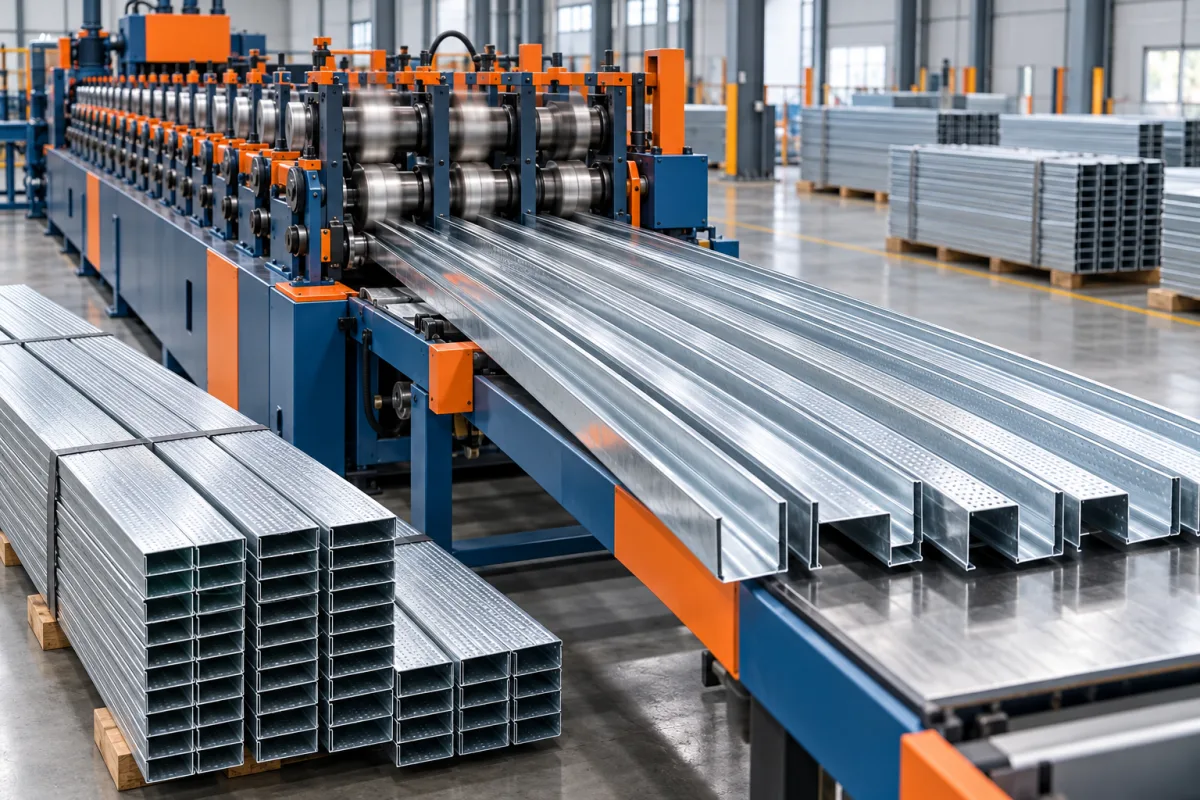
Stud and track production output is the rate of accepted sections delivered in the required package format. It is not simply the strip speed through the forming stands. Punching, short-piece cutting, product changes, collection and bundling can each determine the practical result.
Measure the commercial output boundary
Decide whether the study ends at cut sections, inspected loose pieces or released bundles. State the boundary before comparing numbers. A line that deposits sections onto a table and one that counts and straps bundles are performing different amounts of work.
Use accepted quantity and retain the bundle definition. Pieces per hour is useful for one length mix; linear metres helps compare material movement; bundles per hour describes delivery only when bundle counts and products are known. No single measure explains every order.
Separate stud and track work content
The paired products can have different feature patterns, tooling conditions and packing behavior. Measure them as distinct items within the order rather than assuming one rate applies equally. A business can produce studs quickly yet struggle to complete orders if matching track occupies a different constraint.
Preserve the actual production ratio in capacity planning. Stocking large quantities of one member while the other is unavailable does not necessarily improve customer delivery. The relevant objective may be complete framing packages rather than maximum metres of one section.
Service holes can affect the operating cycle
The effect of punching depends on the proposed route and pattern. Ask for output with the required features rather than a plain-strip demonstration. Keep the feature geometry and frequency with the trial record.
Check feature quality and location on accepted parts. Producing more pieces with incorrect openings increases gross output without improving saleable quantity. The final member's reference dimensions should control acceptance.
Length distribution matters more than one average
Short sections require more cuts and individual collection events for a given linear total. Long sections require suitable support and may change bundling work. Record the distribution rather than only an average length.
A trial using one convenient stock length may be appropriate for a narrowly focused operation, but it cannot predict a shop producing many custom lengths. Build a representative basket that includes the products driving staffing and handling requirements.
Calculate output with a reproducible example
Assume a hypothetical run releases 60 bundles of 20 studs, each 3 metres long. Accepted output is 1,200 pieces and 3,600 linear metres. If the complete measured window is 180 minutes, that is 20 linear metres per minute or 20 bundles per hour over the specified boundary.
These assumed values are arithmetic, not machine capacity. If matching tracks are produced separately, their time must be added when estimating complete-order delivery. Do not use the stud-only rate as the rate for a combined package without accounting for that work.
Collection and bundling can become the bottleneck
Observe whether the former waits for pieces to be removed, nested, counted or strapped. A high forming rate is not useful if the discharge area repeatedly fills. Evaluate the packing arrangement with the actual sections and bundle format.
Keep required safety and protective arrangements in the study. A demonstration that relies on unsustainable manual handling does not establish normal capacity. Improvements should make the route repeatable, not merely produce a short burst of high speed.
Measure product changes through first-good fit
Stud-to-track and size transitions should include all required setup and inspection work. End the operational changeover clock when the new section is accepted and its mating relationship is verified where required.
For a hypothetical schedule with eight changes at 15 minutes each, recovery occupies two hours. If most of that time is checking and handling rather than machine movement, an adjustment-speed upgrade alone may have little effect. Record the components of the transition.
Track yield and counting errors separately
Rejected starts, dimensional failures, feature defects, damaged sections and incorrect bundle counts have different causes. Keep them separate in the loss log. Late packing errors can consume substantial completed work even when the forming yield is good.
- First-off losses associated with each configuration.
- Feature quality and location rejects.
- Cut-end or length problems.
- Handling damage before bundling.
- Count, label or product-mix errors at release.
Improve the constraint serving the order mix
For an illustrative mixed order, producing every stud first may leave the packing team waiting for several track sizes. A different sequence might complete customer packages sooner even with slightly more machine changes. Evaluate the total order-release time and inventory rather than assuming the sequence with the fewest transitions is always best. Scheduling and equipment capability should be reviewed together, using measured recovery times and actual delivery priorities.
If packing limits output, study collection and bundle removal before purchasing faster forming. If frequent changes dominate, improve documented recovery and scheduling. If one member of the pair is persistently unavailable, balance the product plan rather than maximizing the other.
Repeat the study using comparable orders after a change. Keep a less favorable scenario with more short lengths or mixed sizes when making delivery commitments. This provides a more useful capacity range than a single best-case demonstration rate.
Frequently asked stud and track output questions
Can maximum line speed predict bundles per shift?
Only as a theoretical starting point with known lengths and bundle counts. Real output needs cutting, features, changes, packing and yield. Measure the complete route before using the figure for commitments.
Why is track production important in a stud-line study?
Customers may require the matched package, and track can have different setup or packing work. Stud output alone does not prove complete-order capacity.
Should a bundler be evaluated at one profile only?
Use the relevant product range and package formats. A successful test on one easy section may not represent larger, smaller or differently shaped members.
What should a useful daily report show?
Product mix, accepted pieces and metres, bundle definitions, elapsed time, changes, stops and categorized losses. These details explain whether the factory made more useful framing material or merely ran more strip.
Continue your research
- Stud & Track Roll Forming Machines
- Drywall Stud Roll Forming Machine
- Drywall Track Roll Forming Machine
- C89 Light Gauge Steel Framing Machine
- C140 Light Gauge Steel Framing Machine
- Top Hat Light Steel Framing Machine
- How Stud and track roll forming machine Works
- How To Choose a Stud and track roll forming machine
- Stud and track roll forming machine Price: What Affects the Cost?