
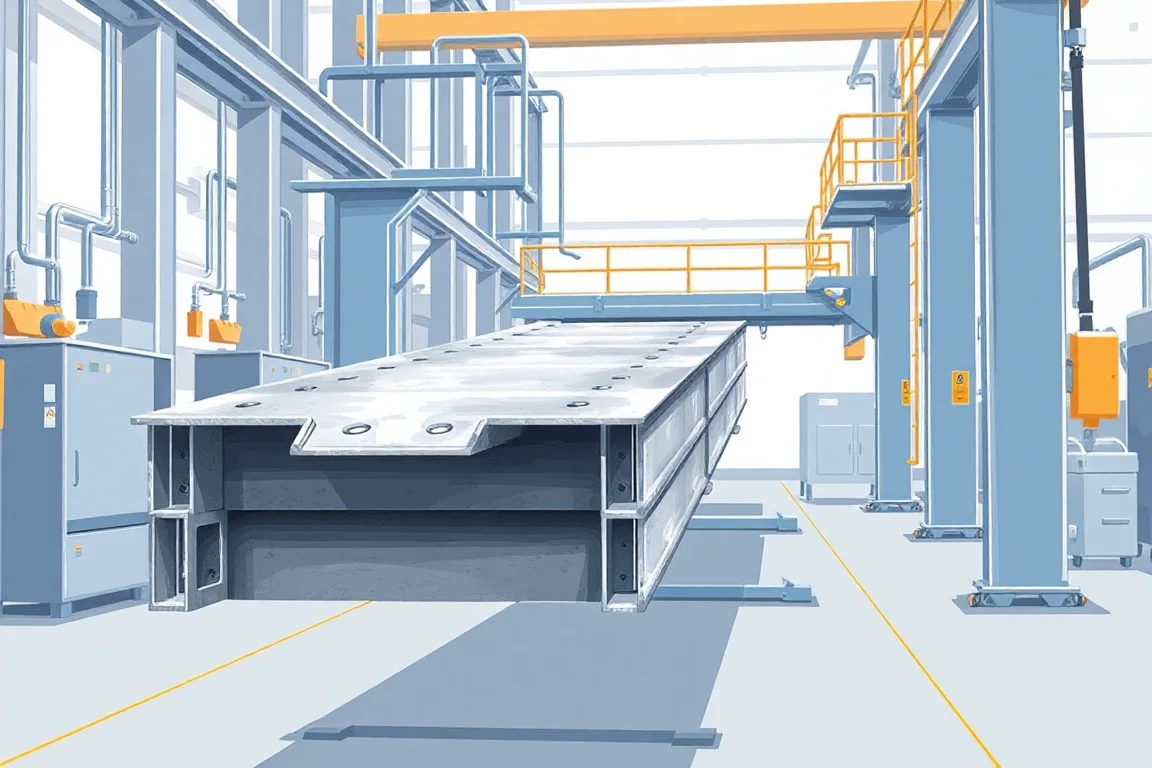
Scaffolding roll forming machines are often marketed on a single headline speed, but that number rarely reflects the output a fabricator can actually ship. For scaffolding planks and related components, production speed must be understood as a chain: punch or emboss, plank or channel forming, cutoff, end fitting or joining, and inspection. The pace of the slowest step determines how many finished, inspected planks leave the line. This guide explains what determines speed, how to measure accepted output, and how to compare alternatives without relying on unverified claims.
What does production speed mean for a scaffolding roll forming machine?
In roll forming, line speed usually refers to the rate at which the strip moves through the forming stands, expressed in length per unit time. It is a useful baseline, but it is not the same as finished component output. A line may run the strip quickly while punching, cutoff, end joining or inspection create queues. For scaffolding planks, the finished part includes the walking surface, ribs, anti-slip features, hooks, end plates and support interfaces. Each of these may be produced at a different pace. Production speed should therefore be defined as the number of conforming, fully assembled and inspected planks produced per unit of running time, not the strip speed alone.
How the production sequence turns strip into finished planks
The typical sequence begins with a coil or strip entering a punch or emboss station. Here, holes, slots, anti-slip patterns or stiffening features are created. The strip then passes through a series of forming stands that gradually bend it into the plank or channel profile. After forming, a cutoff press or shear separates the continuous profile into individual lengths. Those lengths move to end fitting or joining, where hooks, end plates or support interfaces are attached by bolting, riveting, welding or other specified procedures. Finally, inspection checks the walking surface, ribs and attachment interfaces before the plank is accepted.
Interfaces between these stages matter. If punch capacity is lower than forming speed, the strip may stop and start, reducing effective output. If cutoff cannot produce clean ends at the required length, secondary operations may be needed, adding time. If end fitting is manual, it can become the constraint even if forming is fast. Effective planning maps material flow, buffer sizes and operator positions along the line.
Why headline forming speed can mislead
A machine may be described with a forming speed that assumes continuous running, no coil changes, no setup and no interruptions. In practice, coil changes, width or thickness adjustments, punch tooling changes, cutoff length changes and unloading all consume time. A high forming speed only helps if the other stages can keep pace. For example, if the finished plank requires several punched holes and a separate joining operation, the joining station may set the true output ceiling. Buyers should ask how speed is defined and what assumptions are included.
How to estimate accepted output per shift
For planning only, a simple relationship can be used: accepted length = steady running speed × actual running minutes × good-output fraction. This is a planning aid, not a machine specification. The result must then be divided by the representative cut length to estimate the number of pieces, but only when the product mix and cutoff cycle permit that simplification. For example, if the mix changes between plank lengths, the average cut length and the number of cutoff cycles per shift must be accounted for.
Running minutes should exclude planned and unplanned stops. Good-output fraction reflects material that passes inspection. Rejected or reworked material should be counted separately, because it consumes capacity without contributing to shippable output. If you track accepted output per shift, you gain a realistic basis for comparing line configurations and for identifying the bottleneck.
Where the real bottleneck usually hides
Bottlenecks are often not in the forming stands. Punching or embossing can be slower than forming if multiple hits or complex patterns are required. Cutoff can be limited by tooling, especially if end quality demands secondary operations. End fitting or joining can be manual and highly variable. Inspection can also constrain output if it is performed piece by piece or if rework is common. To find the bottleneck, measure the time each stage contributes to the total cycle for a representative product mix. The stage with the longest average duration per piece, including waiting and rework, sets the ceiling.
How material and thickness affect speed and output
Material grade, thickness and finish influence forming loads, springback and the amount of adjustment needed. Heavier or stronger steel may require slower forming to maintain profile quality, and it can increase punch and cutoff forces. Surface finish may affect friction and marking. The required joining procedure, such as welding or bolting, also interacts with material choice. Buyers should specify the base-metal thickness and grade, and ask the supplier to verify the operating range. Speed cannot be separated from the material being formed; a line that runs quickly on one specification may need to run slower on another.
Cutoff, end quality and secondary operations
The cutoff station must be matched to the profile, the cut lengths and the required end quality. Some profiles need support during cutting to avoid deformation. If the cutoff leaves burrs or angular deviation, secondary operations may be required, which reduces effective output. The cutoff cycle time, including any movement or repositioning, adds to the total cycle. When comparing lines, consider how many different cut lengths are needed, how often length changes occur, and whether the cutoff can handle the range without frequent manual adjustment.
Comparing alternatives: what to weigh
When comparing scaffolding roll forming machine options, avoid treating speed as a single number. Instead, compare the whole production system. One alternative is a line optimized for high forming speed with manual end fitting; another may have moderate forming speed but automated joining and inspection. The latter can deliver higher accepted output if joining is the constraint. Another comparison is between a dedicated line for one profile and a flexible line for multiple profiles. Flexibility often reduces speed because of changeover time, but it may be necessary for product mix.
Consider also the level of automation in material handling, the number of operators required, and the skill needed for setup and adjustment. A line that is easy to change over may produce more accepted output across a varied order book, even if its peak speed is lower. Conversely, a high-speed line with long changeovers may suit a narrow, high-volume product range.
Cost implications of speed and output decisions
Cost discussions should focus on quote scope and accepted-output cost. A lower-priced machine may have a lower initial cost but require more labor, more setup time or more rework, increasing the cost per accepted plank. A higher-priced line may include automation that reduces labor and improves consistency, lowering the cost per accepted plank over time. When requesting a quote, define the scope: what is included in the line, what tooling is provided, what commissioning and training are included, and what acceptance criteria apply. Without a defined scope, price comparisons are unreliable.
Application-specific limits: connection systems and profile type
Ringlock and cuplock refer to connection systems for tubes, not proof that a ledger or standard is made on a sheet-profile roll former. Confirm whether the component is a tube or an open section, because the forming process differs. Scaffolding planks are open profiles with ribs and anti-slip surfaces, while tubes are closed sections. A roll forming machine for planks will not produce tubes. Understanding the exact component helps avoid mismatched expectations about speed and tooling.
Checklist for evaluating production speed and output
- Define accepted output per shift using running minutes, not nominal shift minutes.
- Count rejected or reworked material separately from good output.
- Measure the intended cut-length and hole-pattern mix.
- Map the time each stage contributes to the cycle for a representative product.
- Identify the bottleneck stage, including waiting and rework.
- Verify how forming speed is defined and what assumptions are included.
- Ask for the operating range for the specified material and thickness.
- Assess cutoff capability for all required lengths and end quality.
- Evaluate end fitting and inspection methods for their pace and consistency.
- Compare flexibility and changeover time against your product mix.
- Clarify quote scope, including tooling, commissioning and acceptance criteria.
FAQ
Does a higher forming speed always increase output?
No. Forming speed is only one part of the chain. If punching, cutoff, end fitting or inspection cannot keep pace, the line will not deliver more accepted planks. The slowest stage sets the ceiling.
How can I measure the true bottleneck?
Measure the elapsed time each stage takes for a representative product, including waiting, setup and rework. The stage with the longest average time per accepted piece is the bottleneck. This should be done with the actual material and profile.
What is accepted output and why does it matter?
Accepted output is the number of finished, inspected planks that meet all requirements. It matters because only accepted planks can be shipped and generate revenue. Material that is rejected or reworked consumes capacity without contributing to output.
How do material and thickness affect speed?
Heavier or stronger materials can increase forming loads and springback, often requiring slower speeds or more adjustment to maintain quality. Punch and cutoff forces may also increase. The operating range for a specific material and thickness must be verified by the supplier.
Should I choose a dedicated line or a flexible line?
It depends on your product mix. A dedicated line can optimize speed for one profile, while a flexible line may handle multiple profiles with changeover time. If your order book varies, flexibility may produce more accepted output overall despite lower peak speed.
What should a quote for a scaffolding roll forming machine include?
A quote should clearly state what is included: the machine, tooling, controls, commissioning, training and acceptance criteria. It should also specify the material and thickness range to be supported. Without this scope, price comparisons are not meaningful.
Continue your research
- Scaffolding Roll Forming Machines
- Scaffold Plank Roll Forming Machine
- Scaffolding Deck Roll Forming Machine
- Ringlock Scaffold Ledger Roll Forming Machine
- Cuplock Scaffold Ledger Roll Forming Machine
- Scaffold Frame Profile Roll Forming Machine
- How Scaffolding roll forming machine Works
- How To Choose a Scaffolding roll forming machine
- Scaffolding roll forming machine Price: What Affects the Cost?