
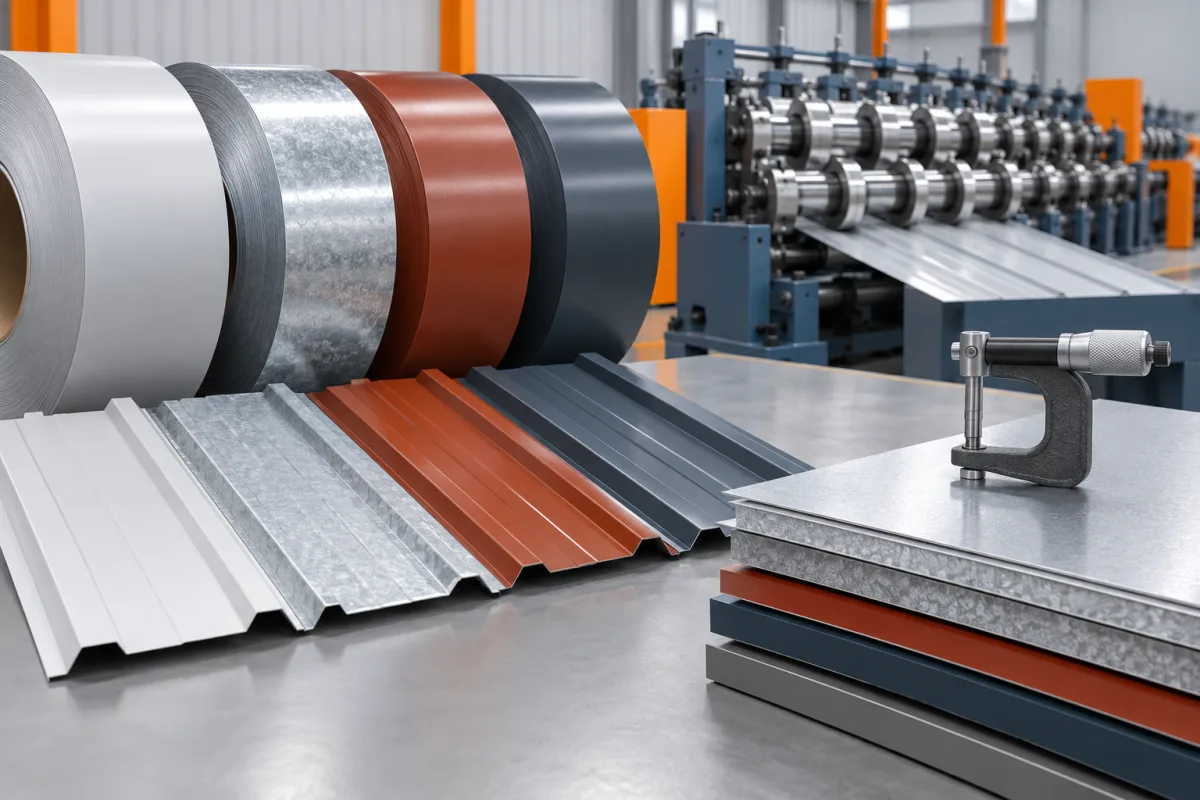
Wall cladding material specification must connect the metal's forming behavior with the facade's visible finish and joint. Nominal thickness is only one input. Grade or alloy, coating, strip width, protective layers and the required returns all influence whether a coil can become an acceptable panel.
Start with the face and joint drawing
A broad flat face and a narrow interlocking return ask different things of the same strip. Identify the full cross-section, including the fixing flange or clip interface, before approving a material range. A coil that forms one wall panel successfully is not automatically approved for another with tighter or differently arranged features.
Show the material in the intended assembly. The relationship between thickness and mating components can affect fit, so a substitution should be reviewed against the joint rather than accepted only because the visible face remains similar.
State base-metal and coating information separately
Specify the thickness convention and the method used to verify it. Coated material descriptions can otherwise lead to confusion between base-metal thickness and total measured thickness. Record permitted variation as part of the purchasing specification.
Provide the coating system and identify which face is exposed. A material described simply as painted steel does not fully communicate the appearance or forming requirement. The back face, protective film and any additional layers should also be identified where they affect the process.
Review steel and aluminum on their own terms
Matching nominal thickness does not establish that two metals behave identically in the same tools. Supply the exact grade or alloy information and request a review of the required profile combinations. Trials should include the functional return and final assembled fit, not just a flat bend sample.
The facade material choice also involves its intended environment and compatibility with the rest of the wall system. Those decisions belong with the responsible product and project specialists. Roll-forming feasibility is an important input, but it does not replace the complete material-selection process.
Treat the visible finish as a production requirement
Describe acceptable and unacceptable surface conditions using agreed references and viewing conditions. Inspect the actual finish after forming, cutting and packing. A successful trial on an easier or differently coated coil does not answer the appearance question for the material being sold.
Keep finish-batch information with production records where it matters to the facade order. A bundle may be dimensionally correct but still unsuitable if identification is lost and incompatible appearance batches are mixed. Material control therefore includes information handling as well as physical handling.
Protective film belongs in the trial condition
Record whether film is applied before forming and how it is treated during cutting, inspection and packing. Agree the inspection method for the underlying surface so damage is not hidden until installation. Use the film supplier's and equipment maker's relevant requirements rather than improvising a universal procedure.
If a film or backing changes, evaluate it as a process change. It can alter contact conditions or the way the product is inspected. Keep the trial record specific enough that the team can distinguish the approved configuration from a later substitution.
Develop strip width from the actual section
The strip supplies the face, bends, returns and joint features. Effective cover or visible face width is not the same as input width. Obtain the slit-width requirement from the approved profile design and retain it with the tooling documentation.
A new reveal or return can change the material development even if the visible face remains unchanged. Do not order replacement coil using the previous product's width without review. The consequence can appear first as an incorrect edge rather than an obvious shortage across the face.
Distinguish material condition from facade appearance
Visible waviness can have more than one contributor, including incoming material, manufacturing, handling and the installed support condition. Record the coil condition and inspect panels at defined process boundaries before assigning a cause. A photograph of an installed wall does not by itself prove a tooling defect.
Conversely, describing all waviness as unavoidable is not a substitute for a controlled product review. Establish the agreed appearance criterion, compare the accepted reference and investigate documented changes. This keeps the discussion focused on evidence rather than opposing generalizations.
Build a material-approval matrix
List the profile, material identity, thickness convention, width, finish and protective layers as one row. Add the trial evidence and any limitations. This prevents an approval for one combination from being mistakenly applied to every item sharing the same nominal thickness.
- Full material and finish identification.
- Approved section and joint revision.
- Representative lengths and assembly components.
- Dimensional, engagement and appearance results.
- Handling and inspection conditions used.
- Decision on substitutions and required revalidation.
Evaluate substitutions against saleable output
A lower-priced coil may not reduce the cost of accepted cladding if it creates more rejects, extra inspection or fit problems. Track consumed material, accepted area and the reasons for rejected panels. Compare lots on the same product and handling route rather than relying solely on price per tonne.
For a hypothetical comparison, two coils may each feed an order with 400 square metres of planned coverage, while different rejection levels leave different accepted quantities. The useful economic comparison uses those accepted quantities and actual costs. Do not assign the difference to material until setup and handling differences have also been examined.
Frequently asked cladding material questions
Will thicker sheet always give a flatter-looking wall?
No universal guarantee follows from thickness alone. Profile, material condition, supports, installation and viewing conditions all matter. Review the complete product and test the chosen combination.
Can a coating change be made without another trial?
Determine that through the material and process review. A different finish or protective layer can affect forming and inspection. Retain evidence for the approved combination rather than assuming all coatings are equivalent.
Should coil width match the visible panel width?
No. The returns and joint also consume material. Use the developed strip width for the specific section, not the visible face dimension.
Which sample is most useful for material approval?
A representative panel and mating assembly made from identified production-intent coil, inspected after the intended handling sequence. Include dimensions, appearance conditions and joint observations, not just a small unlabelled coupon.
Continue your research
- Wall Cladding Roll Forming Machines
- Wall Panel Roll Forming Machine
- Metal Siding Roll Forming Machine
- Box Profile Wall Panel Roll Forming Machine
- Corrugated Wall Cladding Roll Forming Machine
- Trapezoidal Wall Cladding Roll Forming Machine
- How Wall cladding roll forming machine Works
- How To Choose a Wall cladding roll forming machine
- Wall cladding roll forming machine Price: What Affects the Cost?