
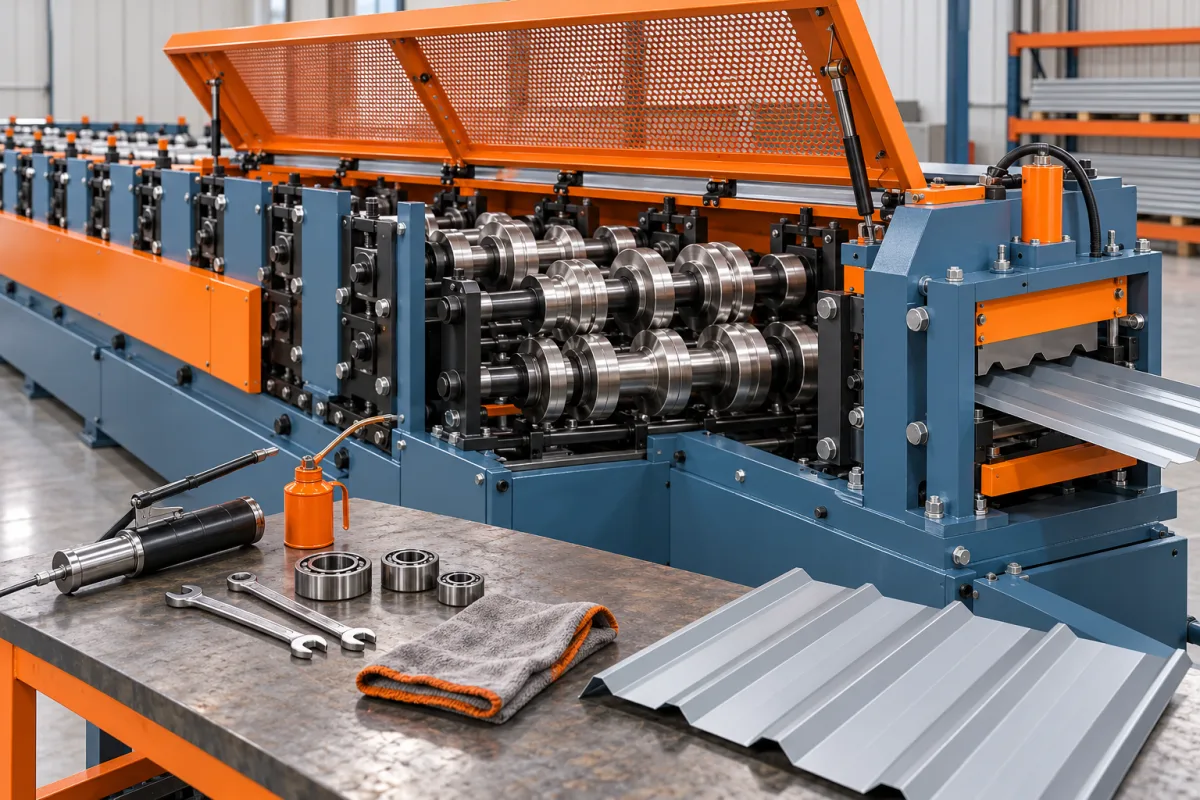
Maintenance for a wall cladding roll forming line must protect the visible surface and the hidden assembly geometry at the same time. A clean-looking machine can still have a damaged support pad that scratches every panel, while a mechanically successful repair can leave a joint outside its approved shape. The maintenance plan should therefore connect equipment condition with the first accepted facade panels after service.
Keep machine-specific procedures in control
Use the equipment maker's requirements for isolation, inspection, lubrication, replacement and return to service. This checklist organizes the work; it does not supply universal intervals or adjustment settings. Assign tasks to personnel qualified for the relevant equipment and energy sources.
Record the actual asset and forming configuration. A site producing several cladding profiles needs to know which path, cutoff tools and handling arrangement were serviced. A generic tick against line maintained can conceal important differences between configurations.
Use panel appearance as an observation, not an access instruction
Operators should report recurring marks, unusual sounds, alarms and changes in product behavior from permitted operating positions. Cleaning or inspecting contact surfaces inside guarded areas requires the approved isolated condition. Never use a slow-running machine as a substitute for isolation.
Define how observations are escalated and how affected product is controlled. A growing scratch pattern may justify a product hold while qualified staff investigate. The production team should not be encouraged to reach into the line to identify a mark's source.
Maintain protected entry and face orientation references
The coil-loading and entry route should preserve the intended visible face and surface condition. Inspect guides and relevant protective contact points under the prescribed maintenance procedure. Record damage, contamination or wear that can affect the product.
Keep orientation and setup references legible. After a configuration change, staff should be able to identify the correct exposed face and material path without relying on memory. Information loss can cause a facade defect just as surely as a damaged mechanical component.
Inspect tools around functional returns
Concealed joints and fixing returns need the correct tooling identity and condition. Service work should preserve the approved profile revision, including the relationship between both edges. Do not mix apparently similar tools from different joints without engineering confirmation.
Record the reason for any replacement or repair and the product checks required afterward. A return-forming tool change should lead to an assembly check using the specified mating components, not only a visual inspection of the roll surface.
Control debris and surface-contact damage
Metal particles or damaged contact surfaces can mark appearance-sensitive cladding. Inspect and clean only under approved procedures, using methods compatible with the equipment and finish requirements. The maintenance record should identify repeated contamination rather than treating each cleaning as an unrelated event.
Trace the source when debris recurs. It may involve another operation or handling boundary. A clean roll section will not prevent scratches introduced by a damaged discharge support, so the inspection route must continue beyond the mill.
Include feature tools and cutoff supports
Where panels contain fixing slots, holes or notches, maintain their tooling and scrap arrangements according to the equipment documentation. Product checks should verify the relevant feature references after service. A feature that looks clean can still be misplaced relative to the joint.
Cutoff components must correspond to the approved section. Inspect the finished returns at both ends after maintenance or a profile change. The central section alone cannot demonstrate that cutting and support leave a usable installation interface.
Treat packing contact points as controlled equipment
Inspect pads, rollers, supports and separation methods used after forming. Record damage that could scratch, dent or distort the panel. A finish-sensitive cladding route should not end its maintenance responsibility at the cutoff.
Check that labels and protective materials remain associated with the correct bundle. Maintenance of printers or identification devices may belong to a different team, but their availability affects product release. An unidentified bundle can create a costly facade mix-up even when its physical condition is good.
Retain configuration and inspection references
Follow the supplied process for backing up and restoring approved controls and setup information. Document authorized changes. A service event should not leave the line dependent on an operator reconstructing a complex joint setup from trial and error.
Maintain the measuring equipment and reference assemblies used for acceptance. Appearance evaluation also needs its agreed viewing conditions and sample identity. If the inspection reference changes unnoticed, the team may incorrectly conclude that maintenance altered the product.
Release the line through a representative facade sample
Choose post-service checks that address the work performed and retain normal product-release requirements. Inspect geometry, mating engagement, cut ends and surface condition after the intended handling sequence. Document the material and finish used.
- Confirm the correct profile, tool and control references.
- Produce identified first-off panels under the approved operating procedure.
- Inspect the serviced operation's product features.
- Assemble the specified joint and inspect the visible face.
- Check after packing contact and record the release decision.
Review recurring defects with the maintenance history
Compare defect logs with service records to find repeat conditions. For example, repeated scratches at one panel position may correlate with a damaged handling component, while recurring engagement issues may require a broader tooling or material investigation. Correlation is a clue, not proof; preserve samples and verify the cause.
Use the findings to improve task descriptions, spare-part control and training. A checklist should become more precise as experience grows while remaining consistent with the maker's requirements. Adding vague daily ticks is less useful than recording the condition that actually predicts a loss.
Frequently asked cladding maintenance questions
Why check the mating clip after tooling maintenance?
The panel is part of an assembly. A repaired or replaced tool can affect functional returns even when the face looks correct. The specified clip or adjacent panel helps verify recovered compatibility.
Can protective pads be replaced with any soft material?
Use an approved replacement suitable for the equipment and finish. An improvised material may behave differently, retain contamination or alter support. Keep the replacement identity in the service record.
Should the first-off check occur before or after packing?
Inspect the relevant manufacturing features before release and include the handling boundary needed to reveal packing damage. One early check cannot prove that later contact surfaces preserve the finish.
What should be stocked as critical spares?
Use verified equipment and profile-specific part references informed by service history and lead times. The list should match the current joint and cutoff configurations, not an obsolete version of the line.
Continue your research
- Wall Cladding Roll Forming Machines
- Wall Panel Roll Forming Machine
- Metal Siding Roll Forming Machine
- Box Profile Wall Panel Roll Forming Machine
- Corrugated Wall Cladding Roll Forming Machine
- Trapezoidal Wall Cladding Roll Forming Machine
- How Wall cladding roll forming machine Works
- How To Choose a Wall cladding roll forming machine
- Wall cladding roll forming machine Price: What Affects the Cost?