
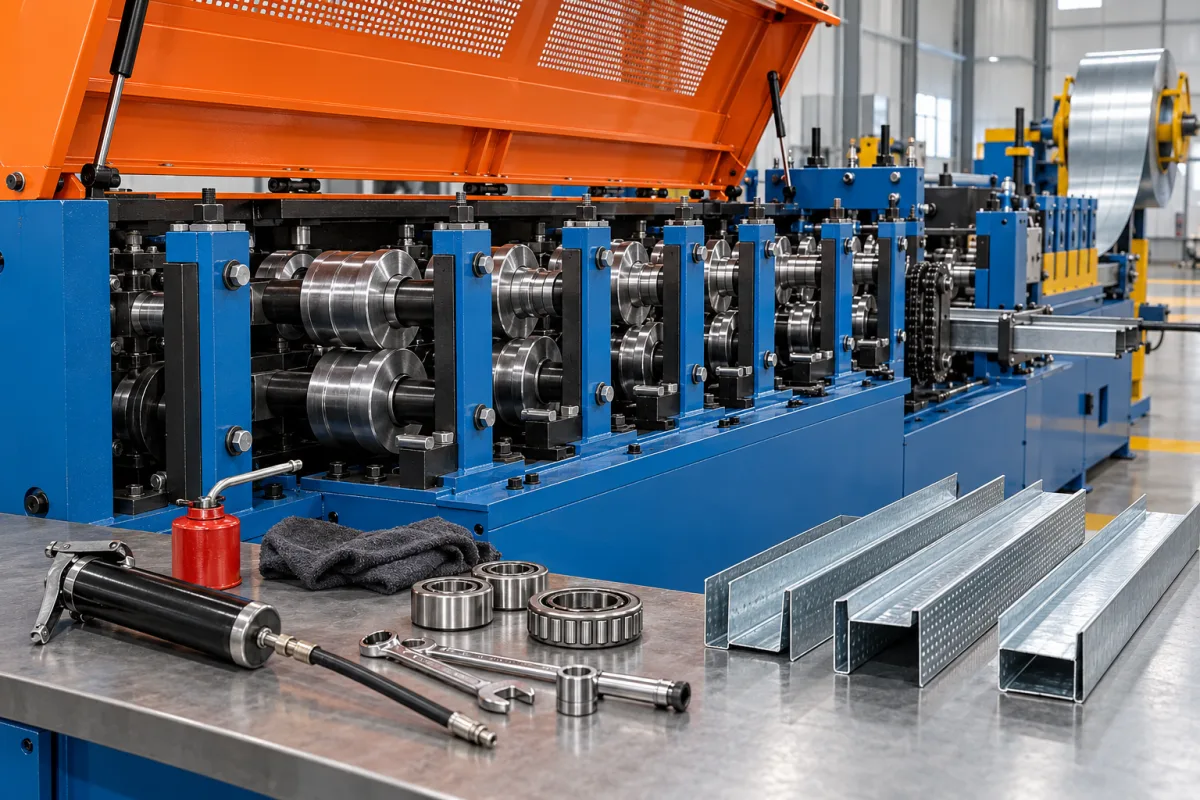
A stud and track maintenance checklist should protect the matched section geometry, specified service features and reliable bundle output. The production route includes more than the forming mill: payoff, punches, cutting, collection and identification all affect the product customers receive. Maintenance release should therefore include representative members and their mating fit.
Use the equipment-specific maintenance requirements
Follow the maker's instructions for intervals, lubrication, inspection, replacement and isolation. A general checklist organizes responsibilities but does not supply universal settings. Assign work to personnel qualified for the relevant machinery and energy sources.
Identify assets and configurations in the service record. If a line uses different tools or paths for studs and tracks, record which were affected. This helps connect later product observations with actual maintenance work.
Keep operating observations separate from access
Operators should report abnormal sounds, alarms, recurring stops and product changes from permitted positions. Cleaning, adjustment or inspection inside hazardous areas requires the approved shutdown and isolation procedure. Low-speed motion is not a safe substitute.
Define the escalation and equipment-hold process for damaged guarding or other unsafe conditions. The checklist should not encourage informal workarounds to preserve output. Authorized personnel must control return to service.
Maintain coil handling and entry references
Inspect payoff, loading equipment and entry components under their instructions. Record wear, damage or abnormal behavior relevant to material presentation. Keep the approved coil envelope available to staff responsible for loading.
Preserve the developed-width and product setup references. A new member range can introduce different material and handling requirements. Review those changes rather than assuming the original checklist covers every later product.
Control feature-tool condition and identity
Service-hole punches and other feature tools need verified identification. Maintain them and associated scrap arrangements through the approved isolated procedures. Record the feature, material and observed condition when service is required.
After work, inspect feature position and condition on the final member. A clean hole alone is not sufficient if its relationship to the cut end or section is wrong. Keep the release sample tied to the correct production data.
Preserve stud and track tooling references
Inspect and service forming components according to the supplied documentation. Do not mix similar-looking parts from different section revisions. Record changes that could affect web, flange or lip geometry and the mating relationship.
Maintain the approved setup information for infrequently used sizes as well as common products. Recovery after maintenance should not depend on trial-and-error adjustments made from an unlabelled sample.
Inspect cutoff and end-support components
The cutting arrangement must leave usable member ends. Follow the equipment's service requirements and confirm the correct components for the product configuration. Record damage or wear with the relevant section.
Release checks should distinguish length accuracy from end deformation. A successful cut cycle does not prove that the stud enters its track. Inspect complete members and include the end in the mating check.
Include collection, nesting and bundling
Maintain the downstream equipment used to collect, orient, count and package sections. A defect in that route can constrain output or damage members after correct forming. Review the actual bundle format and product range.
Keep counting and identification functions in the service plan with clear ownership. If a printer or sensor is serviced by another team, coordinate its release with production. The factory needs correct counts and labels, not merely physically sound loose channels.
Protect control configurations and inspection tools
Use the supplied process for preserving approved settings and authorized changes. After control-related work, verify relevant lengths, feature patterns and product identities with a controlled test. A restored system connection does not by itself prove correct output.
Maintain the measuring equipment and reference pairs used for acceptance. If the inspection method changes, the team may misinterpret a difference as a machine problem. Keep the datum scheme and mating criteria accessible.
Release service with a matched-product test
Select checks proportionate to the work performed while retaining normal first-off requirements. If the serviced mechanism affects both products, produce the relevant stud and track. Verify their dimensions, features, ends and fit.
- Confirm product, material and setup identities.
- Complete the required equipment release.
- Produce identified representative members.
- Inspect section dimensions and service features.
- Check length, cut ends and mating fit.
- Verify bundle count and label where affected.
For a practical example, service to a collection unit may not alter the roll settings but can change how thin sections are supported or counted. Inspect after that boundary and verify the final package. Conversely, forming-tool work needs a geometry and fit check even if collection remains untouched. Matching the verification to the work keeps the checklist meaningful.
Review recurring failures and spare-part readiness
Review the checklist when a new section or bundle format is introduced. The previous release sample may no longer exercise the feature or handling condition that matters most to the expanded product range.
Link service records with fit problems, feature rejects and packing losses. Look for repeat conditions and verify their causes before changing maintenance frequency. A recurring symptom may need an engineering or workflow review rather than more frequent replacement of one part.
Maintain a verified spare list for the current product catalog. Identify obsolete tools and configurations so they are not fitted accidentally. A spare is useful only when its correct application and release checks are known.
Frequently asked maintenance questions
Why test both members after servicing a shared line?
The product is a matched framing pair, and shared equipment can affect either member. The release should demonstrate the required geometry and fit, not just successful machine motion.
Can a bundling fault be treated separately from product quality?
It may be a separate asset problem, but counts, identity and handling condition affect saleable output. Coordinate its correction with final product release.
Should service-hole tools be identified only by diameter?
No. Their verified application and associated configuration matter. Use the supplier's part references and the approved feature drawings.
What is a useful maintenance completion record?
The asset, finding, authorized work, responsible person and verification result, linked to representative product samples where required. A tick without evidence cannot explain whether accepted production was recovered.
Continue your research
- Stud & Track Roll Forming Machines
- Drywall Stud Roll Forming Machine
- Drywall Track Roll Forming Machine
- C89 Light Gauge Steel Framing Machine
- C140 Light Gauge Steel Framing Machine
- Top Hat Light Steel Framing Machine
- How Stud and track roll forming machine Works
- How To Choose a Stud and track roll forming machine
- Stud and track roll forming machine Price: What Affects the Cost?