
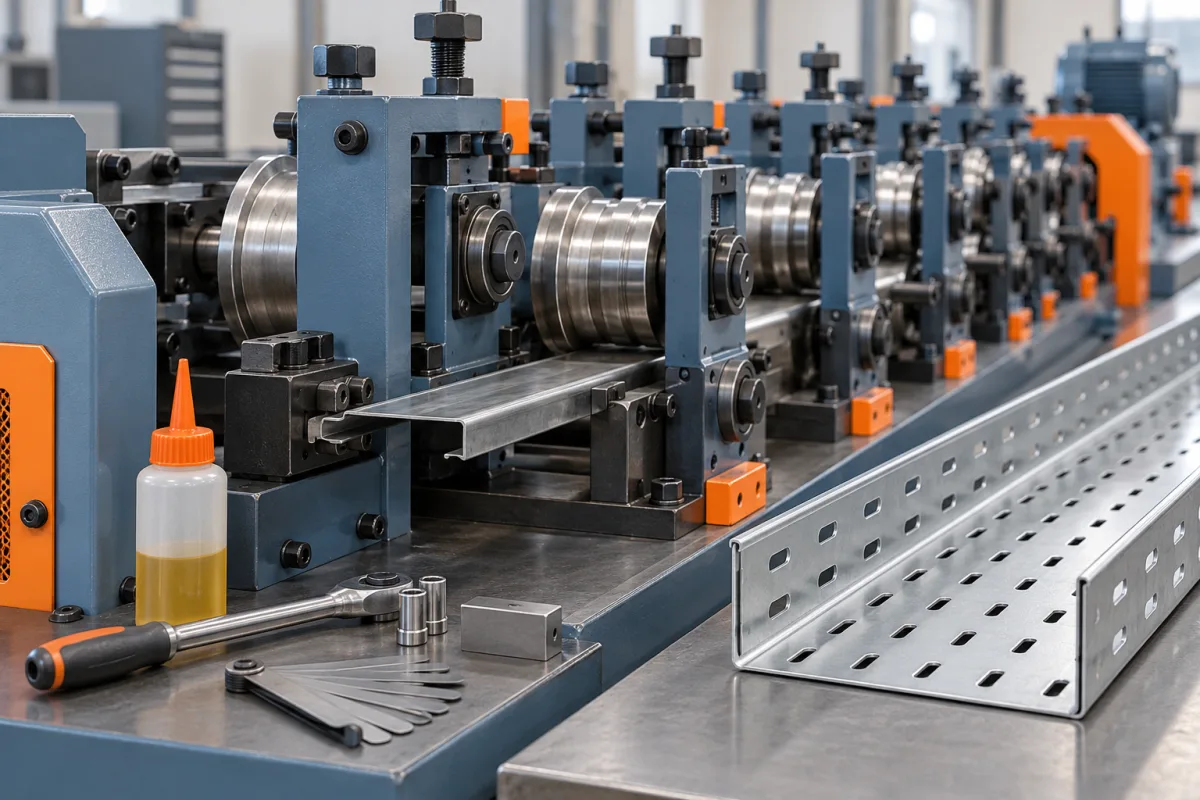
Maintenance for a cable tray roll forming machine is not a single task. It is a set of decisions about what to inspect, when to intervene, and how to prove that the line can still produce accepted tray. The useful question is not simply whether the machine runs, but whether the next coil, the current tooling and the current setup will produce tray that meets the drawing and fits its cover. This checklist is built around that outcome. It assumes the operator has the equipment maker’s manual, a defined product drawing and trained personnel available. It does not replace the manufacturer’s intervals, isolation procedure or lubrication schedule; it helps you organise the work and check the result.
Why maintenance differs on a cable tray line
A cable tray roll forming machine combines several operations that each have their own failure modes. Payoff, leveling, perforation or punching, side forming, cut-off and cover or assembly checks all sit in one sequence. A small change in one station can show up as a burr, a twist or a poor cover fit several metres downstream. Maintenance therefore has to consider the line as a chain of interfaces, not a list of separate machines.
Perforated tray adds a further complication: holes interrupt the material section, so the strip behaves differently as it passes through forming. Punches, dies and scrap paths need attention alongside rollers and guides. Ladder-type systems are a different product family: rung production and assembly may sit outside the rail-forming line, so the maintenance scope is not the same.
Start with the manual, not a generic interval
Every machine has its own lubrication points, filter types, belt tensions and inspection intervals. Those details belong to the equipment maker’s documentation. A generic article cannot safely set them. Use the manual as the baseline and build your own log around it. Record what was inspected, what was replaced, what was adjusted and who did the work. That log becomes your evidence when a defect appears and your basis for improving intervals over time.
Where the manual is silent or ambiguous, treat that as a question for the supplier or a qualified maintenance engineer. Do not guess at torque values, clearances or consumable specifications.
Daily walk-around before production
A short, structured walk-around catches many problems before they become scrap. The aim is to confirm that the line is in a known state, not to hunt for every possible fault.
- Check guards and emergency systems are in place and functional. Never bypass guarding to keep production running.
- Look for loose fasteners, unusual wear marks or fresh metal debris around the line.
- Inspect the strip path for trapped slugs, offcuts or damaged guides.
- Check lubrication levels where the manual defines them, without adjusting settings beyond your training.
- Confirm the cut-off area is clear and the scrap extraction path is not blocked.
- Verify that the last first-piece record and setup sheet match the current job.
If anything is unclear, stop and escalate. A line that starts in an unknown state will produce unknown tray.
Forming rollers, guides and reference points
Forming rollers do the dimensional work. Their condition affects base width, side height and edge return geometry. Trapped slugs or debris between rollers can mark the finished tray, and marked tray may still pass a simple dimensional check while failing appearance or cover fit. Prioritise contact and reference points: the surfaces that locate the strip and set the profile. Clean them, inspect them for wear and confirm they are not damaged.
Strip guides have a similar role. If a guide is worn or mis-set, the strip can wander, and the resulting profile may vary from part to part. The maintenance question is not only whether the guide is present, but whether it still holds the strip consistently through the pass. Check for fretting, scoring or build-up that changes the effective guide surface.
Perforation and punching maintenance
Punch and die condition directly affects hole quality and, in turn, the inspection of perforated parts. Monitor punch burrs, die wear and the scrap path. Keep forming rollers clear of trapped slugs that can mark the finished tray. A slug that escapes the scrap path can travel into the forming section and leave a mark or dent that is difficult to trace later.
Perforation pitch changes and width adjustments are setup tasks that should follow a documented procedure. Clarify in advance how punch pitch changes, how widths are adjusted and whether the cut-off supports all sizes you intend to run. If a maintenance task involves changing punch tooling, treat the first production after that change as a verification event, not routine output.
Cut-off, end quality and secondary operations
The cut-off station determines end squareness and burr condition. Confirm that the profile-supported cut-off is suitable for the current profile, that cut lengths are consistent with the drawing, and that any secondary operations are understood. After maintenance on the cut-off, check the first parts for end quality, including burrs and deformation at the cut line.
Because the cut-off sits at the end of the line, its condition can also reveal upstream problems. If cut lengths drift or ends distort, the cause may be in forming or strip tracking rather than the cut-off itself. Diagnose by evidence: compare the first-piece record, the current setup sheet and the observed defect.
First-piece verification after maintenance
Every maintenance intervention that could affect product dimensions should end with a first-piece verification. Check base width, side height, burr condition and cover engagement. Perforated parts need inspection around holes after forming. Record the results and compare them with the accepted standard for that profile.
This is not a formality. It is the point at which you confirm that the line has returned to a known, capable state. If the first piece is out of tolerance, do not continue to normal production. Investigate the cause, correct it and repeat the verification.
Condition-based versus interval-based maintenance
Two broad approaches are common. Interval-based maintenance follows the manual’s schedule, regardless of observed condition. It is predictable and easy to plan, but it can replace healthy parts or miss a developing fault between intervals. Condition-based maintenance uses observations, measurements and operating evidence to decide when to intervene. It can reduce unnecessary work, but it requires disciplined recording and a clear idea of what normal looks like.
Most cable tray lines benefit from a hybrid. Safety-critical items and consumables follow defined intervals. Forming and cut-off condition is monitored, with intervention triggered by evidence such as recurring burrs, dimensional drift or unusual marks. The trade-off is between planning certainty and responsiveness. Choose based on your product mix, shift pattern and the cost of scrap versus the cost of downtime.
Diagnosing symptoms without hazardous intervention
When a defect appears, gather evidence before changing anything. A maintenance log, a first-piece record and a sample of the defective part are more useful than guesswork. Symptoms to record include where the defect appears along the length, whether it is periodic or continuous, and whether it correlates with a recent setup change.
Do not adjust moving machinery while it is running. Isolate the line using the documented procedure and involve trained personnel for any intervention. For symptoms such as burrs, marks or cover-fit problems, the evidence may point to punch wear, trapped debris, guide condition or a setup change. Diagnose on evidence, not on assumption.
Practical checklist
- Use the original equipment manuals for intervals and consumables.
- Record inspection, replacement and setup changes in a log.
- Check guards and emergency systems before production.
- Inspect the strip path for trapped slugs and debris.
- Check forming rollers and strip guides for wear and build-up.
- Monitor punch burrs and the scrap path.
- Verify cut-off condition and end quality after any intervention.
- Perform first-piece verification and record the results.
- Verify safe restart before normal production.
- Document changes that could affect product dimensions.
FAQ
How often should I lubricate the forming rollers?
Follow the equipment maker’s manual. Lubrication points, methods and intervals depend on the machine design and the environment. If the manual does not cover a specific point, ask the supplier or a qualified engineer rather than guessing.
What is the best way to check for trapped slugs?
Isolate the line using the documented procedure, then inspect the strip path, guides and forming area for debris. Record where debris was found, as repeated locations can indicate a scrap-path problem. Do not reach into or clear a running line.
Can I change perforation pitch without a full setup change?
Perforation pitch changes are a setup task with product-drawing implications. Clarify the procedure in advance, including whether the cut-off supports the new pitch and whether the first production needs verification. Treat any pitch change as a change that requires first-piece approval.
How do I know if cover engagement is still correct?
Check it on a first piece after any maintenance or setup change that could affect base width or side height. Compare the result with the accepted standard for that profile. If engagement is poor, investigate dimensions and edge return geometry before running normal production.
What should I do if burrs keep appearing after punch maintenance?
Record whether the burr is periodic or continuous, and where it appears on the part. Check punch and die condition against the manual’s inspection criteria, and review the scrap path. If the cause is not obvious from evidence, involve trained personnel rather than adjusting on the run.
Is condition-based maintenance always better than interval-based?
Not necessarily. Interval-based maintenance is predictable and easy to plan; condition-based maintenance can reduce unnecessary work but requires good records and a clear baseline. Many lines use a hybrid, with defined intervals for safety-critical items and condition monitoring for forming and cut-off.
Continue your research
- Cable Tray Roll Forming Machines
- Cable Tray Roll Forming Machine
- Cable Ladder Roll Forming Machine
- Solid Bottom Cable Tray Roll Forming Machine
- U Channel Cable Tray Roll Forming Machine
- Cable Support Channel Roll Forming Machine
- How Cable tray roll forming machine Works
- How To Choose a Cable tray roll forming machine
- Cable tray roll forming machine Price: What Affects the Cost?