
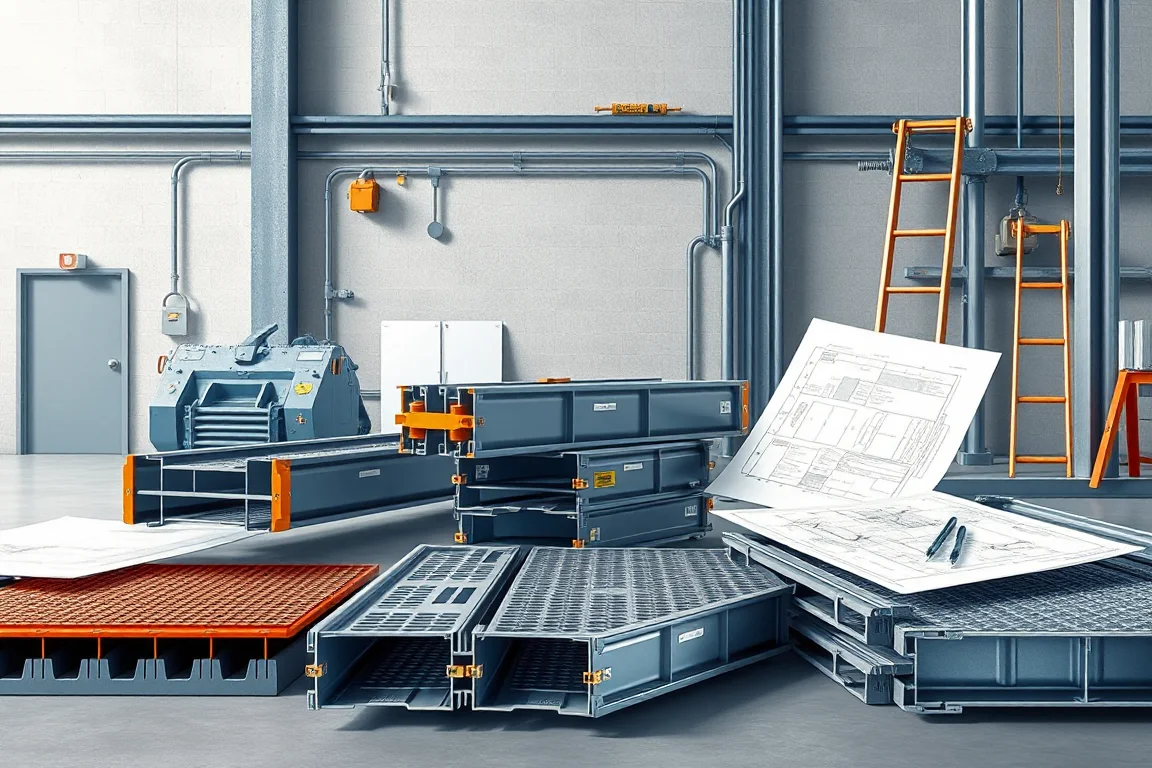
When you request a cable tray roll forming machine price, the figure you receive reflects a scope of supply, not simply a machine. Two quotes for what appear to be equivalent lines can differ substantially because one includes setup, tooling, commissioning and training while the other does not. This guide explains the main cost drivers so you can compare offers on a like-for-like basis and understand where money is actually being spent. It does not provide a price range, because real costs depend on your specific tray types, production volume and site conditions.
What a Cable Tray Machine Quote Actually Includes
A typical quotation for a cable tray roll forming line may cover the uncoiler, feed and leveling section, servo feed, punching press or pre-punch unit, roll forming stands, cutoff press, run-out table, electrical control panel, PLC and HMI, hydraulic power unit, and basic documentation. Some quotes add installation supervision, commissioning, operator training, spare parts, and extended warranty. Others list only the mechanical equipment and leave electrical integration, foundations, and lifting to the buyer.
Before comparing numbers, list every item you expect the supplier to deliver. If a scope item is missing from one quote, the price gap may simply reflect that omission. Ask for a line-item breakdown that separates mechanical equipment, electrical and control, tooling, documentation, and services.
Perforation Pattern and Punching Tooling Cost
Cable tray side rails and bases often need perforations for coupling, ventilation or cable retention. The pattern geometry, hole size, pitch and number of perforated rows determine how many punches and dies are required. A simple line of round holes uses fewer tools than a pattern with slots, elongated holes or multiple rows. More tools mean more cost in the punching station, longer setup, and potentially slower cycle time.
Punching can be done in a separate press before roll forming, or by an integrated stationary/intermittent or flying arrangement, according to the feed and feature sequence. Integrated punching usually adds cost but can reduce handling and improve line speed consistency. Hard tooling for a fixed pattern is generally less expensive than adjustable or quick-change tooling, but the latter can reduce changeover time when you produce several tray designs.
Width and Depth Families and Changeover Cost
Cable tray comes in many widths and side-rail heights. A machine designed for one width and one depth can simplify the scope, but its quoted cost must be compared with equivalent tooling, output and handling rather than assumed to be the lowest. If you need several widths, you can choose removable spacers, cassette-type roll stands, or a line with adjustable roll positions. Each option affects price and changeover time.
When evaluating width flexibility, consider how often you will change and how much production time you lose. Manual spacer changes may take longer than swapping a complete roll cassette, but cassettes cost more upfront. Depth changes often require different forming passes or additional stands. If your order mix includes many shallow trays and a few deep ones, a dedicated line for the dominant size plus a separate setup for the rest may be more economical than a fully flexible line.
Material and Finish Implications
The strip material, thickness and coating influence machine cost. Thinner gauge material requires less forming force, so rolls, shafts and the drive may be lighter and less expensive. Thicker or high-strength steel demands larger motors, stronger shafts and more robust stands, which increases price. Stainless steel and aluminum can behave differently in forming and may need different roll finishes or lubrication.
Pre-coated or galvanized strip can be damaged by rough handling, so you may need protective rolls, gentle feed systems, and careful guidance. If your trays will be painted or powder-coated after forming, the machine still must produce consistent geometry, but you may avoid some surface-critical features. Distinguish trays fabricated and then hot-dip galvanized from trays formed from pre-galvanized coil. Specify the chosen route and its forming, joining, surface and handling requirements.
Cutoff, Covers and Downstream Work
The cutoff press cuts the formed tray to length. A simple mechanical stop and shear is cheaper than a servo-controlled flying cutoff that cuts on the fly. Flying cutoffs allow continuous production and are often paired with a run-out table and stacking system. If you produce long lengths or high volumes, the extra cost can be justified by the measured effect on complete-cycle output while meeting the same length and end-quality requirements.
Covers are separate roll-formed profiles that require their own tooling and possibly a separate line or a quick-change cassette on the same machine. A cover line adds cost but can be a profit center if your customers buy tray and cover together. Some manufacturers run covers on a dedicated small line because the profile is simpler and volumes may differ from tray production.
Automation and Your Actual Order Mix
Automation raises the initial price but can lower unit cost. A PLC with recipe management reduces setup errors when you switch between tray sizes. Automatic width adjustment, servo feed and integrated punching increase throughput and consistency. However, automation value depends on the particular work it changes, including setup frequency, quality losses, staffing and utilization; assess those factors for the actual order mix.
Consider the real mix of tray widths, depths, materials and perforation patterns you expect to run each month. A highly flexible line that sits idle most of the time may cost more per accepted tray than a simpler line that runs one or two sizes efficiently. Conversely, a low-cost single-size line that requires frequent manual changeover may become a bottleneck if your orders vary.
Installed Costs and Support Responsibilities
The ex-works machine price is only part of the total. Freight, insurance, import duties, foundation work, crane rental, electrical supply, compressed air, and commissioning labor add to the installed cost. Clarify who is responsible for unloading, positioning, leveling, wiring, and safety guarding. Some suppliers include installation supervision and training; others charge for travel and accommodation.
Also consider ongoing costs: spare rolls, punches, dies, hydraulic oil, filters, and operator time for maintenance and changeover. A machine with common, locally available components may have lower long-term support costs than one with proprietary parts. Ask for a recommended spare parts list and estimate annual consumption based on your expected running hours.
Hypothetical Cost per Accepted Tray or Metre
The following is a purely hypothetical arithmetic example to show how to think about unit cost. It uses invented numbers and does not represent any real machine or market price. Suppose a line costs 100,000 units of currency, installed and commissioned. You expect to produce 500,000 gross processed metres over an explicitly assumed planning period. Ignoring financing, labor, material and energy, the capital allocation per gross processed metre is 100,000 divided by 500,000, which equals 0.20 currency units per metre. If the line produces 5 percent unrecovered rejection, the accepted output is 500,000 times 0.95, or 475,000 metres. The capital cost per accepted metre becomes 100,000 divided by 475,000, or approximately 0.21 currency units per metre. This simple example shows that yield loss directly increases unit cost. Add material, labor, energy and maintenance to get a full cost per metre.
Normalizing Two Quote Scopes Without Brand Claims
To compare two quotes fairly, create a common scope table. List every element: uncoiler, feed, leveler, punching, roll stands, cutoff, run-out, controls, hydraulics, tooling, documentation, installation, training, warranty and spare parts. Mark each quote as included, excluded or optional. Then adjust the quoted prices by adding the cost of missing items from your own estimates or from the other quote. This reveals the true comparable price.
Also normalize technical assumptions: material thickness range, maximum coil weight, line speed, changeover time, and perforation pattern. If one quote assumes thinner material or fewer tools, its lower price may not be equivalent. Ask each supplier to state the basis of their offer in writing. This is not about favoring one supplier; it is about comparing scopes, not just totals.
Cost Checklist
- Scope of supply: mechanical, electrical, hydraulic, tooling, documentation.
- Material thickness and grade range assumed in the quote.
- Number of widths and depths supported, and changeover method.
- Perforation patterns and number of punch/die sets.
- Cutoff motion and control: stationary or flying arrangement, with the specified feed/control method.
- Cover production: separate line or integrated cassette.
- Automation level: PLC, recipe management, automatic adjustment.
- Installation, commissioning, training and warranty terms.
- Spare parts list and recommended consumables.
- Utilities: power, compressed air, foundation requirements.
Frequently Asked Questions
Why do two cable tray roll forming machine quotes differ so much?
Quotes differ because they cover different scopes. One may include punching tools, installation and training, while another lists only the basic machine. Technical assumptions such as material thickness, number of widths and automation level also change the price. Normalize the scope before comparing totals.
How does the perforation pattern affect the price?
More complex patterns need more punches and dies, which increases tooling cost and setup time. Compare integrated and separate punching with the actual tooling, motion, output and handling scope; pre-punching describes operation order, not necessarily a separate or cheaper machine. If you can standardize on fewer patterns, you reduce both initial and changeover costs.
Is it cheaper to buy a single-width machine and change rolls manually?
A simpler single-width arrangement may have a lower quoted price, but compare equivalent supplied scope rather than assuming that outcome. However, if you frequently switch widths, the labor and downtime can raise your cost per accepted tray. The right choice depends on your order mix and how often you change over.
What ongoing costs should I budget for?
Budget for spare punches and dies, hydraulic oil, filters, roll maintenance, and operator time for changeovers. Also consider energy, compressed air, and any replacement parts. A recommended spare parts list from the supplier helps you estimate annual consumption based on running hours.
How can I compare quotes from different suppliers fairly?
Create a line-by-line scope table and mark each item as included, excluded or optional. Adjust prices by adding the cost of missing items. Also compare technical assumptions such as thickness range, speed and changeover time. This lets you compare equivalent scopes, not just headline numbers.
Continue your research
- Cable Tray Roll Forming Machines
- Cable Tray Roll Forming Machine
- Cable Ladder Roll Forming Machine
- Solid Bottom Cable Tray Roll Forming Machine
- U Channel Cable Tray Roll Forming Machine
- Cable Support Channel Roll Forming Machine
- How Cable tray roll forming machine Works
- How To Choose a Cable tray roll forming machine
- Materials and Thickness for Cable tray roll forming machine